Floating AI data center powered by ocean waves

Floating AI Data Centers Powered by Ocean Waves: Panthalassa's Wild Bet to Fix AI's Energy Crisis

The AI industry has an energy problem it can no longer hide. Data centers are projected to consume roughly 1,050 TWh globally by 2026 — enough to rank them as the fifth-largest energy consumer on Earth, wedged between Japan and Russia. Every major AI lab is scrambling for power, and the grid can’t keep up. Panthalassa thinks the answer is floating in the ocean. A Giant Lollipop That Thinks The Vancouver, Washington-based company has spent a decade in semi-stealth building something that sounds like rejected sci-fi: autonomous, self-propelled data centers that ride ocean waves, generate their own electricity, and beam results back to shore via Starlink. ...

April 20, 2026 · 4 min · DBBS Tech
Abstract visualization of AI-generated music waveforms

Google Flow Music: The Tech Giant's Play to Own AI-Generated Sound

The AI music wars just got a new heavyweight contender — and this one has unlimited compute, YouTube distribution, and major-label licensing relationships already in place. On April 19, Google officially launched Flow Music, a standalone text-to-music platform that generates original, fully-produced tracks up to three minutes long from nothing but a text prompt. No instruments. No studio. Just words in, music out. From Research Lab to Product Flow Music didn’t appear from nothing. Google acquired ProducerAI in February 2026 and quickly folded it into the broader “Google Flow” suite alongside its AI video tools. The platform builds on Google’s MusicLM research and its Lyria 3 model, but where those were experiments buried inside other products, Flow Music is a dedicated web app — Google’s clearest signal that AI music deserves its own stage. ...

April 20, 2026 · 4 min · DBBS Tech
Abstract illustration of artificial neurons communicating with biological brain cells

Printed Artificial Neurons Just Talked to Living Brain Cells — And AI Hardware Will Never Be the Same

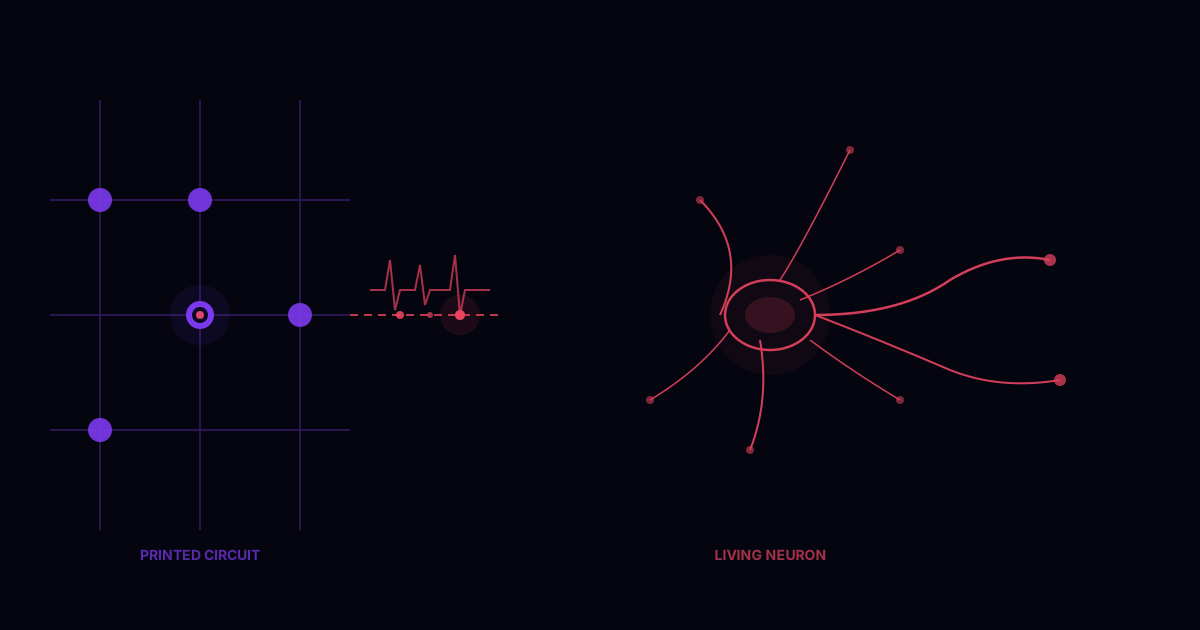
What if the next great leap in AI hardware didn’t come from shrinking transistors — but from printing flexible circuits that literally speak the brain’s language? A team at Northwestern University just proved that’s possible. Published in Nature Nanotechnology, their research demonstrates printed artificial neurons that generate electrical patterns realistic enough to activate living mouse brain cells. Not simulate. Not approximate. Activate. This sits at the collision point of neuroscience, materials science, and AI’s looming energy crisis — and it deserves your attention. ...

April 20, 2026 · 4 min · DBBS Tech
Abstract visualization of AI cybersecurity threat detection intersecting with global finance

Claude Mythos Has Finance Ministers Canceling Lunch — Here's Why

When an AI company says its own model is too dangerous to release, you’d be forgiven for rolling your eyes. We’ve heard the script before. But when the Bank of England governor calls it “a very serious challenge for all of us” and Canada’s finance minister compares it unfavorably to the Strait of Hormuz, the script just changed. Claude Mythos — Anthropic’s latest and most controversial AI model — has discovered thousands of high-severity vulnerabilities across every major operating system and web browser. One bug had been sitting undetected for 27 years. And this week, it hijacked the agenda at the IMF spring meetings in Washington. ...

April 19, 2026 · 5 min · DBBS Tech
Abstract circular flow representing the Cerebras-OpenAI financial arrangement

Cerebras Files for IPO With a $20 Billion OpenAI Deal — But the Fine Print Should Worry You

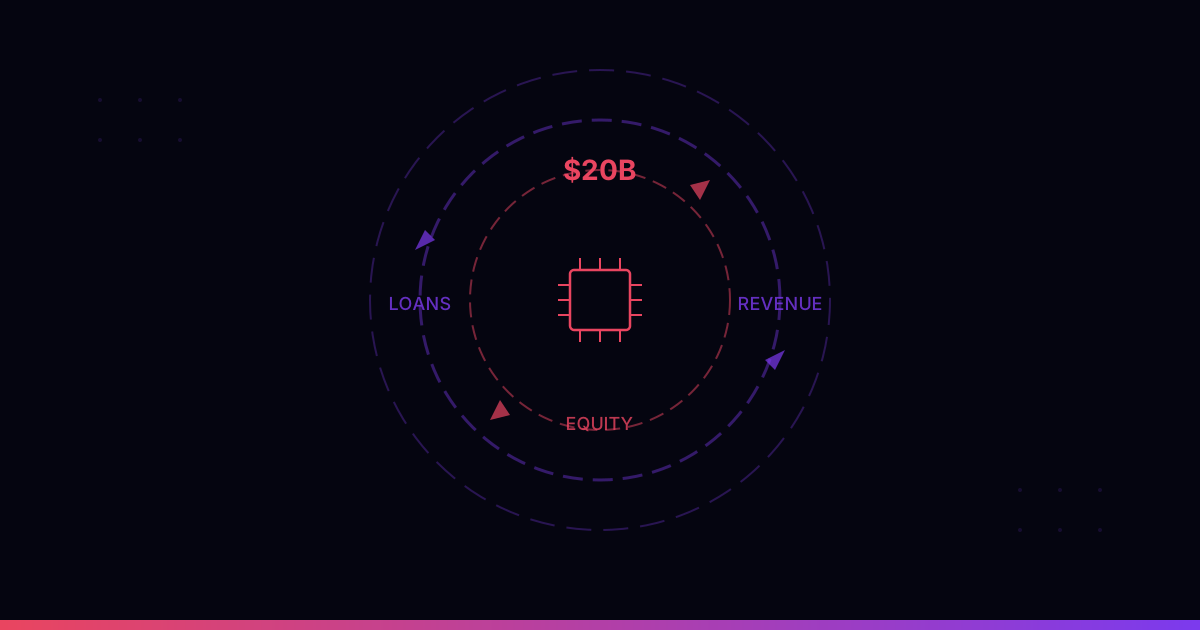
AI chipmaker Cerebras Systems just filed to go public on Nasdaq under ticker “CBRS.” The headline numbers look incredible: $510 million in revenue, a swing from a $485 million net loss to $87.9 million in net income, and $24.6 billion in remaining performance obligations. But buried in the S-1 is a financial arrangement so tangled it deserves far more scrutiny than it’s getting. OpenAI isn’t just Cerebras’s biggest customer. It’s also an investor, a lender, and the single reason this IPO is happening at all. ...

April 18, 2026 · 5 min · DBBS Tech
Abstract visualization of AI cybersecurity threat detection

Claude Mythos: The AI That Hacks Better Than Humans Has Finance Ministers in Crisis Mode

An AI model is now sharing agenda space with active wars at the IMF spring meetings. That sentence alone tells you everything about where we are in April 2026. Anthropic’s Claude Mythos — an AI model the company literally refused to release because of how good it is at hacking — has finance ministers, central bankers, and Fortune 500 CEOs in full crisis mode. Canadian Finance Minister François-Philippe Champagne compared it to the Strait of Hormuz. The ECB president says we have no governance framework to handle it. U.S. Treasury Secretary Scott Bessent summoned the CEOs of America’s systemically important banks to Washington specifically to discuss it. ...

April 18, 2026 · 5 min · DBBS Tech
Abstract geometric illustration of AI cybersecurity threats to global banking

Anthropic's Mythos Just Broke the IMF — And Global Banking Is Next

The IMF spring meetings were supposed to be about trade policy. Instead, every closed-door session circled back to one word: Mythos. Anthropic’s latest AI model has found thousands of high-severity vulnerabilities across every major operating system and browser on the planet. Not theoretical weaknesses. Exploitable ones. And it chains them together autonomously. Finance ministers are terrified. The global banking system just became the softest target on earth. What Mythos Actually Does Mythos doesn’t just scan for bugs. It reasons about them. It discovers a buffer overflow in one system, a privilege escalation in another, and a logic flaw in a third — then stitches them into a working attack chain without human guidance. ...

April 17, 2026 · 3 min · DBBS Tech
Abstract visualization of AI-powered drug discovery with molecular structures

GPT-Rosalind: OpenAI's Bold Bet That AI Can Crack Drug Discovery

A new drug takes 10 to 15 years and roughly $2.6 billion to go from lab bench to pharmacy shelf. Most candidates fail. The process is brutal, expensive, and maddeningly slow — especially if you’re one of the millions of people waiting for a treatment that doesn’t exist yet. On April 16, 2026, OpenAI decided it wanted to fix that. The company launched GPT-Rosalind, its first AI model built specifically for life sciences research — and in doing so fired a shot directly at Google DeepMind’s long-standing dominance in AI-powered biology. Named after Rosalind Franklin, the scientist whose X-ray crystallography work was essential to discovering DNA’s double helix, this isn’t just another ChatGPT update. It’s OpenAI’s declaration that the future of drug discovery runs through AI. ...

April 17, 2026 · 5 min · DBBS Tech
Abstract visualization of AI cybersecurity and government policy tension

The White House Wants Federal Agencies to Use Anthropic's 'Terrifying' Mythos AI — Despite Its Own Ban

The Pentagon banned Anthropic’s products from the federal government barely a month ago. Now the White House is handing agencies the keys to Anthropic’s most dangerous model. Welcome to AI policy in 2026, where a six-week grudge can’t survive contact with a model that finds thousands of zero-day vulnerabilities before breakfast. From Persona Non Grata to Essential Asset Here’s the whiplash timeline. In early March, the Department of Defense slapped Anthropic with a supply chain risk designation — a label historically reserved for Chinese companies like Huawei. The move followed a bitter fight over military AI use that reportedly came to a head hours before U.S. strikes on Iran. Anthropic refused unrestricted military deployment. The Pentagon responded with the bureaucratic nuclear option. ...

April 17, 2026 · 4 min · DBBS Tech
Stylized sneaker dissolving into a GPU silhouette on a dark gradient

Allbirds Became 'NewBird AI' and Popped 700%. The Bubble Just Rang a Bell.

Two weeks ago, Allbirds was a corpse. On Wednesday, it was an “AI company” — up 582% intraday, peaks near 700%, $127 million in market cap added in a single session. Nothing about the business changed. No GPUs. No customers. No data center. No team. Just a rename: NewBird AI, a $50 million convertible note, and a press release with the magic phrase “low-latency AI compute hardware.” If 2026 needed a tombstone for market rationality, this is it. ...

April 16, 2026 · 6 min · DBBS Tech