AI chipmaker Cerebras Systems just filed to go public on Nasdaq under ticker “CBRS.” The headline numbers look incredible: $510 million in revenue, a swing from a $485 million net loss to $87.9 million in net income, and $24.6 billion in remaining performance obligations.
But buried in the S-1 is a financial arrangement so tangled it deserves far more scrutiny than it’s getting.
OpenAI isn’t just Cerebras’s biggest customer. It’s also an investor, a lender, and the single reason this IPO is happening at all.
The $20 Billion Handshake
In January, Cerebras announced a deal to provide OpenAI with up to 750 megawatts of computing power through 2028 — valued at over $10 billion. Friday’s filing revealed the real number: more than $20 billion over three years, with an option to extend to $30 billion through 2030 by purchasing an additional 1.25 gigawatts of capacity.
For context, Cerebras did $510 million in revenue for all of 2025. They just locked in a single-customer commitment worth roughly 40 times their annual revenue.
That alone would be noteworthy. But the financial plumbing underneath is where it gets genuinely unusual.
When the Revenue Is Circular, the Valuation Is Circular
Here’s the sequence:
- December 2025: Cerebras issues OpenAI warrants to purchase up to 33.4 million shares of non-voting Class N stock
- January 2026: OpenAI gives Cerebras a $1 billion loan at 6% interest — repayable through product delivery, not necessarily cash
- January 2026: OpenAI commits to buying $20 billion in Cerebras products and services
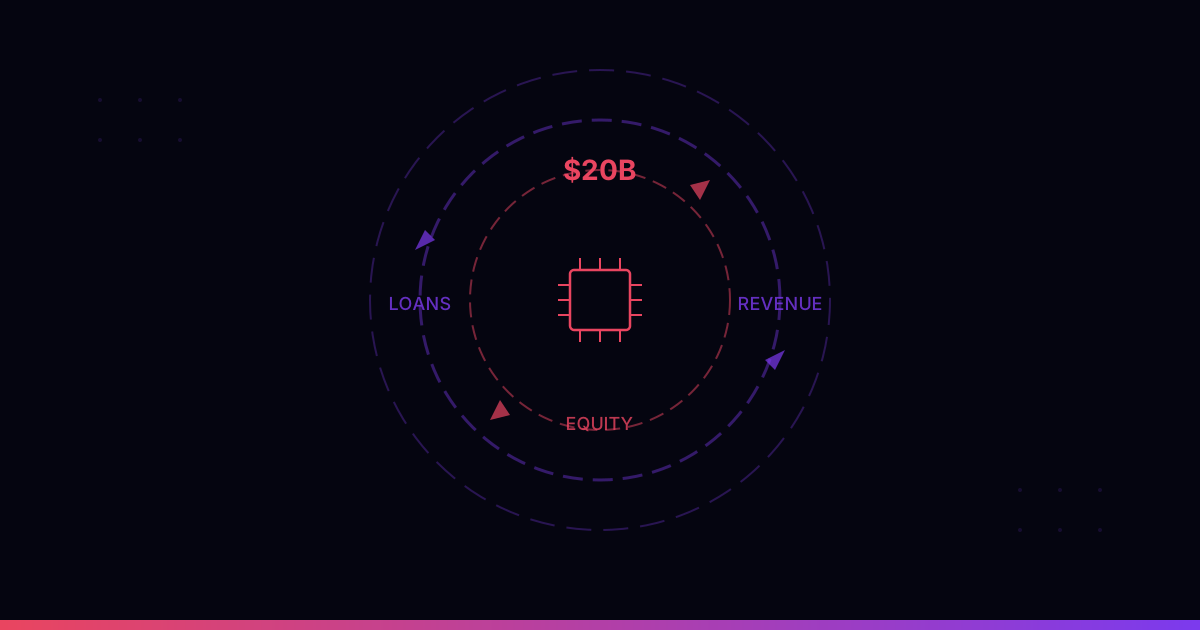
So OpenAI lends Cerebras $1 billion to build infrastructure. Cerebras builds it. OpenAI pays Cerebras to run workloads on that infrastructure. The revenue boosts Cerebras’s financials. Cerebras goes public on those financials. And OpenAI’s equity warrants — which vest fully if OpenAI hits 2 gigawatts of total purchases — appreciate in value because of the revenue OpenAI itself is providing.
If OpenAI’s spending reaches $30 billion within three years, it could acquire roughly 10% of Cerebras. The company’s largest customer would also be a significant shareholder — with a financial incentive to keep spending, because that spending increases the value of its own equity position.
The Technology Is Real
Before the cynicism overwhelms everything: Cerebras makes legitimately differentiated hardware. Their approach is radical — instead of cutting a silicon wafer into hundreds of individual chips, they keep the entire 12-inch wafer intact to produce a single massive processor.
The WSE-3 (Wafer Scale Engine 3) is a chip the size of a dinner plate: 46,225 square millimeters of silicon, 4 trillion transistors (50x more than Nvidia’s H100), and 900,000 AI-optimized cores. By integrating processor and memory on the same wafer, Cerebras eliminates the data transfer bottleneck that plagues GPU clusters.
For AI inference — generating responses from trained models — this architecture offers genuinely compelling advantages. Tasks requiring hundreds of interconnected GPUs can run on a few WSE-3 chips with lower latency and, Cerebras claims, lower cost.
The technology is real. The question is whether the business model around it is sustainable without one customer providing most of the revenue while simultaneously owning a piece of the company.
Same Problem, Different Customer
Cerebras has a customer concentration issue that hasn’t gotten better — it’s just changed shape.
When the company first tried to IPO in 2024, 87% of first-half revenue came from G42, a Microsoft-backed UAE entity. That filing was withdrawn amid CFIUS national security concerns.
In 2025, G42 dropped to 24% — but another UAE entity (Mohamed bin Zayed University of AI) contributed 62% of revenue. And now OpenAI represents “a substantial portion of projected revenues over the next several years.”
They’ve traded one concentration problem for another. If your biggest customer walks, your business implodes. And OpenAI’s contract explicitly gives it the right to terminate if Cerebras fails to deliver on time or falls below performance thresholds.
AI’s Circular Economy
This isn’t an isolated arrangement. It’s part of a pattern that has become the defining financial architecture of the AI boom:
- Nvidia invested in CoreWeave. CoreWeave built data centers full of Nvidia chips. CoreWeave went public on the revenue.
- Microsoft invested in OpenAI. OpenAI spent billions on Azure. Microsoft counted it as cloud revenue growth.
- Amazon signed a deal to buy $270 million in Cerebras stock while also deploying Cerebras chips in AWS.
- OpenAI is now investing in Cerebras while being Cerebras’s primary revenue source.
Each arrangement is technically legal. Real products get built, real services get delivered. But when the money keeps circulating between the same handful of companies — and each circuit gets counted as new revenue justifying higher valuations — it looks less like organic growth and more like a leveraged bet with extra steps.
What’s It Actually Worth?
Cerebras is reportedly targeting a $35 billion valuation — up from $23.1 billion just months ago. The $12 billion markup is almost entirely attributable to the expanded OpenAI deal. That’s a 68x revenue multiple.
For comparison:
- Nvidia trades at roughly 25x trailing revenue with thousands of customers across every industry
- AMD trades at about 10x
- CoreWeave came to market at a lower revenue multiple despite its own controversial IPO
The bull case is simple: inference demand is exploding, wafer-scale chips are genuinely better for certain workloads, and OpenAI’s deal validates the technology at massive scale.
The bear case is equally straightforward: you’re buying a company whose revenue, valuation, and IPO viability all depend on a single customer that negotiated equity ownership as part of the deal.
The Uncomfortable Question
Sam Altman has said the partnership is about “reducing dependence on Nvidia.” That’s a reasonable strategic goal — Nvidia’s dominance gives it enormous pricing power.
But acquiring an ownership stake in your alternative supplier so large that the supplier’s existence as a public company depends on your continued purchase orders isn’t diversification. It’s vertical integration dressed up as a market transaction.
Cerebras makes great chips. The demand for AI inference computing is real. But before you buy at $35 billion, ask the uncomfortable question: if OpenAI stopped buying tomorrow, what would be left?
The answer to that question is the actual value of Cerebras. Everything above it is a bet on a relationship, not a company.