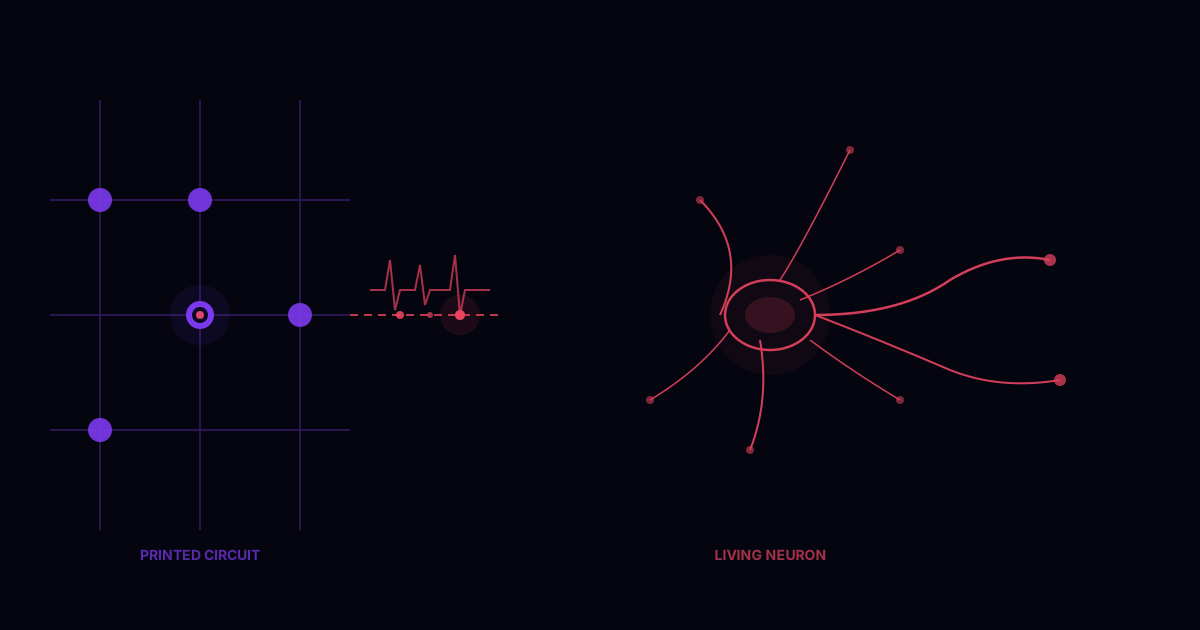
What if the next great leap in AI hardware didn’t come from shrinking transistors — but from printing flexible circuits that literally speak the brain’s language?
A team at Northwestern University just proved that’s possible. Published in Nature Nanotechnology, their research demonstrates printed artificial neurons that generate electrical patterns realistic enough to activate living mouse brain cells. Not simulate. Not approximate. Activate.
This sits at the collision point of neuroscience, materials science, and AI’s looming energy crisis — and it deserves your attention.
AI’s Power Problem Is Getting Worse
Modern AI is absurdly energy-hungry. Training a large language model can consume the equivalent of hundreds of homes running for a year. Inference at scale isn’t much better. As models balloon and data volumes compound, the math gets ugly fast.
The human brain? Twenty watts. A dim light bulb. Five orders of magnitude more efficient than digital computers while handling pattern recognition, reasoning, and sensory processing that still embarrasses our best silicon.
“The way you make AI smarter is by training it on more and more data,” said Mark C. Hersam, the study’s lead researcher. “This data-intensive training leads to a massive power-consumption problem. We have to come up with more efficient hardware.”
The logical move: stop trying to out-engineer physics. Copy the brain.
What They Built
The team created artificial neurons from electronic inks — nanoscale flakes of molybdenum disulfide (MoS2) as semiconductor and graphene as conductor — sprayed onto flexible polymer substrates via aerosol jet printing.
The clever bit: previous researchers treated the stabilizing polymer in these inks as a defect and burned it away. Hersam’s team did the opposite. They partially decomposed it on purpose, then drove further decomposition with current. The result is a conductive filament — all current squeezed through a narrow channel — that produces sudden, neuron-like voltage spikes.
Not simple on-off pulses. Rich, complex spiking patterns: single spikes, continuous firing, and bursting. The full vocabulary of neural communication.
Then They Talked to Real Neurons
Working with neuroscientist Indira M. Raman, the team applied their artificial signals to slices of mouse cerebellum.
The living Purkinje neurons fired back. They responded as if receiving signals from neighboring biological neurons.
“Other labs have tried to make artificial neurons with organic materials, and they spiked too slowly,” Hersam said. “Or they used metal oxides, which are too fast. We are within a temporal range that was not previously demonstrated.”
Printed circuits. Flexible substrates. Speaking the brain’s native protocol. And the brain listened.
Why Brain-Computer Interfaces Should Pay Attention
Current neural implants — Neuralink and its competitors — rely on rigid silicon electrodes that can irritate or damage tissue over time. Flexible, printed devices that naturally match biological timing could be:
- Less invasive — soft materials conform to neural tissue
- Cheaper — printing is additive and low-waste versus semiconductor fab
- More biocompatible — signals matching biological timing reduce damage risk
- Scalable — aerosol jet printing handles complex 3D arrangements
For neuroprosthetics aimed at restoring hearing, vision, or movement, this is the difference between crude electrical stimulation and native-protocol communication.
The Neuromorphic Computing Play
Beyond medicine, this feeds the neuromorphic computing movement — building AI hardware that mimics brain architecture instead of the von Neumann model we’ve been iterating on for decades.
Traditional chips achieve complexity through billions of identical transistors on flat, rigid wafers. The brain does the opposite: diverse neuron types, specialized roles, 3D arrangement, constant rewiring.
Because each of Hersam’s printed neurons can generate multiple signaling patterns — encoding more information per device — future neuromorphic systems could use far fewer components while achieving greater computational sophistication. Less power. Less material. Faster processing for workloads that benefit from brain-like architectures.
What’s Missing
Let’s stay grounded. This is early-stage. The experiments used brain slices, not living animals. The neurons demonstrated communication but not bidirectional adaptive learning. Scaling from lab demo to functional implant or computing system involves countless engineering gaps.
But the foundation is genuinely novel. Biologically realistic spiking behavior from cheap, printable materials on flexible substrates. Nobody else has demonstrated that combination.
The Bigger Picture
The industry is pouring hundreds of billions into GPU clusters and custom silicon. Meanwhile, the brain keeps quietly demonstrating there’s a radically different — and radically more efficient — way to compute.
Northwestern’s printed neurons won’t replace H100s next year. But they represent something the brute-force scaling crowd doesn’t have: a path to hardware that doesn’t just process information about the brain — it works like one.
The energy math will eventually force the question. When it does, this research will look prescient.