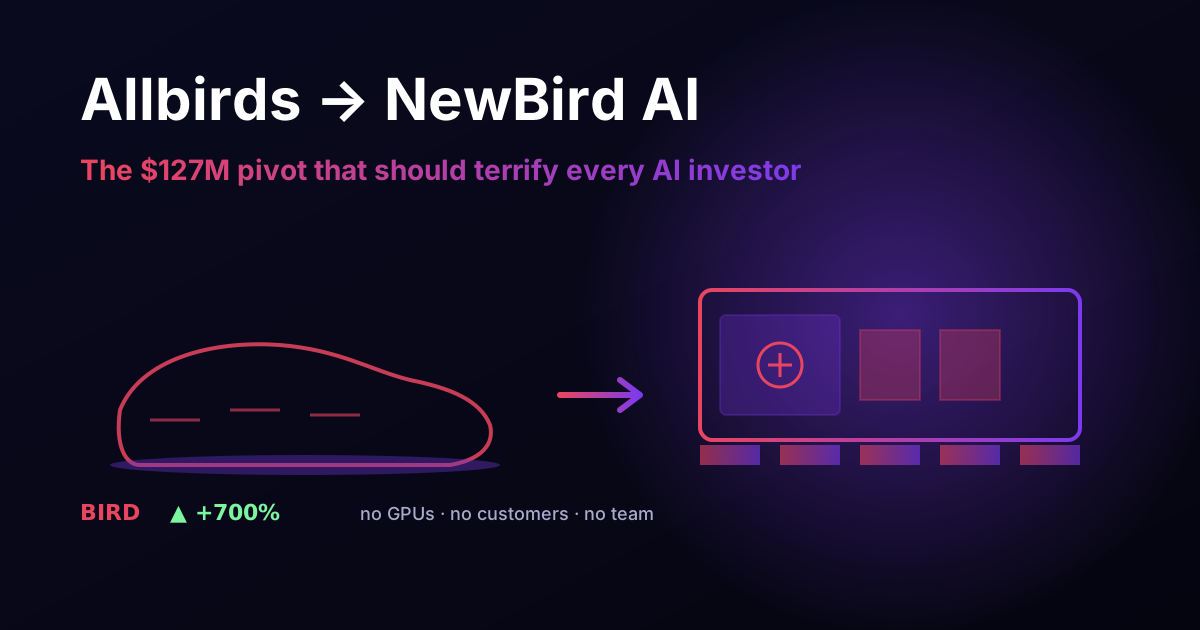
Two weeks ago, Allbirds was a corpse. On Wednesday, it was an “AI company” — up 582% intraday, peaks near 700%, $127 million in market cap added in a single session. Nothing about the business changed. No GPUs. No customers. No data center. No team. Just a rename: NewBird AI, a $50 million convertible note, and a press release with the magic phrase “low-latency AI compute hardware.”
If 2026 needed a tombstone for market rationality, this is it.
From Patagonia-Vest Darling to GPU-Rental Dream
Six years ago, Allbirds was the shoe glued to every VC’s foot. Leonardo DiCaprio invested. Obama endorsed it. It IPO’d in 2021 at a $4 billion valuation as the poster child for sustainable capitalism — merino wool, eucalyptus fiber, carbon labels on the tongue.
Then the brand stopped mattering. Shares dropped 99% from peak. Q3 last quarter: a $20.3 million loss. In January, the last U.S. full-price store shut. On April Fools’ Day — you can’t make this up — the company agreed to sell itself to a brand-licensing shop for $39 million, roughly 1% of its peak.
Eight months ago, cofounder Tim Brown was quoting a Maori proverb to Fortune about “walking backward into the future.” “This is a brand worth fighting for,” he said, “with principles that have never felt more full of potential.”
The principles, it turns out, were negotiable.
The SEC filing makes the pivot official — and quietly euthanizes the company’s origin story. NewBird AI will shed its public benefit corporation status because the new entity “would be less focused on the public benefit of environmental conservation.”
Translation: the sustainability thing was always marketing. Now the marketing is GPUs.
What NewBird AI Actually Is
Strip the press release and here’s the entire thesis, in the company’s own words:
“The Company will initially seek to acquire high-performance, low-latency AI compute hardware and provide access under long-term lease arrangements…”
That’s it. Buy GPUs. Rent them out. The company calls this aspiration GPU-as-a-Service and claims it wants to become a “fully integrated GPUaaS and AI-native cloud solutions provider.”
Here’s what “fully integrated GPUaaS” actually looks like in 2026:
- CoreWeave — ~$30B in committed contracts, owned real estate, signed deals with Anthropic and Meta.
- Nebius, Lambda, Crusoe, Together AI — thousands of H100s and B200s, purpose-built facilities, multi-year head start.
- The hyperscalers — Azure, AWS, GCP, Oracle spending a combined $400+ billion on AI capex this year alone.
NewBird AI has: $50 million in convertibles “expected to close in Q2,” zero announced hardware, zero customers, and a logo that used to sell sneakers. At B200 list prices, $50 million buys maybe 1,200–1,500 GPUs before a dollar goes to power, cooling, colo, networking, or staff. That’s not a hyperscaler gap-filler. That’s a pod in somebody else’s data center.
The Long Island Iced Tea Cover Band
If this feels familiar, you were paying attention in 2017. That year, a small beverage company called Long Island Iced Tea Corp. renamed itself Long Blockchain Corp., promised to “explore opportunities” in distributed ledger tech, and ripped 183% in a day. It was subpoenaed, delisted by Nasdaq, and hit with SEC insider-trading charges. Executives pleaded guilty.
Before and after that, the rhythm repeated — Zoom Technologies (+1,800% because day traders confused it with the video Zoom), Riot Blockchain, Kodak’s pharma pivot. Every bubble gets one.
NewBird AI is a near-perfect 2026 cover of the 2017 Long Blockchain track. Same chord progression: dying company, hot buzzword bolted to the name, one-line business plan, euphoric retail bid.
What is different is the scale of the target. Blockchain pivots in 2017 were chasing a narrative. AI pivots in 2026 are chasing a real $400-billion-a-year capex supercycle. That makes fake-it-till-you-make-it extraordinarily tempting — and it makes the signal-to-noise ratio brutal for anyone trying to invest in the real thing.
Why This Pop Matters More Than It Looks
Individual meme stocks don’t matter. What this one reveals about the tape does.
1. “AI” is now a pure valuation multiplier, disconnected from capability. A company with no engineers, no customers, and no hardware added more market cap in a day than the sneaker business was worth. Capital markets are paying for the word.
2. This is retail. Institutions aren’t touching a $2 sub-scale name. The ~20x volume spike on BIRD is the fingerprint of retail stacking calls on a story. Same pattern as Long Blockchain, ZOOM, AMC. Meaning: a lot of non-professional money is sitting in whatever the next three of these are.
3. Late-cycle behavior. Every real tech boom has a genuine thesis and a dumb-money tail. The real thesis — frontier models, agentic workflows, inference at scale — is backed by the Stanford AI Index’s ~30-point accuracy gains on hard benchmarks in 18 months. The dumb-money tail is companies rebranding into the trend. When the tail gets this fat, the top isn’t always imminent. It’s always closer than it looks.
4. Governance red flag. Scrapping PBC status mid-quarter to chase GPUs is the corporate equivalent of a divorce note written in crayon. Anyone buying NewBird AI is trusting management that abandoned both its product category and its founding charter in the same breath.
The Cynical Part That’s Actually Clever
Here’s the uncomfortable truth: this move is irrational for shareholders and extremely rational for insiders.
The company was about to sell for $39 million. Wednesday’s press release vaulted the equity to roughly ten times that on paper. The $50 million convertible prices into a much higher stock, diluting outsiders far less than a normal raise would. Issue into the frenzy, bank a real war chest, quietly become a mediocre GPU broker — and the pivot has “worked,” in the narrow sense that insiders extracted value from AI mania before the music stopped.
That’s not an accusation. It’s a description. And every struggling small-cap CFO is watching closely right now.
Expect more. A lot more.
How to Spot the Real Ones
Three things separate real AI infrastructure from the NewBird imitators:
- Signed customer contracts with named counterparties. If the release talks about “demand” in the abstract, run.
- Hardware delivery in MW of contracted power, not hypothetical GPU counts.
- Management continuity and technical bench. A CFO, a brand guy, and a press release don’t build neoclouds. A team from AWS, Nvidia, or CoreWeave might.
NewBird AI checks zero of those boxes. Maybe it will. History says it won’t.
The Takeaway
Allbirds didn’t discover AI. It discovered that in 2026, saying the word “AI” is worth more than a decade of brand-building, sustainability marketing, celebrity endorsements, and IPO proceeds combined.
That’s either a searing indictment of market psychology, a rational response to a genuinely enormous capital cycle, or — most likely — both.
The wool sneaker goes to a licensing firm. The ticker goes to a GPU fever dream. And every real AI company now spends the next twelve months convincing investors they’re not the next Long Blockchain.
The question worth arguing: has the AI trade tipped into bubble territory, or is this just froth on a cycle that still has years to run?
Drop your take in the comments. And if you own BIRD — maybe don’t check it after lunch.