You can’t embargo the most valuable commodity on Earth and expect everyone to play nice.
US prosecutors just dropped their biggest AI hardware enforcement action yet — a $2.5 billion smuggling operation that funneled restricted Nvidia servers through Bangkok directly into Chinese hands. The details read like a spy thriller. The implications hit like a freight train.
The Operation
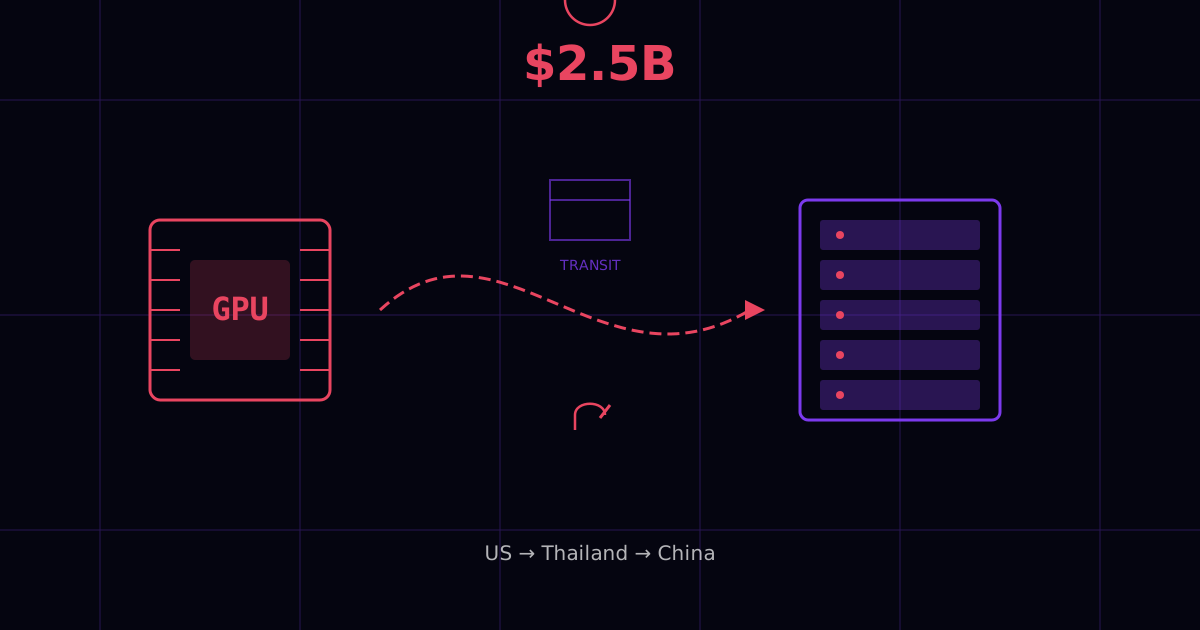
Bangkok-based OBON Corp allegedly purchased massive quantities of Super Micro servers packed with Nvidia’s H200 and B300 chips — the silicon that powers frontier AI training. Instead of deploying them in Thailand’s growing AI ecosystem, the servers were rerouted to China. Alibaba is named as an end customer.
The numbers are absurd. Over $500 million in AI equipment shipped in a two-month window between April and May 2025. The full operation spanning 2024-2025 hit $2.5 billion total.
The logistics? Embarrassingly simple. Servers shipped from the US to Taiwan and Southeast Asia, repackaged into unmarked boxes, smuggled into China. Billions in export control infrastructure defeated by cardboard and shipping labels.
Supermicro’s Reckoning
The March 2026 indictment charged several Supermicro executives — including senior leadership — with facilitating the shipments. The stock cratered immediately. This isn’t some shadowy broker getting caught. This is a major US-listed server manufacturer allegedly helping circumvent national security controls on the decade’s most strategic technology.
Supermicro has survived accounting scandals and governance drama before. Federal charges for aiding chip smuggling to a geopolitical rival? That’s a different weight class entirely.
Alibaba Says Nothing to See Here
Alibaba’s denial was swift and absolute: no relationship with Supermicro, OBON, or any third-party brokers. Never used banned Nvidia chips. Period.
If the DOJ proves otherwise, we’re looking at potential secondary sanctions, entity list additions, and a dramatic escalation in US-China tech hostilities. Even if Alibaba’s clean, the case proves Chinese demand for cutting-edge AI hardware remains insatiable — domestic alternatives from Huawei notwithstanding.
The Black Market Tax
Here’s the perverse economics at play. Strong Chinese demand plus the smuggling crackdown has nearly doubled B300 server prices to roughly $1 million each (7 million yuan). Every enforcement action that shuts down a supply channel doesn’t kill demand — it just makes remaining channels more profitable.
It’s prohibition economics, applied to GPUs. The most expensive black market commodity isn’t drugs or weapons anymore. It’s graphics cards.
Meanwhile, Nvidia’s official China sales have dropped to zero. Jensen Huang confirmed it himself. But the gap between official policy and on-the-ground reality has never been wider.
Why Export Controls Keep Failing
The structural problem is simple: AI chips are small, extraordinarily valuable, and desperately wanted across Asia. Southeast Asian countries are simultaneously legitimate AI hubs and convenient smuggling waypoints. Thailand, Malaysia, and Indonesia are all courting AI investment from US tech giants while serving as potential diversion points.
Since 2022, Washington has progressively tightened chip restrictions — updating controls multiple times, each iteration trying to close loopholes that buyers immediately exploited. The H200 was banned, partially unbanned with a 25% tariff, then restricted again. Policy whiplash that confuses compliance departments as much as smugglers.
Nvidia says it “expects ecosystem partners to adhere to strict compliance.” But once a server leaves the authorized chain, tracking its final destination is nearly impossible.
What Comes Next
More indictments. Prosecutors have identified multiple smuggling networks beyond OBON-Supermicro. This is the tip of the iceberg.
Thailand’s diplomatic headache. OBON’s ties to the Thai government’s AI strategy put Bangkok between Washington’s enforcement demands and its own tech ambitions.
China doubles down on domestic chips. Every bust strengthens Beijing’s argument for self-sufficiency. Huawei’s Ascend chips get more state backing.
Higher stakes. As frontier models demonstrate increasingly powerful capabilities — from cybersecurity to drug discovery — controlling who can train them becomes existential national security policy. The smuggling incentives only grow.
The Bottom Line
This case is the collision between economics and geopolitics, distilled into one indictment. The US wants to maintain AI advantage through hardware control. China wants frontier AI regardless. And wedged between them are companies and countries who see enormous profit in bridging the gap.
Export controls can slow technology transfer. They cannot stop it. The question isn’t whether restricted chips reach China — they clearly already have, in massive quantities. The question is whether enforcement can ever make the cost of smuggling outweigh the rewards.
Based on this case? We’re not even close.