Jensen Huang has a new side hustle. While Nvidia remains the undisputed king of AI chips — the company that turned sand into a $5.2 trillion empire — it’s quietly becoming one of the most aggressive investors in the entire AI ecosystem.
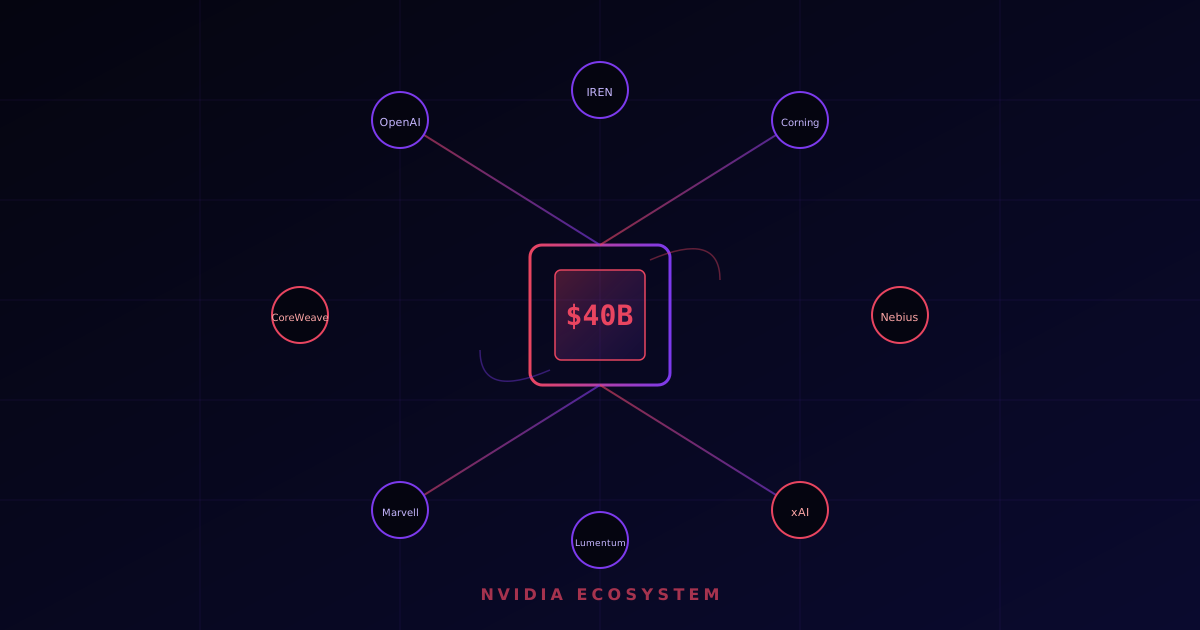
In 2026 alone, Nvidia has committed more than $40 billion in equity investments across the AI stack. The company selling picks and shovels in the gold rush is now bankrolling the miners, the land, and the roads.
The question everyone should be asking: masterstroke or house of cards?
The Deal Machine That Never Stops
The pace is relentless. Just this past week, two massive deals landed:
IREN — a data center operator — secured up to $2.1 billion in Nvidia investment. In return, IREN committed to deploying up to 5 gigawatts of Nvidia’s DSX-branded infrastructure. Five gigawatts. That’s enough to power a small country.
Corning — the 175-year-old glass company — locked in investment rights up to $3.2 billion. Three new U.S. facilities will manufacture optical technologies for Nvidia’s next-gen rack-scale systems, which are ditching copper for fiber-optic interconnects. When the Gorilla Glass company retools factories for your AI networking needs, the game has fundamentally changed.
These follow a cascade of earlier bets: $2 billion each into Marvell, Lumentum, and Coherent (photonics and interconnect tech). $2 billion into CoreWeave and another $2 billion into Nebius (neocloud data centers). And the headliner: $30 billion into OpenAI, the single largest check Nvidia has ever written.
Own the Whole Stack
“We try to invest in all of them,” Huang said during an April podcast. “We don’t pick winners.”
Magnanimous framing. Razor-sharp strategy. Here’s what Nvidia’s portfolio now covers:
- Chips: Its own GPUs (obviously)
- Networking: Corning, Lumentum, Coherent for optical interconnects
- Data centers: IREN, CoreWeave, Nebius for physical infrastructure
- AI models: OpenAI, Anthropic, xAI as direct investments
Every dollar invested has a multiplier effect. The funded company builds infrastructure, buys Nvidia GPUs, demand reinforces itself. It’s not diversification — it’s ecosystem capture.
The Dot-Com Ghost
Here’s where it gets uncomfortable.
Critics see a direct parallel to the vendor financing schemes that inflated the dot-com bubble. In the late ’90s, telecom giants like Lucent and Nortel extended enormous loans to their own customers — effectively funding purchases of their own equipment. When those customers collapsed, everything collapsed with them.
Mizuho analyst Jordan Klein nailed the skepticism: “It smells like you are pre-funding the purchase of your own GPUs.”
Bloomberg recently mapped what it called “circular deals” across AI — tracking how Microsoft, OpenAI, and Nvidia keep paying each other in what looks like a closed loop. Nvidia invests in a company. That company buys Nvidia chips. Nvidia books the revenue. The company’s valuation rises. Nvidia’s investment gains value. Rinse, repeat.
The numbers back the concern. Nvidia’s private company investments ballooned from $3.39 billion to $22.25 billion in a single fiscal year. Reported gains jumped from $1.03 billion to $8.92 billion.
Why This Isn’t 1999 (Probably)
Before panic sets in, some critical differences:
Nvidia is flush with real cash. The company generated $97 billion in free cash flow last year. It’s deploying profits, not extending credit it can’t afford. Lucent was writing IOUs. Nvidia is writing checks it can cover.
AI demand is real and measurable. This isn’t speculative fiber to towns that don’t need it. Every major tech company, every government, and increasingly every enterprise is scrambling for GPU access. The capacity being built will get used.
The deals have strings attached. IREN must deploy DSX infrastructure. Corning builds factories specifically for Nvidia systems. These aren’t blank checks — they’re partnerships with hardware commitments baked in.
Wedbush’s Matthew Bryson acknowledged the “circular investment theme” but argued that execution creates a “competitive moat” — a self-reinforcing ecosystem AMD, Intel, and custom silicon from Google and Amazon will struggle to crack.
AI’s Central Bank
What’s really happening is something unprecedented: Nvidia is evolving from chip company to the central bank of AI infrastructure. Providing liquidity, directing capital flows, setting standards everyone else builds around.
Even Intel at peak dominance never played venture capitalist like this. Apple controls its supply chain but doesn’t take billions in equity stakes. Nvidia does both — sells the product AND funds the buyers AND invests in the supply chain.
The AI industry’s appetite for compute illustrates why this works. Anthropic just signed a $1.8 billion cloud deal with Akamai and separately tapped SpaceX’s computing resources. Companies are cutting deals with CDN providers and rocket companies just to get enough GPU access. Nvidia sees this demand and plants itself at the center of every transaction.
What It Means
For investors: Nvidia’s next earnings (due in ~two weeks) will be the first real look at how these bets are performing. The gains have been enormous. So has the concentration risk.
For the AI industry: Taking Nvidia money means guaranteed hardware supply — invaluable when GPUs remain scarce. But it means deeper lock-in, making alternatives harder to adopt.
For everyone else: This plumbing determines how fast AI advances and how expensive it stays. Every data center, fiber-optic cable, and GPU cluster funded by these deals will eventually run the AI in your phone, your doctor’s office, and your workplace.
The Bottom Line
Nvidia is making a bet that’s either visionary or reckless — and the outcome depends entirely on whether AI demand keeps climbing. If it does, Nvidia will have financed an ecosystem that runs exclusively on its technology, creating the most dominant platform lock-in since Windows. If demand plateaus, it’ll be holding $40 billion+ in companies whose business model is “buy Nvidia chips.”
With $97 billion in free cash flow and 11x stock appreciation in four years, Nvidia has earned benefit of the doubt. But the dot-com parallel isn’t FUD — it’s a legitimate structural question about what happens when a market’s biggest seller becomes its biggest financier.
History doesn’t repeat, but it rhymes. We’ll find out soon enough which verse this is.