The headlines are terrifying. AI was the number one reason companies cited for job cuts in both March and April 2026. Nearly 50,000 layoffs this year have been explicitly blamed on artificial intelligence. And yet — unemployment hasn’t spiked. The economy keeps adding jobs.
Something doesn’t add up.
That’s because the real story isn’t about AI replacing workers. It’s about AI disassembling jobs into component parts, keeping humans for some pieces, and automating others. The result is less dramatic than headlines suggest — but potentially more disorienting for the people living through it.
The Numbers Tell a Complicated Story
Challenger, Gray & Christmas’s April 2026 report puts AI-related cuts at 21,490 last month — 26% of all job cuts. For the second consecutive month, AI was the single most-cited reason for reducing headcount. Year-to-date: roughly 49,135 cuts attributed to AI.
Here’s the twist: overall layoffs are actually down 50% compared to the same period in 2025. The total number of jobs being cut is shrinking, even as AI’s share grows. Companies aren’t mass-firing — they’re selectively trimming roles where AI now handles the bulk of the work.
Microsoft’s 15x Agent Explosion
Microsoft’s 2026 Work Trend Index — surveying 20,000 workers across 10 countries — drops a jaw-dropping stat: employees are using 15 times more AI agents compared to last year.
But Microsoft also identified what they call an “AI paradox.” Leadership tells workers to use AI, but managers aren’t modeling the behavior. Organizations push adoption without redesigning work to accommodate it. The result: a messy middle ground where AI tools exist alongside unchanged job descriptions.
Companies that bolt AI onto existing processes see marginal gains. Companies that restructure roles around what humans and AI each do best see transformative ones.
The 57% Figure That Explains Everything
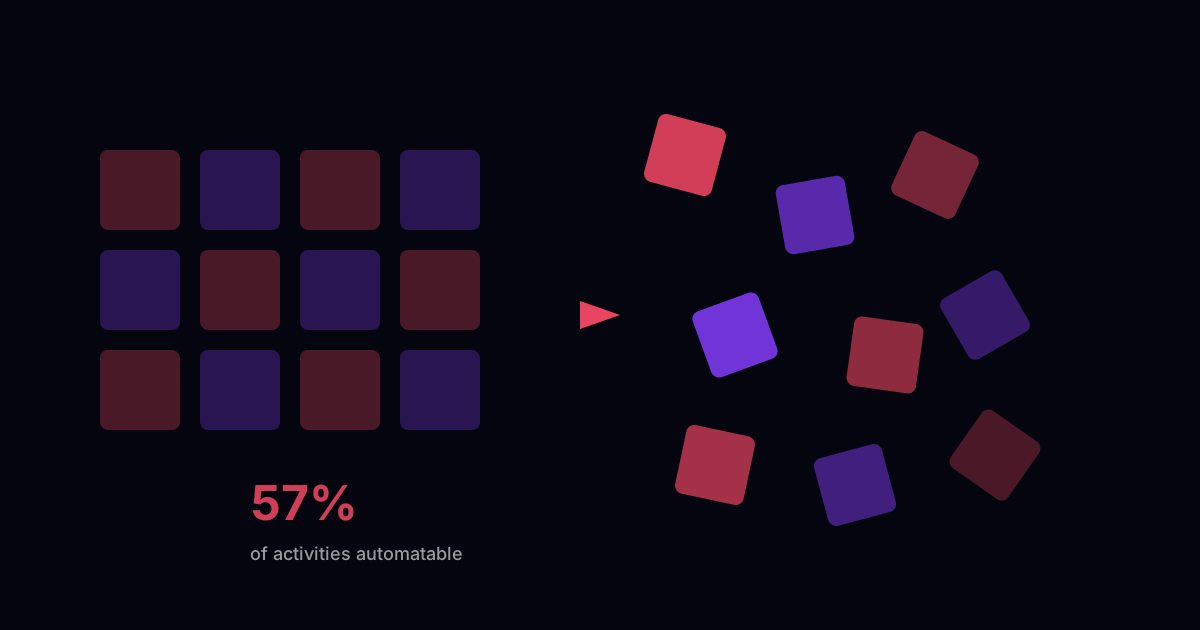
McKinsey senior partner Alexis Krivkovich dropped the stat that deserves more attention: AI can technically automate 57% of work-related activities in the US economy right now.
Not 57% of jobs. 57% of activities.
The distinction matters enormously. A software engineer’s job might be 40% code-writing (increasingly automated), 30% system design, 20% communication, and 10% debugging. AI eats some slices, not the whole pie.
As one consulting exec put it: “You can’t take one quarter of Lisa, one quarter of Jessica, one quarter of Nitin and one quarter of somebody else and make it one person.” The fractional nature of AI automation makes clean job replacement nearly impossible for most roles.
1.3 Million New AI Jobs — The Counter-Signal
Lost in the doom-and-gloom coverage: LinkedIn’s 2026 Labor Market Report found that employers have created at least 1.3 million AI-related job opportunities in the past two years.
These aren’t just ML engineering roles. They include data annotators, AI trainers, prompt engineers, forward-deployed engineers, ethics specialists, and entirely new categories like “agent orchestrators” — people who design and manage fleets of AI agents.
The pattern mirrors every technology wave: some jobs get destroyed, different jobs get created, existing jobs get reshaped. What makes this cycle unusual is the speed. Previous automation waves played out over decades. This one plays out over quarters.
Who’s Actually Getting Hurt
Two groups stand out.
Entry-level workers face the steepest challenge. Many junior roles existed partly as training grounds — do the grunt work, learn the business, move up. When AI handles the grunt work, the on-ramp disappears. Companies like Cloudflare and Coinbase have cut disproportionately from junior positions.
Middle management faces a different threat. If AI agents coordinate workflows, summarize reports, and track project status, the “information router” function of many management roles becomes redundant. That 15x growth in agent usage suggests this compression is accelerating fast.
What Restructured Work Actually Looks Like
Boris Cherny, head of Claude Code at Anthropic, offered a concrete example: a software engineer’s job involves much more than coding. System design, code review, troubleshooting, deciding what to build. AI handles more of the writing; humans handle more of the thinking.
This pattern — humans moving up the abstraction ladder while AI handles execution — is playing out everywhere:
- Marketing: Less copywriting, more strategy and brand positioning
- Legal: Less document review, more creative argumentation
- Finance: Less data crunching, more scenario analysis
- Customer service: Less ticket resolution, more complex escalation
The Money Follows the Machines
The most telling insight came from Andy Challenger: “Regardless of whether individual jobs are being replaced by AI, the money for those roles is.”
Even if your specific position survives, your compensation might not. If AI makes you 3x more productive, your company doesn’t pay you 3x more — they hire fewer people at the same rate, or reclassify your role at a lower band since “the AI does most of the hard part.”
The economic pressure isn’t just about headcount. It’s about how value and compensation get redistributed when machines handle the routine and humans handle the exceptions.
What You Should Actually Do
The data suggests concrete strategies:
Audit your own role. What percentage of your work could an AI handle today? Be honest. The activities where you’re most replaceable are the ones to move away from.
Move toward judgment and ambiguity. AI excels at well-defined tasks with clear inputs and outputs. It struggles with ambiguity, politics, novel situations, and incomplete information.
Learn to orchestrate, not just execute. The fastest-growing roles are about managing AI systems, not competing with them. Directing AI agents is becoming a core professional skill.
Build relationships aggressively. The more your value comes from trust, context, and human connection, the harder you are to automate. Relationships are the ultimate moat.
The anxiety is real. The disruption is real. But it’s not the robot apocalypse — it’s a messy, uneven, sometimes painful restructuring of what “work” means. And honestly? That might be harder to navigate than a clean replacement would be.