Choosing a college major has always been stressful. In 2026, it’s become existential gambling.
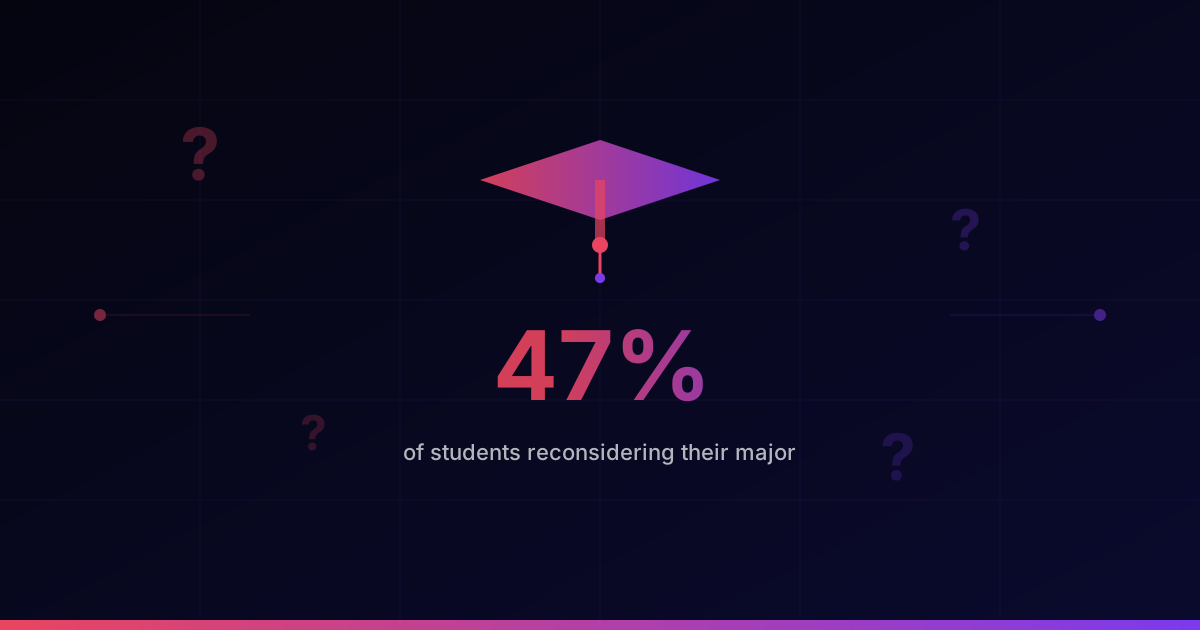
A sweeping new survey from Gallup and the Lumina Foundation finds that 47 percent of currently enrolled college students have seriously considered changing their major because of AI’s impact on the job market. And 16 percent have already done it.
One in six college students in America has changed the trajectory of their education — not because they discovered a new passion or failed organic chemistry, but because a technology that barely existed in its current form four years ago has made them question whether their degree will be worth anything at graduation.
This isn’t vague anxiety. It’s measurable, data-backed, and it should worry everyone.
The Numbers Are Striking
The Gallup-Lumina 2026 State of Higher Education Study surveyed 3,801 students between October 2–31, 2025. The headline findings:
- 47% have thought seriously about switching majors due to AI
- 16% have already changed their major
- 56% of associate degree students have reconsidered, vs. 42% of bachelor’s students
- 60% of male students have contemplated a change, vs. 38% of female students
- Men are nearly twice as likely to have already switched (21% vs. 12%)
The gender gap is telling. Men are more heavily represented in tech and engineering — the fields most directly in AI’s crosshairs — and they’re responding more aggressively. Whether that’s smart planning or panic is an open question.
Tech Students Feel It Most
Students in technology programs lead the anxiety rankings: 70 percent have given serious thought to switching. Vocational students are right behind. More than half of humanities, engineering, and business students have also considered a change.
The calmest? Healthcare and natural sciences — only 34 percent in each group are seriously reconsidering. AI isn’t performing surgery or running PCR assays yet. (Radiology students might want to start sweating, though.)
Here’s where it gets interesting: among the 16% who actually switched, the top destination was social sciences (26%), followed by business (17%) and technology (13%). Students are moving both toward and away from tech — some fleeing automation, others chasing the AI gold rush.
“Students are moving in both directions when it comes to tech fields,” Dr. Courtney Brown of the Lumina Foundation told Business Insider. “Some are switching into tech because they see opportunity in AI, while others are moving away because they’re worried about disruption.”
Their Fears Aren’t Irrational
The data backs them up. Stanford’s Digital Economy Lab found that between 2022 and 2025, early-career workers in AI-exposed occupations saw 16 percent relative employment declines while experienced workers stayed stable. Entry-level software development, clerical work, and content creation have all measurably contracted.
The cruel irony: the generation told “learn to code” is watching AI learn to code better and faster than most junior developers.
A Niche report from March found student interest in traditional programming dropped to just 10% of CS interest in 2026, down from 14% in 2020. Meanwhile, AI-specific specializations grew from 1.7% to 4.7% in three years.
The smart money is on building AI, not doing what AI already does.
The Paradox: Terrified of AI, Dependent on AI
A companion finding from the same study: 57 percent of students use AI in coursework at least weekly, and one in five use it daily. Business, tech, and engineering students are the heaviest users.
Top uses include understanding complex material (nearly 90% of AI-using students), saving time on assignments, checking homework, editing writing, and summarizing lectures. About a third use it to write papers outright.
The kicker: 53 percent say their school either discourages (42%) or outright prohibits (11%) AI use. Only 7% of schools encourage free use.
Students are simultaneously terrified of AI taking their jobs and completely dependent on it for school. If that’s not the defining paradox of 2026 higher education, nothing is.
Higher Ed Is Already Behind
Three problems are converging:
The curriculum problem. If nearly half your students question whether their degree is future-proof, that’s a crisis of confidence in your product. Universities need AI literacy across every discipline — not just CS. An English major who understands prompt engineering is far more employable than one pretending the technology doesn’t exist.
The advising problem. Academic advisors are now career futurists whether they like it or not. “Should I switch from accounting to data science?” isn’t really about coursework — it’s about whether a career will exist in five years. Most advising offices aren’t equipped for that conversation.
The hiring shift. A March 2026 HireVue report found that while 79% of entry-level roles still require a bachelor’s degree, 70% of employers are adopting skills-based hiring. More than a quarter are discussing dropping degree requirements entirely. Students are agonizing over which major to pick while employers increasingly care about what you can do.
A Generation Betting Under Radical Uncertainty
What’s really happening goes beyond education policy. An entire generation is making 4-year bets in a landscape that shifts every 4 months.
ChatGPT launched in November 2022. By April 2026, frontier models write professional code, analyze legal documents, generate research papers, and create Hollywood-quality video. The capability growth has been relentless.
Students entering college today graduate into a 2030 job market that literally no one can predict. The most honest answer to “what should I major in?” might be: something that teaches you to think, adapt, and work alongside AI. Which sounds like advice but is really an admission that the old playbook is broken.
The Bottom Line
This Gallup data is a wake-up call — not just for students, but for every institution, employer, and policymaker involved in preparing the next generation for a workforce being rebuilt in real time.
Don’t panic-switch into whatever’s hot today. The AI interest surge in CS programs tripled in three years — that pipeline will produce a glut. Instead, learn AI regardless of your major, bet on judgment over tasks, and stay flexible.
The students who thrive won’t be the ones who picked the “right” major. They’ll be the ones who kept learning after graduation.
Sources: Gallup, Business Insider, Inside Higher Ed, The Hill, Niche