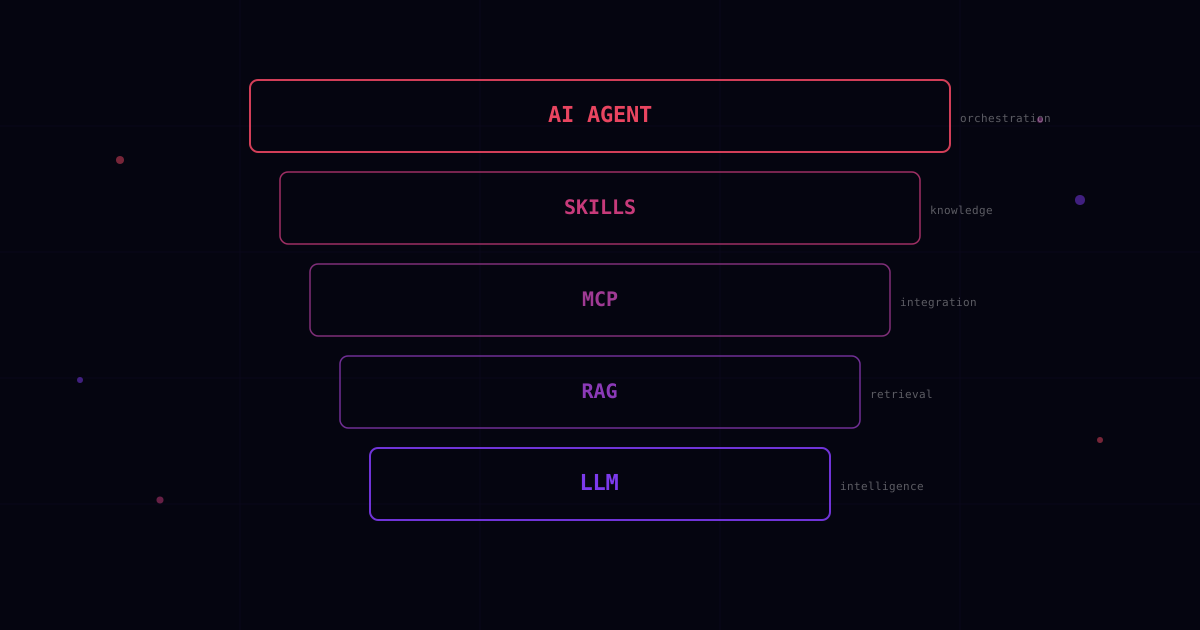
Every week, a new blog post asks: MCP or RAG? RAG or Agents? Agents or MCP? The question is wrong. These aren’t competing technologies. They’re layers — and the teams shipping the most capable AI systems in 2026 are stacking all three.
Here’s what each layer actually does and why you probably need more than one.
MCP: One Plug to Rule Them All
LLMs are brilliant and trapped. They can reason about your calendar but can’t read it. They can plan a database migration but can’t execute it. They need hands — and before MCP, giving them hands was a mess.
OpenAI had function calling. Anthropic had tool use. Google had their own thing. Build an integration for one, rebuild it for another. Classic M×N problem.
The Model Context Protocol killed that problem. Created by Anthropic in late 2024, MCP is now backed by OpenAI, Google, and Microsoft. It’s JSON-RPC 2.0 over stateful connections with a clean three-role architecture: hosts (your LLM app), clients (connectors), and servers (the tools themselves).
Servers expose three things:
- Resources — data the model can read (files, DB records, API responses)
- Prompts — templated workflows
- Tools — functions the model can call
Think of it as USB for AI. One standard interface. Thousands of servers already exist for GitHub, Slack, Postgres, and everything else you’d want to wire up.
MCP vs Function Calling
Function calling still works fine for simple, single-vendor apps. But if you’re building anything that needs to work across providers, auto-discover available tools, or enforce server-side security? MCP wins. It’s the difference between a proprietary charger and USB-C.
As of early 2026, MCP has crossed the tipping point. Microsoft baked it into Windows at Build 2025. It’s native in Claude, ChatGPT, Copilot, Cursor, and VS Code. The debate is over — MCP is the standard.
RAG: Your Model’s External Hard Drive
Your LLM was trained months ago. It doesn’t know about your company’s internal docs, last week’s sales spike, or the policy update you shipped yesterday. Fine-tuning is slow and expensive. RAG is fast and cheap.
Retrieval-Augmented Generation is simple in concept: before the LLM answers, grab the most relevant documents from your knowledge base and stuff them into the prompt. The model generates answers grounded in your data, not just its training set.
The basic flow hasn’t changed since Lewis et al. introduced it in 2020: embed the query → vector search → retrieve top chunks → inject into context → generate. What has changed is everything around it.
RAG in 2026 Is Not Your 2023 RAG
Modern production systems layer multiple techniques:
- Hybrid search — dense vectors for semantic similarity plus BM25 for keyword precision
- Reranking — cross-encoder models re-score initial results for accuracy
- Adaptive retrieval — the system decides whether to retrieve at all (sometimes the LLM already knows)
- GraphRAG — knowledge graphs for multi-hop reasoning across connected concepts
- Agentic RAG — agents that actively decide when, what, and how to retrieve
When RAG Is the Wrong Call
Not every problem needs retrieval. Skip it when:
- The LLM already has the knowledge baked in
- You need reasoning over entire large documents (long-context models may be better)
- Your data changes faster than you can index
- Retrieval latency kills your UX
RAG has graduated from “experimental novelty” to foundational infrastructure. But it’s still a layer, not a solution.
AI Agents: The Brain That Plans and Acts
Chatbots answer questions. Agents do work.
An AI agent observes its environment, reasons about what to do, decides on an action, executes it, then loops until the job is done. The key difference from a chatbot: agents maintain state across steps and take real actions in the world.
The Architecture Zoo
- ReAct — think, act, think, act. Simple, effective, battle-tested.
- Plan-and-Execute — make the whole plan first, then run it. Better for complex multi-step work.
- Multi-Agent — specialized agents collaborate. A researcher, a writer, a reviewer. Frameworks like CrewAI nail this.
- Hierarchical — manager agents delegate to worker agents with oversight at each level.
The Framework Landscape
The ecosystem has matured fast:
| Framework | Sweet Spot |
|---|---|
| LangGraph | Complex workflows needing fine-grained control |
| CrewAI | Multi-agent team collaboration |
| AutoGen | Rapid prototyping and research |
| OpenAI Agents SDK | Teams deep in the OpenAI ecosystem |
| LlamaIndex Agents | Data-heavy enterprise apps |
The Production Reality Nobody Talks About
Agent demos are magic. Agent production is engineering. You need timeouts, turn limits, output validation, cost controls, error recovery, and human-in-the-loop checkpoints. The frameworks are ready for production. The question is whether your guardrails are.
The Stack: Stop Picking One, Use All Five
Here’s the mental model:
┌─────────────────────────────────────┐
│            AI AGENT                 │  Decides WHAT to do
├─────────────────────────────────────┤
│         AGENT SKILLS                │  Knows HOW to do it
├─────────────────────────────────────┤
│             MCP                     │  CONNECTS to tools & data
├─────────────────────────────────────┤
│             RAG                     │  RETRIEVES relevant knowledge
├─────────────────────────────────────┤
│             LLM                     │  The reasoning engine
└─────────────────────────────────────┘
An agent decides it needs to answer a policy question. It loads a skill that knows how to search internal docs. That skill uses MCP to connect to the document system. The system performs RAG to find relevant sections. The LLM synthesizes the answer.
Each layer does one thing well. Remove any layer and the system still works — just with reduced capabilities. Stack them all and you get something that actually ships.
Bonus: Where the Stack Is Heading
GPT-5’s Hidden Router
When OpenAI launched GPT-5 in August 2025, the big reveal wasn’t a single model — it was a system. Behind the unified API sits a router that directs each query to the right sub-model: gpt-5-main for speed, gpt-5-thinking for deep reasoning, gpt-5-thinking-pro for maximum compute. Say “think hard about this” and the router shifts you to the heavy model automatically.
The router trains continuously on real signals — when users manually switch models, preference rates, measured correctness. This is prompt routing at the infrastructure level. The stack is getting smarter about which stack to use.
Agent Skills: Lazy Loading for AI
Agent Skills solve a real problem: context windows are big but not infinite. Stuffing a 100K-token system prompt with everything the agent might need is wasteful and degrades performance.
A skill is a folder with a SKILL.md file — metadata, instructions, optional scripts. The agent runtime keeps a lightweight registry of available skills. When a request matches a skill, the full instructions load just in time. It’s lazy loading for AI knowledge, and it works across Claude Code, Cursor, Spring AI, and others.
The Decision Cheat Sheet
| You need… | Reach for… |
|---|---|
| Answers from your docs | RAG |
| LLM calling your APIs | MCP |
| Multi-step workflow automation | AI Agent |
| All of the above | Agent + RAG + MCP |
| Cross-provider compatibility | MCP over function calling |
| Lean agent prompts | Agent Skills |
| Smart model selection | Prompt routing |
The simplest rule: RAG is for knowledge. MCP is for actions. Agents are for autonomy. Start with the simplest layer that solves your problem. Add complexity only when you earn it.
The Composable Future Is Already Here
The AI stack is converging on modularity. MCP standardizes connections to the world. RAG injects knowledge the model wasn’t trained on. Agents plan and act autonomously. Skills keep everything efficient.
There is no “winner” in MCP vs RAG vs Agents. They’re layers in the same stack. The only question is how many you need — and for most serious applications in 2026, the answer is: more than one.
Sources: MCP Spec · GPT-5 System Card · RAG Survey · Agent Frameworks (Turing) · Agent Skills (DigitalOcean)