When the Federal Reserve starts war-gaming artificial intelligence, pay attention. Not because central bankers are known for tech hot takes — but because when the people who control interest rates start modeling AI scenarios, the economic establishment has officially stopped treating this as hype.
On February 17, Fed Governor Michael S. Barr stepped in front of the New York Association for Business Economics and delivered what might be the most important AI speech to come out of Washington this year. No vague platitudes about “responsible innovation.” Instead, three distinct futures for how AI reshapes work — and one of them should keep you up at night.
Three Roads, Radically Different Destinations
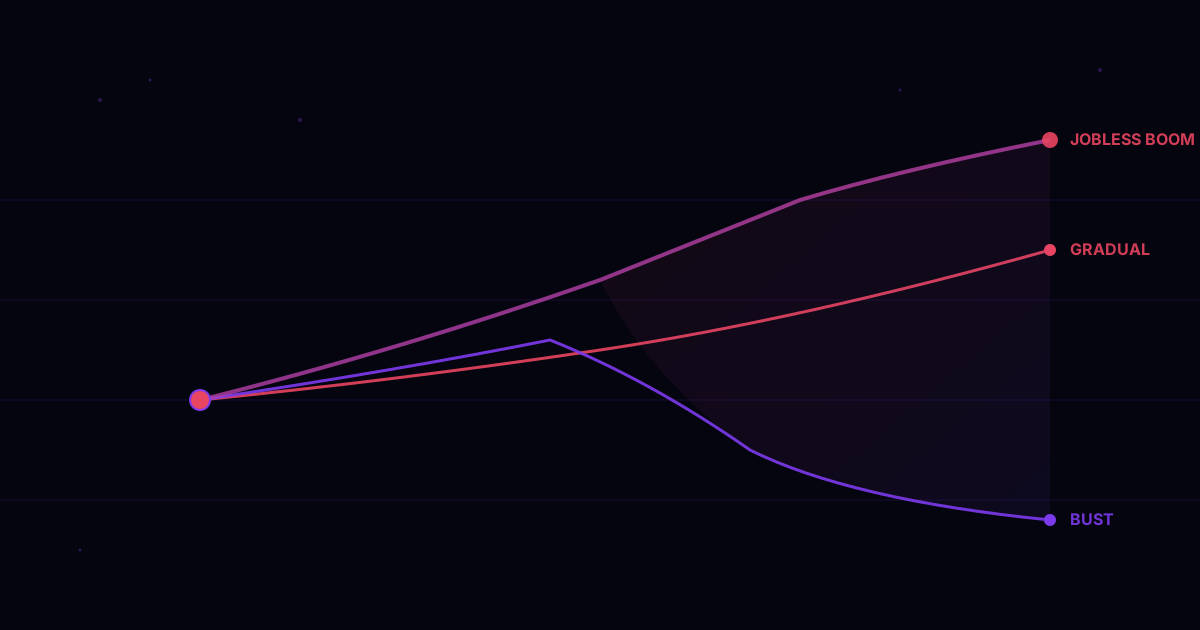
Barr’s framework cuts through the noise. Rather than pretending anyone can predict exactly how this plays out, he mapped three plausible paths.
Scenario 1: The Slow Burn. AI integrates gradually, like electricity or PCs before it. Productivity climbs. Some jobs vanish. New industries absorb the displaced. Real wages eventually rise. Messy but manageable — the kind of transition we’ve navigated before.
Scenario 2: The Bust. AI investments fail to deliver. The trillion-plus dollars flooding into AI infrastructure becomes the next dot-com bubble. Financial institutions holding AI-related debt take heavy losses. Barr drew explicit parallels to 19th-century railroad speculation and the early-2000s tech crash.
Scenario 3: The Jobless Boom. This is the headline-grabber — and it deserves to be. AI agents rapidly replace professional and service work while robotics automate manufacturing and transport. “Layoffs soar, leading to widespread unemployment,” Barr said. Economic gains concentrate among capital holders and “AI superstars” while everyone else scrambles.
A sitting Fed governor publicly describing a future where large portions of the population become “essentially unemployable.” Let that sink in.
The Numbers Say We’re on the Gradual Path. For Now.
Barr believes current data is “closest” to Scenario 1. But the details tell a more complicated story.
As of December 2025, only 17% of U.S. businesses report using AI in operations, per the Census Bureau. Sounds low — until you zoom in. Among companies with 250+ employees, it’s 30%. McKinsey’s data is sharper: 88% of large firms use AI in at least one function, and generative AI usage rocketed from 33% in 2023 to 79% in 2025.
The adoption speed is historically unprecedented. A St. Louis Fed paper found that generative AI workplace adoption after ChatGPT’s launch matched the pace of PC adoption after the IBM PC hit shelves in 1984. And Barr noted workers are using AI tools “without their manager’s knowledge” — real adoption is almost certainly higher than surveys capture.
We’re in a strange in-between: fast by historical standards, but still concentrated in large, tech-forward companies. The question isn’t whether the flood comes. It’s when.
Gen Z Is Already Feeling It
The most alarming data point wasn’t about GDP or aggregate unemployment. It was about young workers.
Early-career workers in AI-exposed fields — software development, customer service, content creation — are already seeing employment declines relative to other sectors. Companies that once hired armies of junior developers and support staff are discovering AI can handle the entry-level work that used to be a career stepping stone.
“For these workers, the short run may have long-term consequences,” Barr warned. Economic research consistently shows that entering a weak labor market causes career scarring that follows you for decades.
This is the part of the AI transition that doesn’t get enough attention. We obsess over whether AI will replace jobs in the abstract, but the reality is more surgical: it’s hollowing out the bottom rungs of career ladders first. The senior engineer is fine — for now. The new grad competing with Copilot for their first role? Different story entirely.
Why This Means Rates Aren’t Coming Down
Here’s where it gets interesting for anyone watching their mortgage rate. Even in the optimistic scenario, Barr argued there are monetary policy implications most people aren’t considering.
A genuine AI productivity boom increases demand for capital investment. Businesses pour money into compute, AI talent, and automation. Workers anticipating higher lifetime earnings save less. Both dynamics push up the “neutral” interest rate.
Barr said it explicitly: “The AI boom is unlikely to be a reason for lowering policy rates.”
With inflation still at 3% (above the Fed’s 2% target), job creation “near zero” for the past year, and 800,000 immigrants having left the workforce in 2026, the economy is walking a tightrope. AI is simultaneously the wind and the net.
The $1 Trillion Bet
One underappreciated risk: the sheer scale of capital riding on AI. A forecasted $1 trillion in new AI-related debt over five years creates massive exposure no matter which scenario wins.
Barr compared the moment to historical episodes of transformative-technology overinvestment. Railroads eventually reshaped the modern economy — but most railroad investors lost everything first. The dot-com crash wiped out billions before the internet delivered on its promise a decade later.
“I actually don’t know how it’s going to play out,” Barr admitted. When a Fed governor says that, it’s not uncertainty. It’s honesty about genuine novelty.
What This Actually Means for You
Workers: Diversify skills aggressively. The at-risk jobs aren’t just data entry and basic coding — they’re entry-level knowledge work positions across industries. If your job is primarily executing well-defined tasks, AI is coming for it, degree or not.
Investors: Know which AI bet you’re making. The “everyone wins” narrative is seductive but historically illiterate. Transformative technologies produce brutal shakeouts before they produce broad returns.
Company leaders: That 17% adoption figure will look quaint in 18 months. Treating AI as an experiment you’ll get to eventually is how you become the one who gets disrupted.
The Bottom Line
The Federal Reserve is now publicly modeling a future where AI creates mass unemployment. Not a tech doomer. Not a think tank fishing for clicks. The institution responsible for maintaining full employment — acknowledging that one of three plausible outcomes is a world where huge swaths of workers become obsolete.
We’re probably on the gradual path. The data suggests it. History suggests it. But “probably” is doing a lot of heavy lifting when the downside scenarios include either a financial crisis or a social one.
Barr can’t control which future arrives. But by naming all three clearly, he made it harder for anyone to claim they weren’t warned.