The AI industry just had one of its most revealing weeks — not because of any single announcement, but because three companies made moves that expose where this market is actually heading.
Anthropic launched Claude Fable 5 at premium prices with built-in safety classifiers. Google slashed its AI subscription to $5/month. OpenAI acquired a cloud infrastructure company to make its coding agents run for days without stopping.
Three different bets. One clear signal: the AI market is fracturing into tiers, and the gap between “good enough” and “best available” is becoming a strategic decision that actually matters.
Fable 5: The Most Capable Model With a Built-In Bouncer
Anthropic’s Fable 5 is the first publicly available model from its Mythos class — the tier that sits above Opus. The benchmarks are genuinely impressive. Stripe ran a codebase migration across 50 million lines of code in a single day. Hex reported it was the first model to hit 90% on their analytics benchmark. Vibe-coding platform Base44 says it “one-shots full apps.”
But here’s the part nobody expected: Fable 5 comes with a chaperone.
A separate classifier system watches every conversation in real time. Ask about cybersecurity vulnerabilities, certain biology topics, or how to replicate the model’s own capabilities, and the query gets silently routed to Claude Opus 4.8 instead. You still get an answer — just not the answer Fable would have given.
Anthropic says at least 95% of sessions run entirely on Fable’s own responses. But you’re paying Fable prices regardless — $10 per million input tokens, $50 per million output — double the cost of Opus 4.8.
Over 1,000 hours of external red-teaming couldn’t find a universal jailbreak. And with the launch, Anthropic now requires 30-day data retention on all traffic, even for enterprise customers who previously had zero-retention deals. They say it’s for jailbreak defense, not training.
Security measure or privacy erosion? Both, probably.
Google’s $5 Power Move
While Anthropic goes premium, Google went the opposite direction. On June 8th, Google slashed AI Plus from $7.99 to $4.99/month and doubled the included storage to 400GB.
For context: ChatGPT Plus is $20/month. Anthropic’s Pro plan is $20/month. Google just undercut everyone by 75% on consumer AI access.
This isn’t charity — it’s strategy. Google is commoditizing the layer below frontier models, betting that most people don’t need Fable-class capabilities. They need a capable assistant that works with their email, documents, and calendar. At $5/month, AI access hits utility pricing. Not having an AI assistant will start feeling like not having email.
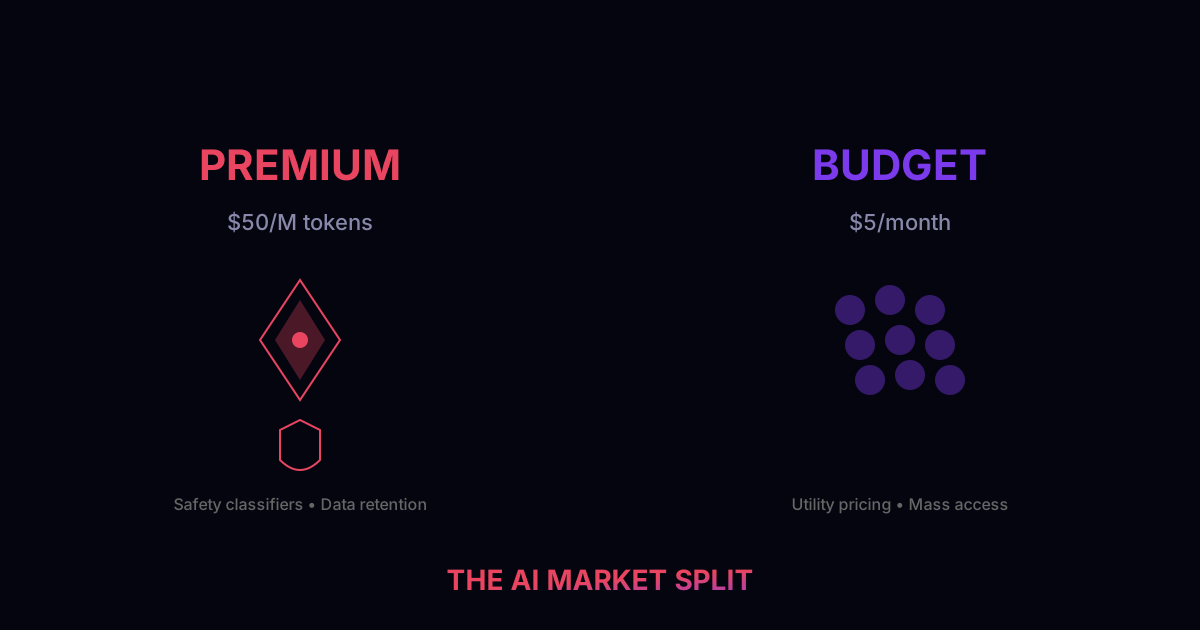
The market structure forming here matters: expensive, controlled frontier models for professionals versus cheap, accessible models for everyone else. The middle is getting squeezed.
OpenAI Buys the Infrastructure for Autonomous Agents
While Anthropic ships safety classifiers and Google wages price wars, OpenAI made a quieter move that might matter more long-term. On June 11th, they announced the acquisition of Ona — formerly Gitpod — a German startup building cloud execution environments for AI agents.
Right now, OpenAI’s Codex (reportedly at 5 million weekly users) works best for bounded tasks: fix this bug, write this function. Ona’s infrastructure would let Codex run autonomously for hours or days on larger projects — migrations, refactors, entire feature builds — in the customer’s own cloud.
This mirrors a broader pattern: AI companies aren’t just competing on model quality anymore. They’re competing on the full stack — models, tools, and the environments where agents actually do sustained work. The model is becoming just one piece of a larger platform play.
The RSI Warning Nobody Should Ignore
Buried under the product launches was something more significant. The week before Fable’s launch, Anthropic published an essay on recursive self-improvement — AI systems designing and building their own successors with minimal human input.
Their position: RSI hasn’t happened yet and isn’t inevitable, but it’s “coming sooner than most institutions are prepared for.” They called for a coordinated industry brake pedal, something like the FAA’s role in aviation.
The cynical read: Anthropic is positioning itself as the “responsible” lab right before an IPO filing. The generous read: they’re genuinely worried about what they’ve built. Both things can be true simultaneously. Incentives sometimes align with good outcomes.
What This Actually Means
For developers: Fable 5 is worth testing on complex, multi-hour autonomous workloads. Its lead over competitors widens as tasks get messier and longer. Just budget for the price tag and occasional safety redirects.
For business leaders: choosing your AI tier is becoming a real strategic call. Frontier models are more expensive and more controlled. Consumer models are cheaper and more accessible. “Just use the best one” isn’t a strategy anymore when the best one costs 10x more and comes with mandatory data retention.
For everyone else: Google’s price cut is the news that actually affects your daily life. Five dollars a month for capable AI with 400GB of storage. We’re watching AI become a utility in real time.
The AI market just told us what it wants to be when it grows up: a split between premium tools for professionals and commodity tools for everyone. The companies that figure out which side they’re on — and price accordingly — will win. The ones stuck in the middle won’t.