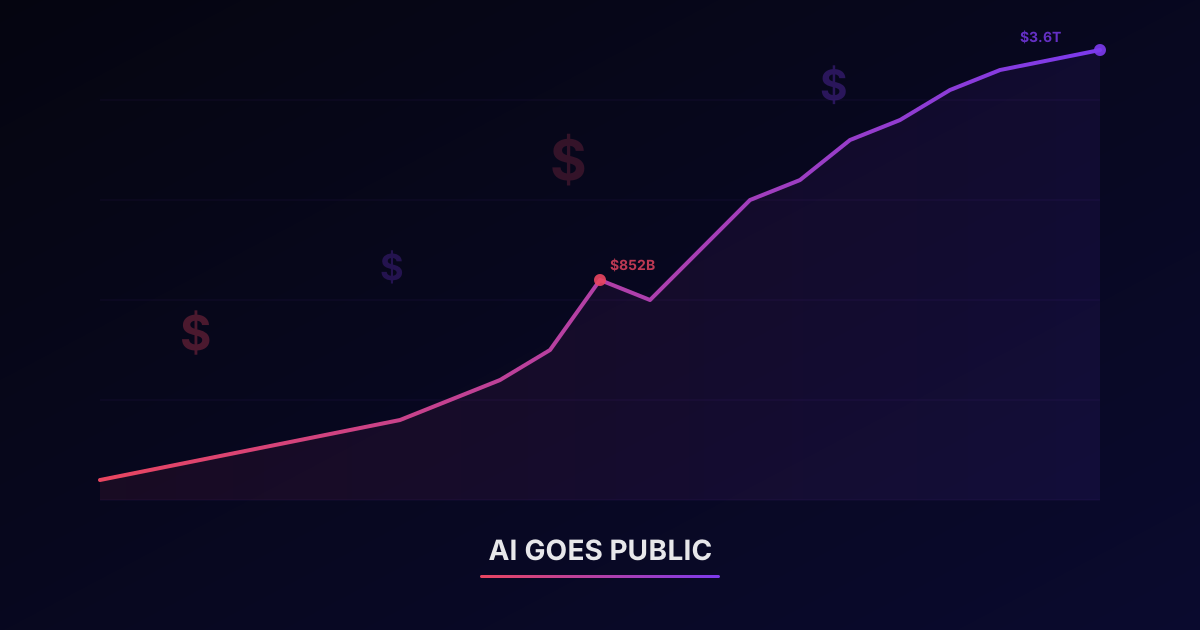
The AI industry just crossed a Rubicon. OpenAI — the company that kicked off the generative AI revolution with ChatGPT — has confidentially filed an S-1 with the SEC. One week after Anthropic filed its own IPO paperwork. With SpaceX also preparing a debut at $1.75 trillion.
Combined IPO pipeline: $3.6 trillion. We haven’t seen anything like this since the dot-com era. Arguably, we’ve never seen it at all.
From Nonprofit Lab to $852 Billion
OpenAI’s trajectory borders on absurd. Founded as a nonprofit in 2015, it released ChatGPT in late 2022 and changed everything. Converted to for-profit. Amassed hundreds of millions of users. Closed a $122 billion funding round in March 2026 — the largest in Silicon Valley history — at roughly $852 billion.
Goldman Sachs and Morgan Stanley are handling the listing. Some reports point to September 2026. Others say late 2026 or 2027.
OpenAI’s own announcement was characteristically casual: “We recently submitted a confidential S-1. We expect it to leak so we’re just announcing it. We have not decided on timing yet.”
Translation: We want the optionality.
The $85 Billion Problem
Here’s where it gets uncomfortable for public market investors. OpenAI expects to lose $14 billion in 2026. Profitability isn’t projected until 2030. The company plans to spend $122 billion on compute by 2028, and even after doubling sales, projects burning through $85 billion that year.
HSBC estimates a $207 billion funding gap by 2030. Meaning OpenAI may need to raise more capital after going public.
Amazon famously didn’t turn a profit for years. But the sheer scale of this burn is unprecedented. And OpenAI has struggled to find a second hit after ChatGPT — it acquired Jony Ive’s hardware startup, launched video tool Sora with Disney, then killed Sora in April. ChatGPT still dominates with 900 million weekly users, but revenue and growth targets have reportedly been missed.
Anthropic: The Leaner Rival
If OpenAI’s financials are a cautionary tale, Anthropic’s are a counterpoint. The Claude maker filed its own IPO paperwork on June 1st with notably rosier numbers.
Anthropic is close to its first quarterly profit — a milestone OpenAI is years away from. It raised $65 billion in its latest round and has built a reputation for capital efficiency that makes OpenAI’s everything-app strategy look bloated.
The irony: Anthropic was born from former OpenAI researchers who left over safety concerns. Now it’s racing its parent company to Wall Street with better numbers. The coding-assistant market, where Claude Code became a breakout hit, turns out to be a remarkably efficient business.
Can Wall Street Absorb the Shock?
Three mega-IPOs within months of each other: SpaceX at $1.75 trillion, OpenAI near $1 trillion, Anthropic at $900 billion-plus. These aren’t normal listings. They’re events that could reshape index composition and force institutional investors into impossible allocation decisions.
BMI Research (Fitch Solutions) warned the combined listings “may disrupt the market’s ability to absorb all the new shares without pressuring stock prices.” The core concern: none of these companies have proven profits that justify their valuations.
There’s also the Musk factor. A public OpenAI would pit Sam Altman directly against Elon Musk as competing public companies. Musk’s lawsuit alleging illegal nonprofit conversion was dismissed by a jury in May 2026, clearing one legal hurdle. But the rivalry is just getting started.
The Regulatory Tailwind
Around the same time as its S-1 filing, OpenAI published a sweeping philosophical blog post about AGI and humanity’s future — the kind of forward-looking statement companies in a pre-IPO “quiet period” typically avoid.
That they felt comfortable doing it says something about the current regulatory climate. The SEC under the Trump administration has taken a hands-off posture toward AI companies. On June 2, Trump signed an executive order titled “Promoting Advanced Artificial Intelligence Innovation and Security,” reinforcing a pro-innovation stance.
For investors, this cuts both ways. Smoother path to market, but less scrutiny of financial disclosures for companies with deeply uncertain economics.
What Going Public Changes
For years, the most important AI companies have been private — funded by VCs, sovereign wealth funds, and big tech partners. IPOs change the game:
Transparency. Quarterly earnings, executive compensation disclosures, material risk reports. We’re about to learn a lot about what frontier AI actually costs.
Accountability. Public shareholders bring different pressure than patient venture backers. Quarterly expectations replace multi-year runway.
Talent dynamics. IPOs create liquidity events for employees. This could trigger departures — Forbes flagged “ongoing talent departures” as a key OpenAI risk — or attract new people drawn by publicly traded equity.
Competition in real time. With both OpenAI and Anthropic public, every product launch, benchmark result, and customer win moves share prices. The AI race becomes a stock market spectator sport.
The Bottom Line
OpenAI’s IPO filing is the exclamation point on a sentence four years in the making: generative AI is not a research project anymore — it’s a financial instrument.
History tells us transformative technologies eventually justify enormous valuations. It also tells us the road from “transformative” to “profitable” is littered with casualties. Amazon made it. Pets.com didn’t.
The AI IPO wave of 2026 will determine which side of that divide these companies land on. One thing’s certain: the second half of this year is going to be one hell of a ride.