Forget chatbots. Google just told the world it’s done with the old “ask me a question, I’ll give you an answer” paradigm.
At Google I/O 2026 on Tuesday, the company launched Gemini 3.5 Flash — a model that’s less interested in chatting with you and more interested in doing things for you. Alongside it came Gemini Spark, a 24/7 personal AI agent deeply wired into Google’s ecosystem. This isn’t incremental. This is Google planting a flag: the future of AI isn’t conversation — it’s action.
A “Small” Model That Punches Like a Flagship
Gemini 3.5 Flash sits in Google’s efficient Flash line, not the heavyweight Pro tier. But it performs like a flagship. According to Google’s numbers, it outperforms Gemini 3.1 Pro on nearly every benchmark — coding (76.2% on Terminal-Bench 2.1), agentic tasks, and multimodal reasoning (84.2% on CharXiv Reasoning).
The real headline? It does this at 4x the speed of comparable frontier models, pushing nearly 300 tokens per second. An optimized variant reportedly hits 12x faster with the same quality.
DeepMind’s Koray Kavukcuoglu put it bluntly: “You no longer have to trade quality for latency.”
Speed matters more than ever because agents don’t work in single turns. They spawn sub-agents, run parallel tasks, iterate on code, and navigate interfaces — all of which multiply latency. A smart-but-slow model is a bottleneck. A smart-and-fast model is an engine.
AI Agents Building an Operating System — Live on Stage
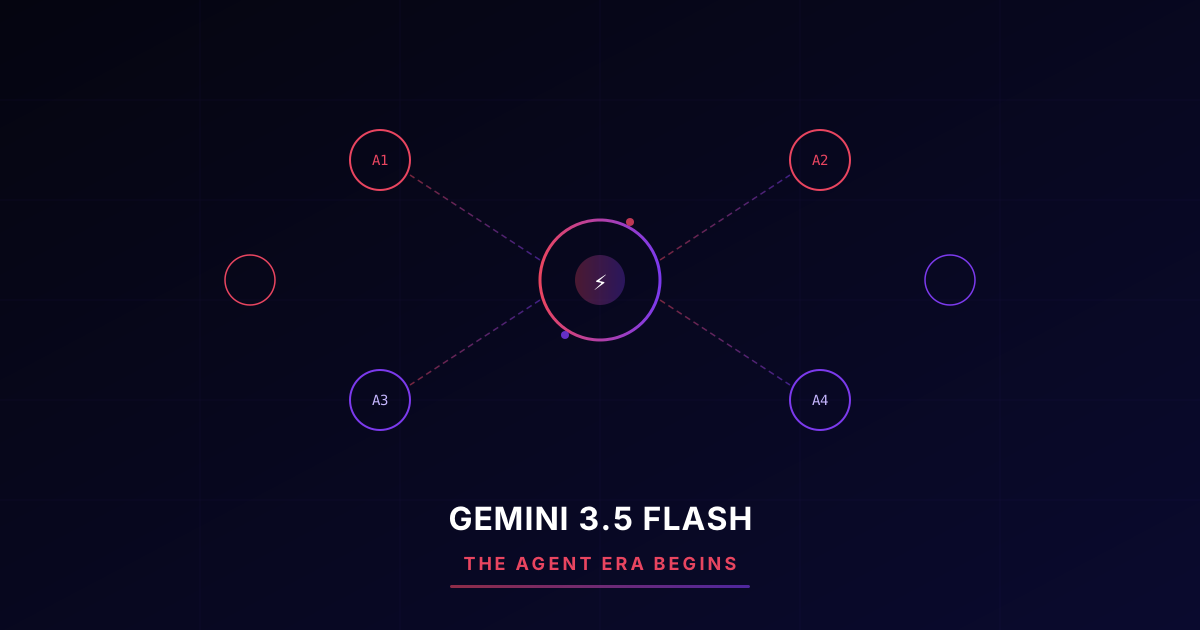
The most jaw-dropping demo wasn’t a chatbot conversation. It was Google engineer Varun Mohan showing multiple Gemini 3.5 Flash agents spawning inside Antigravity — Google’s agent-first IDE — each working on separate components, then assembling them into a complete operating system.
AI agents. Unsupervised. Building an OS.
Demos are demos — we’ve all seen impressive staged presentations that don’t survive contact with reality. But the architecture is significant. Flash was co-developed with Antigravity specifically so agents would have a native execution environment. Google also shipped Antigravity 2.0 as a standalone desktop app built around agent-first development.
The model can run autonomously for multiple hours on complex tasks, pausing at decision points requiring human judgment. And when 3.5 Pro arrives next month, the two models are designed to work in tandem: Pro as the orchestrator, Flash as the fleet of sub-agents doing the actual work. Project manager meets tireless team.
Gemini Spark: Google’s Always-On Personal Agent
If Flash is the engine, Gemini Spark is the car Google wants you to drive every day. It’s a 24/7 personal AI agent integrated into Gmail, Calendar, Docs, and eventually third-party apps like OpenTable and Instacart.
The difference from standard Gemini? Proactivity. Standard Gemini waits for you to ask. Spark actively monitors, gathers information, and takes action while you’re away:
- Scanning credit card statements for surprise fees
- Skimming preschool emails to build a morning digest
- Drafting follow-up emails after meetings and sending them to the right people
WIRED drew an explicit comparison to OpenClaw, the viral open-source AI agent that power users have been using to automate everything from inboxes to vending machines. Spark is clearly Google’s corporate answer to that grassroots movement — with the advantage of native access to Google’s massive ecosystem.
The catch: Spark is rolling out slowly. A small group of early testers this week, then beta access for subscribers to Google’s $100+/month AI plan. Given the risks of autonomous agents acting on personal data — and Google’s ongoing lawsuit fallout from a user who nearly committed a mass casualty event after weeks of chatting with Gemini — caution makes sense.
The Economics Change Everything
Google claims companies using the most AI tokens could save a billion dollars per year by switching to Flash. The API pricing backs this up: $1.50 per million input tokens and $9 per million output tokens, compared to $2 and $12 for the 3.1 Pro model it matches or beats.
This isn’t just about saving on API calls. It’s about what becomes viable. Multi-step code reviews, long-running data pipelines, complex UI automation — tasks that were too expensive to run autonomously suddenly have a cost structure that pencils out. Agentic workflows that need to run for hours go from money pit to plausible business.
2026: The Year Agents Go Mainstream
Google isn’t alone in this bet. Anthropic launched Claude Cowork. OpenClaw went viral. Microsoft has been pushing Copilot agents everywhere. But I/O 2026 might be the moment the agent era goes truly mainstream, because Google has something the others don’t: distribution.
Gemini 3.5 Flash is now the default model in the Gemini app and AI Mode in Google Search — available to billions of people globally. That’s not a developer preview. That’s shipped to everyone, today.
The shift from chatbot to agent changes how we think about AI interfaces entirely. You don’t chat with an agent — you delegate. You set parameters. You check in on progress. It’s closer to managing a remote employee than having a conversation. Google seems to understand this, and the tooling reflects it.
The Bottom Line
Developers: Start building agentic. Flash + Antigravity 2.0 is available now, API pricing makes experimentation cheap, and the Flash + Pro orchestration combo dropping next month could become the production standard.
Regular users: Gemini Spark is worth watching but maybe not worth $100/month yet. Wait for the beta to mature and see if Google can deliver proactive assistance without the privacy nightmares.
Competing AI companies: Be nervous. Not because Flash is necessarily the best model in the world — but because Google can ship it to billions of people overnight, baked into Search, Gmail, and Android. That distribution moat is enormous.
The chatbot era was the warm-up act. The agent era just got its keynote.
Sources: Google Blog, TechCrunch, Ars Technica, WIRED, CNBC