The Chief Data Officer took a decade to go mainstream. The Chief Digital Officer never really got there. The Chief AI Officer? Eighteen months.
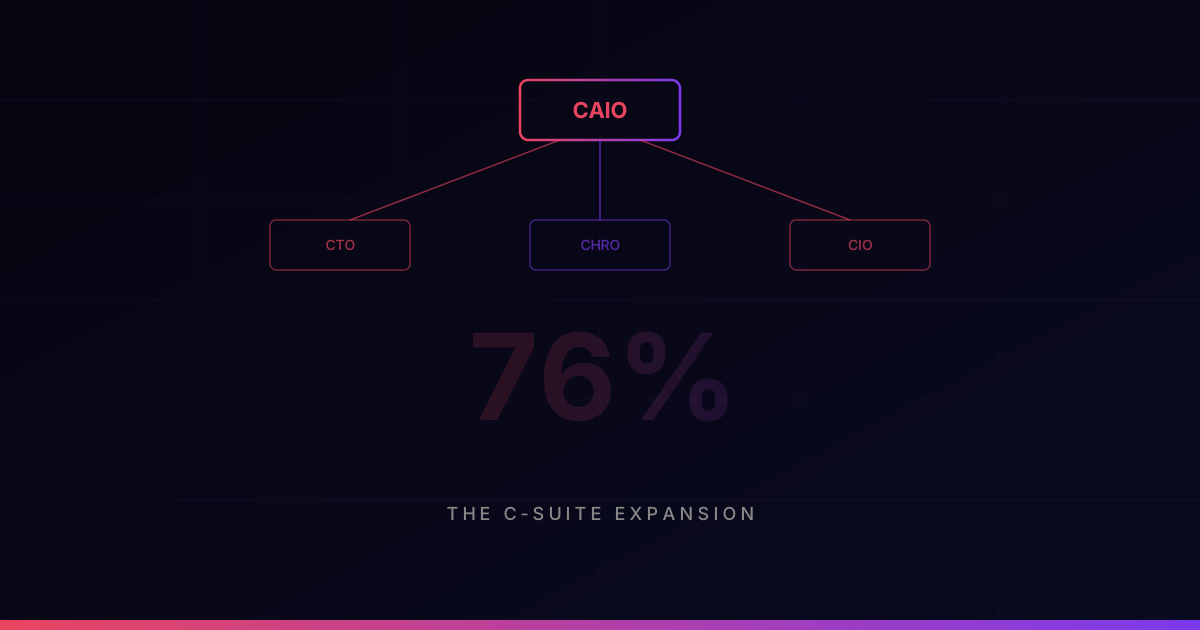
IBM’s latest study — surveying 2,000+ CEOs across 33 countries — drops a jaw-dropping stat: 76% of organizations now have a CAIO, up from just 26% in 2025. That’s not adoption. That’s a corporate stampede.
Why This Role Exists
Every company has a CTO managing infrastructure and a CIO handling systems. But who owns the question of how AI actually changes the way work gets done?
That’s the CAIO’s mandate. Not deploying tools — coordinating how AI transforms decisions, workflows, and execution across the entire business. As IBM’s Asia Pacific GM Hans Dekkers put it, the role is about “enabling calculated risk-taking” with guardrails that “let teams accelerate without spinning out of control.”
Translation: someone has to stop six departments from building six competing chatbots. That someone now has a title.
HSBC and Lloyds Banking Group both staffed CAIO roles this year. These aren’t vanity titles — they come with real budgets and real accountability.
The Culture Problem Nobody’s Solving
Here’s what should scare every CEO reading the IBM report: only 25% of employees regularly use AI, despite 86% of CEOs believing their workforce already has the skills.
That perception gap is a canyon. And it gets worse.
Randy Bean’s AI & Data Leadership survey found that 93.2% of respondents cited cultural challenges — not technology limitations — as the primary barrier to AI adoption. Companies have bought the tools. They’ve launched the pilots. But they haven’t touched the workflows, approval chains, metrics, or incentive structures that govern how people actually work.
Give someone an AI assistant but don’t change their job description, their KPIs, or their manager’s expectations? That tool is collecting digital dust.
HR Becomes the Power Player
Plot twist nobody saw coming: 59% of CEOs expect the CHRO’s influence to grow as AI matures. In the age of automation anxiety, the people person is gaining power.
It makes sense. AI literacy, reskilling, workforce planning, managing the psychological weight of automation — these are HR problems. Between now and 2028, CEOs expect 29% of employees will need retraining for entirely new roles, and 53% will need upskilling just to keep doing their current jobs.
That’s not a training program. That’s a workforce overhaul.
But there’s a catch. Gartner’s Jonathan Tabah warns that AI will sort HR departments into two buckets: those that become more strategic than ever, and those that get automated into irrelevance.
The Decision Nobody’s Talking About
Buried in IBM’s data is a prediction every middle manager should read twice: CEOs estimate 25% of operational decisions are already made by AI without human intervention. By 2030, they expect 48%.
Nearly half. Pricing updates, inventory allocation, incident resolution — handled by machines. And 79% of executives say they’re already pushing decision-making authority further down their organizations, backed by AI delivering real-time analysis.
The CAIO’s most important job might not be deploying AI. It might be drawing the line between what the algorithm decides and what a person must.
Will It Last?
Not everyone’s convinced. Gartner’s Tabah doesn’t expect the CAIO to go truly mainstream — the cost of a new C-suite seat is real, and once AI becomes embedded enough, dedicated oversight might feel redundant.
It’s the same question companies asked about the Chief Digital Officer a decade ago. Most of those roles got absorbed.
But what the CAIO represents is already permanent: AI has graduated from the IT department to the boardroom. IBM found that companies redesigning five key areas — technology, finance, HR, operations, and cross-functional collaboration — are four times more likely to hit their AI objectives than those bolting AI onto existing structures.
The title might be transitional. The transformation isn’t.
Sources: IBM CEO Study 2026, CNBC, Randy Bean AI & Data Leadership Survey 2026