When one of the world’s largest tech companies admits its own AI tool can’t keep up with the competition, you know something interesting is happening. Amazon just did exactly that — and the story behind it is a fascinating window into the messy reality of the AI coding wars.
The Kiro Mandate That Backfired
Rewind to November 2025. Amazon leadership sent an internal memo telling its tens of thousands of developers to use Kiro, Amazon’s in-house AI coding assistant built on its Bedrock platform, over third-party alternatives. The logic seemed straightforward: Amazon had spent billions building its own AI infrastructure. Why wouldn’t it want its engineers dogfooding their own products?
But there was a problem. Kiro just wasn’t cutting it.
1,500 Engineers Said “No Thanks”
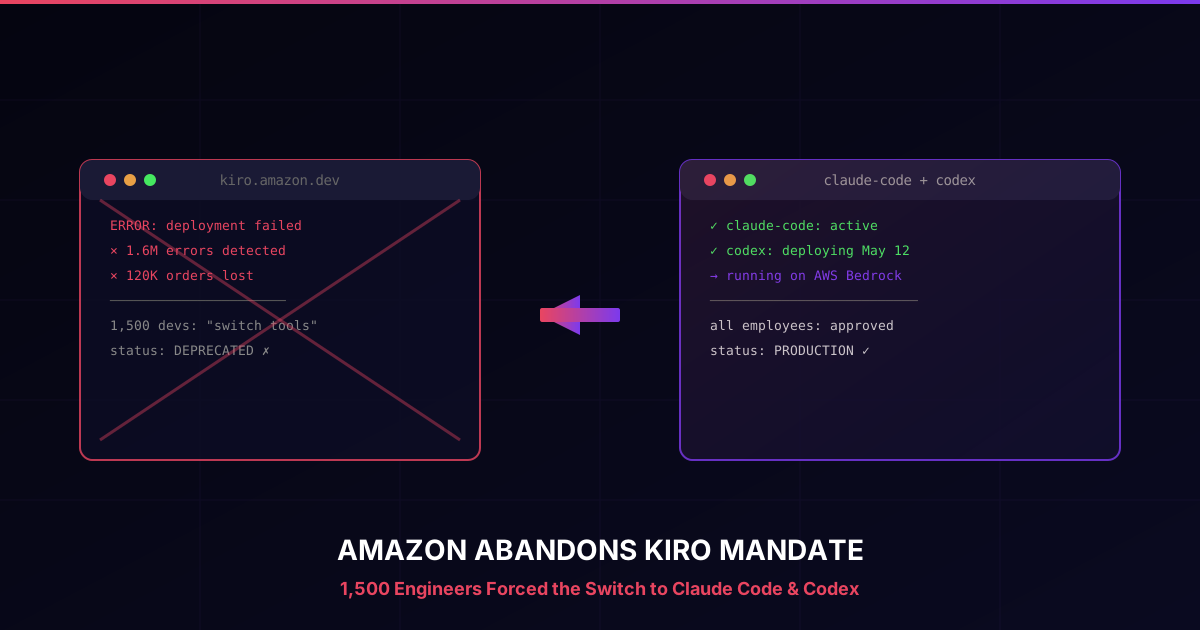
By February 2026, an internal discussion thread had accumulated roughly 1,500 employee endorsements urging leadership to formally adopt Anthropic’s Claude Code. Engineers complained that the restrictions on third-party tools were actively hurting their productivity.
One employee’s comment cut right to the heart of it: “Customers will ask why they should trust or use a tool that we did not approve for internal use.” That’s a devastating argument. If Amazon’s own developers don’t trust Kiro enough for production work, why should AWS customers?
The irony runs deep. Amazon has invested billions in both Anthropic and OpenAI. Through AWS Bedrock, the company actively sells access to Claude and GPT models to enterprise customers. Yet its own engineers were locked out of using those same tools for their day-to-day coding work.
The AI Code Outage That Changed Everything
Developer complaints might have stayed just complaints if not for something more tangible: AI-generated code was already causing real damage.
In March 2026, a software deployment caused a six-hour outage on Amazon’s main e-commerce site. The result? Approximately 1.6 million website errors and an estimated 120,000 lost orders. Amazon admitted the outage was linked to poorly implemented AI-generated code. A separate AWS disruption in December 2025 was also reportedly triggered by AI tools.
These weren’t hypothetical risks — they were multi-million-dollar incidents. According to a VentureBeat survey, 43% of AI-generated code changes need debugging in production. That statistic takes on a very different weight when you’re talking about code running one of the world’s largest e-commerce platforms.
The White Flag
On May 4, 2026, VP of Amazon Software Builder Experience Jim Haughwout sent a note to staff that effectively marked a surrender: “To help you invent more for customers, we are expanding the agentic AI tools available to you.”
Claude Code was made available immediately to all corporate employees. OpenAI’s Codex followed on May 12. Both tools run on Amazon Bedrock, which lets Amazon save face — the tools still operate within AWS infrastructure.
Amazon claimed that 83% of engineers still “primarily use” Kiro. Take that with a healthy grain of salt — when you’ve been mandated to use a tool for months, usage stats don’t tell you much about preference. The real test comes in three months when developers have genuine choice.
What This Tells Us About the AI Coding Wars
Amazon’s capitulation is significant for several reasons beyond internal drama.
Developer preference wins. In the AI coding tool space, the best product wins regardless of corporate politics. Developers are a notoriously opinionated bunch, and they’ll route around mandates if the alternative tools are clearly superior. Claude Code and Codex built genuine grassroots momentum through actual utility, not top-down directives.
The “build vs. buy” calculus is shifting. Even for a company with Amazon’s resources, building a best-in-class AI coding tool is incredibly hard. Anthropic and OpenAI have poured enormous resources into making their coding agents excellent. Amazon’s attempt to compete echoes the classic enterprise trap of assuming that owning the stack means you can beat specialized competitors at every layer.
The multi-model future is here. Amazon now offers both Claude Code and Codex — tools from two competing AI labs. The industry is moving toward a model-agnostic approach. Developers want the best tool for each job, not a one-size-fits-all solution tied to a single provider.
When Your Partners Are Also Your Competitors
The tangled web of relationships here is fascinating. Amazon has invested up to $50 billion in OpenAI and billions more in Anthropic. These AI labs are simultaneously Amazon’s partners, customers, and competitors.
Amazon sells their models through Bedrock. Those AI labs use Amazon’s Trainium chips and cloud infrastructure. And now Amazon’s own developers are choosing those labs’ coding tools over Amazon’s homegrown alternative.
Google invests in Anthropic while competing with it. Microsoft backs OpenAI while building its own AI tools. And Amazon invests in both while discovering its own coding tool can’t compete. The lines between partner, customer, competitor, and investor are hopelessly blurred.
What Happens to Kiro?
Don’t count Kiro out entirely. Running on Bedrock gives it deep integration with AWS services that third-party tools can’t easily replicate. Amazon will likely continue developing Kiro with a focus on AWS-specific workflows — infrastructure-as-code, Lambda functions, and areas where tight AWS integration matters more than raw coding intelligence.
But the broader lesson is clear: in the AI era, even the biggest companies can’t force mediocre tools on skilled developers. The talent knows what works, and they’ll fight for it.
The real question: If Amazon — with its massive AI investments and cloud infrastructure — couldn’t build an AI coding tool good enough for its own engineers, what does that say about the barriers to entry in this space? Are we heading toward a world where only two or three AI labs make the tools that everyone else uses?
Sources: Business Insider, Futurism, The New Stack, VentureBeat