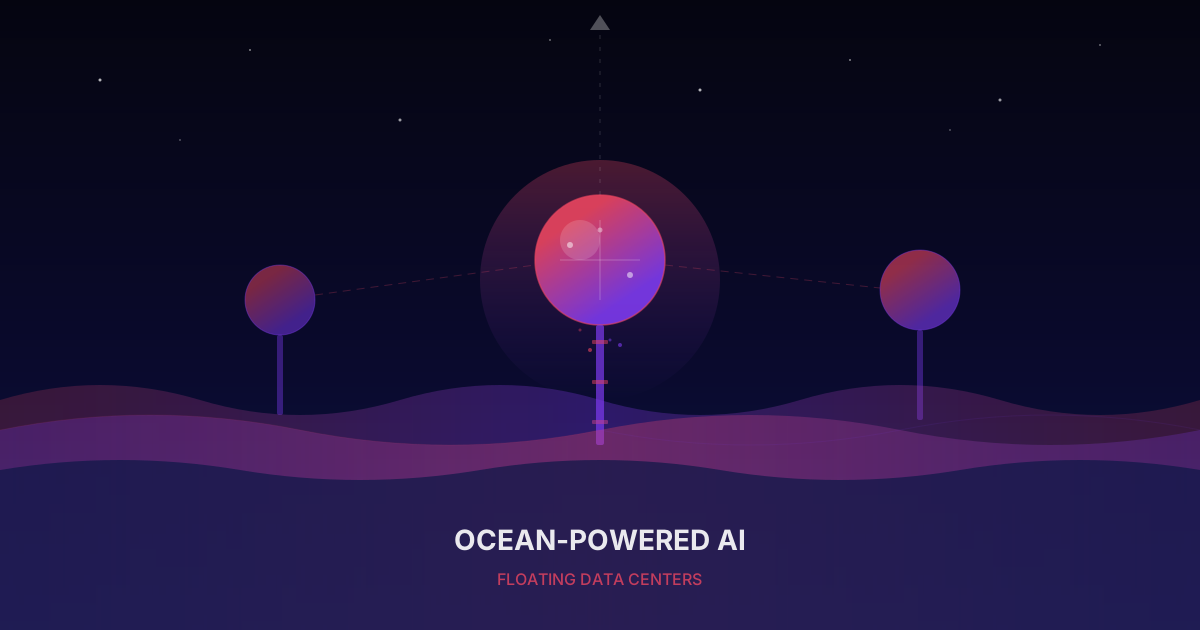
Picture thousands of giant steel orbs bobbing in the Pacific Ocean, each one quietly running AI models while powered entirely by the waves beneath them. No power grid. No cooling towers. No angry neighbors fighting a new data center build.
Peter Thiel just bet $140 million that this isn’t science fiction.
Portland-based startup Panthalassa announced its Series B this week to build what might be the most audacious answer yet to AI’s insatiable hunger for electricity: autonomous, wave-powered computing nodes that operate in the open ocean. And in a world where companies are exploring space-based solar and nuclear micro-reactors to keep the lights on, floating data centers might actually be the conservative option.
AI’s Power Problem Is Getting Desperate
The context matters. AI’s electricity appetite has gone from concerning to genuinely alarming. Training and running large models requires staggering amounts of power, and demand is growing far faster than grid infrastructure can handle. Communities are pushing back hard against new data center builds. Permitting delays stretch into years. Grid constraints aren’t just inconvenient — they’re becoming an existential threat to AI scaling.
In China, demand for Nvidia’s B300 servers has nearly doubled prices to around $1 million each. And that’s just the hardware — actually powering the things is a separate nightmare.
This is why Panthalassa’s pitch resonates: what if you could generate power and run AI models in the same place, completely off-grid, using an energy source that never stops?
How It Actually Works
Each Panthalassa “node” looks like a massive lollipop — a buoyant spherical head connected to a long, submerged vertical tube. The Ocean-3 prototype stretches about 85 meters, roughly the height of Big Ben. As waves pass, the node bobs up and down while surrounding water moves in small orbital paths. That relative motion drives seawater through internal turbines, generating electricity continuously.
The generated power runs onboard AI inference chips directly. Surrounding seawater provides natural cooling. Results beam back to shore via satellite. No transmission lines, no grid connection, no cooling bills.
“There are three sources of energy on the planet with tens of terawatts of new capacity potential: solar, nuclear, and the open ocean,” said CEO Garth Sheldon-Coulson. Bold framing, but the math checks out — ocean wave energy is genuinely enormous and barely tapped.
The $140 Million Bet
Panthalassa has been iterating since 2021, with a three-week sea trial off Washington state in February 2024. The fresh funding completes a pilot manufacturing facility near Portland and accelerates Ocean-3 deployment in the northern Pacific later this year.
Each node is designed to be autonomous and self-propelled, maintaining optimal positioning independently or as part of a distributed offshore mesh. Commercial deployments target 2027.
The company cleverly frames its core innovation as transforming “an energy transmission problem into a data transmission problem.” Generate power where you are, send data instead of electricity. It’s an elegant reframe.
The Very Real Problems
Let’s pump the brakes, because the challenges are genuine.
Bandwidth and latency. Satellite links mean limited throughput — perhaps hundreds of megabits per second per terminal, according to University of Pennsylvania computer architect Benjamin Lee. That’s workable for inference responses, but coordinating larger workloads across nodes gets tricky.
Durability. These nodes need to survive hurricanes, salt spray, constant motion, and biofouling for over a decade without human maintenance. Job listings specifically mention designing for “the harshest ocean conditions.” Traditional data center construction looks like assembling IKEA furniture by comparison.
Maintenance logistics. When something breaks 500 miles offshore in the Pacific, you can’t just send a technician. That’s a fundamentally different cost equation.
Inference only. Panthalassa targets AI inference, not training. You’re not training GPT-6 on a bobbing sphere. But inference is where the scaling demand is exploding anyway, so this limitation is less crippling than it sounds.
Microsoft Already Proved the Ocean Works (Sort Of)
This isn’t the first time someone put servers in the ocean. Microsoft’s Project Natick submerged a sealed data center off Scotland from 2018 to 2020. The results were encouraging: underwater servers had a failure rate one-eighth that of land-based counterparts, because the sealed environment eliminated humidity, corrosion, and human error.
But Natick was a sealed container parked on the ocean floor. Panthalassa is building autonomous, self-powered, wave-riding platforms. It’s the difference between parking your car in shade and building a car that runs on wind while driving itself.
Still, Natick proved ocean environments can actually improve server reliability. That’s a data point worth remembering.
What This Signals About AI Infrastructure
Panthalassa sits at the intersection of two mega-trends: AI’s exponential power demands and the growing impossibility of building traditional infrastructure fast enough.
Last month, Meta signed a deal to beam solar energy from space. Startups are exploring off-planet computing. Nuclear micro-reactors are being proposed for individual campuses. When floating computers are arguably the most conservative approach on the table, you know the power situation has gone sideways.
For coastal regions and island nations with limited grid capacity, ocean-based inference nodes could provide AI computing access that would otherwise require massive infrastructure investment. For the industry broadly, it’s a potential pathway to scaling without fighting over grid connections and building permits.
The Bottom Line
This is a moonshot. The engineering challenges are enormous, satellite bandwidth constraints are real, and operating autonomous hardware in the open ocean for years without maintenance is unproven at scale.
But the conventional solutions — more power plants, more transmission lines, more permits — are hitting hard limits of time, politics, and physics. In that context, harvesting the ocean’s essentially unlimited wave energy to run AI models on-site starts looking less like a fever dream and more like a legitimate piece of the puzzle.
If Ocean-3 performs well in its Pacific trials this year, expect a flood of imitators. If it doesn’t, $140 million goes to Davy Jones’ locker.
Either way, the fact that serious investors are backing this tells you something important: the gap between AI’s ambitions and the world’s ability to power them is so vast that the ocean floor isn’t the bottom of the barrel anymore. It’s the new frontier.