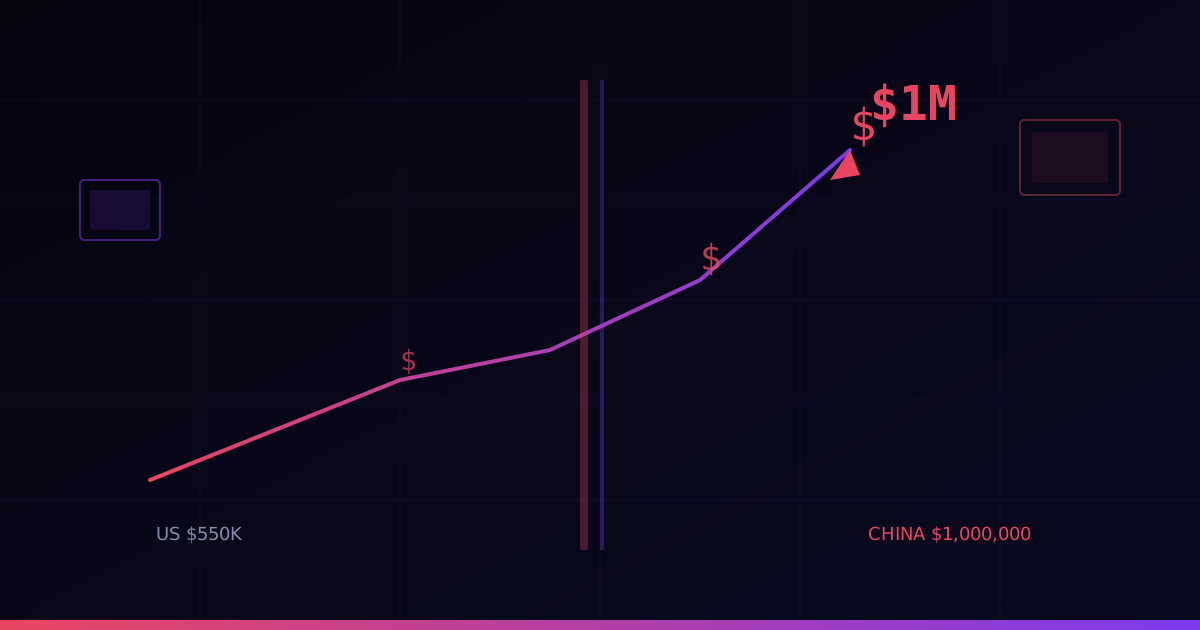
A single Nvidia B300 server now costs roughly $1 million on China’s grey market. That’s nearly double the US retail price and almost double what it sold for in China just months ago.
The cause is a collision of forces: exploding AI demand, a US crackdown on chip smuggling that’s strangling supply, and the growing desperation of Chinese tech companies racing to stay competitive. This isn’t a pricing anomaly. It’s the US-China tech cold war rewriting the economics of artificial intelligence in real time.
How a $550K Server Becomes a $1M Server
According to a Reuters exclusive, Nvidia’s B300 servers are now priced at approximately 7 million yuan ($1 million) in China — up from around 4 million yuan late last year. In the US, the same hardware retails for about $550,000.
That 82% markup isn’t a luxury tax. It’s a scarcity premium.
Each B300 server packs eight GPUs with 288 GB of high-bandwidth memory, delivering 14 petaFLOPS at FP4 precision. It’s the gold standard for AI inference — the computational engine behind every ChatGPT response, every AI-generated image, every agentic coding assistant.
The catch: these chips are officially banned from sale in China. Nvidia has publicly warned that “unlawful diversion is a recipe for failure” and that “enforcement mechanisms are rigorous and effective.”
Yet the hardware keeps finding its way in. Until recently, anyway.
The Arrest That Broke the Pipeline
The price spike accelerated after US authorities prosecuted Yih-Shyan “Wally” Liaw, a co-founder of Nvidia server partner Supermicro, in March 2026. The charge: chip smuggling — funneling restricted hardware into China through intermediary channels.
This wasn’t some shadowy back-alley operation. Supermicro is one of Nvidia’s most important server assembly partners. The message from US authorities was clear: nobody is too big to prosecute.
The grey market went dark almost overnight. Brokers got skittish. Supply channels that had operated semi-openly shuttered. Many Chinese companies now avoid holding Nvidia hardware on their books entirely, fearing sanctions exposure. Some have pivoted to rentals — which have surged to 190,000 yuan ($28,000) per month on one-year contracts.
Demand Isn’t Flinching
Here’s the part that makes this truly remarkable: even as prices double, demand is accelerating.
Chinese AI models nearly tripled their share of global token usage to 32% in March 2026, up from just 5% a year earlier, per Morgan Stanley. At the company level, MiniMax, Zhipu, and Alibaba’s Qwen each reported token usage rising six to seven-fold between December 2025 and March 2026.
DeepSeek’s V4 launch in late April — optimized for Huawei’s domestic Ascend chips — only poured gasoline on the fire. Every token requires compute. Every compute cycle requires chips. And the best chips remain Nvidia’s.
Huawei’s $12 Billion Opening
The Nvidia squeeze is creating a massive opportunity for Huawei. The company now expects AI chip revenue to climb 60% to roughly $12 billion in 2026 as Chinese tech giants flood it with orders for Ascend 950 processors.
DeepSeek V4 was specifically designed to run on Huawei’s Ascend hardware, triggering a scramble among major Chinese firms to secure supply. DeepSeek has even indicated V4-Pro pricing could drop significantly in H2 2026 once Huawei’s Ascend 950 supernodes “ship at scale.”
This is the decoupling scenario US policymakers both wanted and feared. Export controls are successfully making Nvidia hardware harder and more expensive to get. But they’re simultaneously accelerating China’s push toward chip independence — potentially creating a fully self-sufficient competitor ecosystem that won’t need Nvidia at all.
Nvidia still holds 55% market share in China, with AMD trailing at 4%. But Chinese chipmakers have claimed nearly half the local market, according to IDC data from April 2026. The trend line is unmistakable.
The H200 Limbo Making Everything Worse
Adding another layer of chaos: Nvidia’s H200 chips — less powerful but still highly capable — remain in regulatory limbo. Despite approvals from both governments, the H200 hasn’t shipped to China because the two sides can’t agree on sale conditions.
This standoff concentrates demand even more heavily on smuggled B300 units, further inflating prices. For Chinese companies making infrastructure decisions today, this uncertainty is arguably worse than an outright ban — at least a ban provides clarity.
What the Million-Dollar Server Tells Us
This story illuminates four uncomfortable truths about where AI is headed:
Compute remains the bottleneck. Despite model efficiency breakthroughs, raw compute demand continues to outstrip supply — especially for inference at scale. There simply aren’t enough GPUs to go around.
Export controls are working — sort of. They’re imposing real costs. A million-dollar server that costs half that in the US is a genuine competitive disadvantage. But they’re also leaky, incentivize smuggling, and accelerate the domestic chip development they were designed to prevent.
The hardware market is bifurcating. Two parallel ecosystems are emerging: a Western one centered on Nvidia, and a Chinese one increasingly built around Huawei. This split will shape AI development, deployment standards, and geopolitical power dynamics for decades.
The grey market is a vulnerability for everyone. For the US, smuggled chips undermine export controls. For Chinese companies, supply chains that can evaporate overnight with a single prosecution aren’t a foundation for an AI industry. Neither side benefits.
The Bottom Line
We’re watching the most expensive game of cat-and-mouse in technology history. The US restricts. China acquires anyway while building alternatives. And caught in the middle are tiny pieces of silicon now worth their weight in gold, flowing through shadow supply chains spanning continents.
The million-dollar Nvidia server is a symbol of this moment — a world where AI compute hunger is so intense that companies will pay almost any price, and where the battle over who gets to build the future is being fought not just in boardrooms, but in the murky underworld of international chip smuggling.
The question nobody can answer yet: will export controls ultimately slow China’s AI progress, or will they simply have built Nvidia’s most formidable competitor?