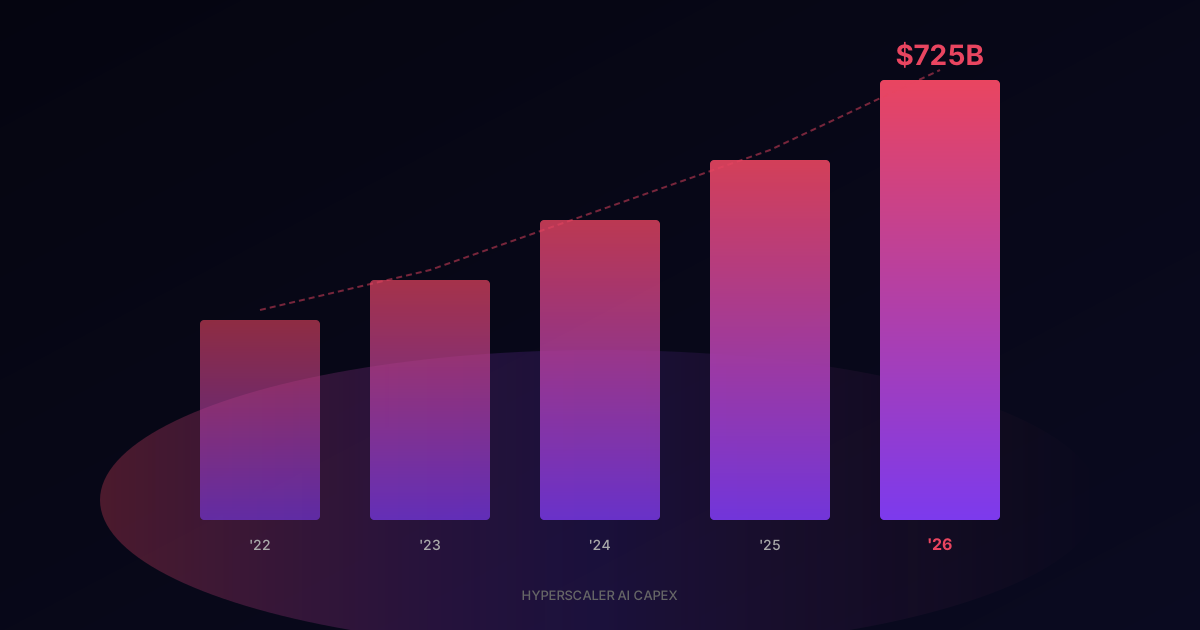
Three-quarters of a trillion dollars. That’s how much Microsoft, Alphabet, Meta, and Amazon plan to spend on capital expenditure in 2026 — and nearly all of it is aimed at AI infrastructure.
Wednesday night’s earnings dump wasn’t just big. It was historically unprecedented. Every single hyperscaler either raised or reaffirmed their guidance upward, blowing past Wall Street’s already-aggressive $670 billion estimate. If anyone still questioned whether Big Tech was serious about the AI arms race, $725 billion in concrete, silicon, and fiber optic cable answers that definitively.
The Scorecard
Amazon: ~$200 billion in planned capex. AWS posted $37.59 billion in Q1 revenue — a 28% year-over-year jump and its fastest growth in 15 quarters. AWS AI revenue now exceeds $15 billion annually.
Microsoft: $190 billion for the full year, including $25 billion in higher component costs. Q1 revenue hit $77.7 billion (up 18%), with AI revenue surging 123% year over year.
Alphabet: $180–$190 billion, raised $5 billion from last quarter. And the kicker — CFO Anat Ashkenazi said 2027 capex will “significantly increase” from 2026. Google Cloud revenue exploded 63% to $20.02 billion, crushing estimates by $2 billion.
Meta: $125–$145 billion, bumped $10 billion at both ends. Stock dropped 6% — the market’s lone expression of spending anxiety.
Why 77% More Than Last Year
These four companies spent $410 billion in 2025. That was already a record. The 2026 figure — roughly the GDP of Switzerland — represents a 77% increase.
Three forces are converging.
Demand is outstripping supply. Google’s Sundar Pichai said it plainly: “We are compute constrained. Our cloud revenue would have been higher if we were able to meet the demand.” That’s the most bullish statement a CEO can make — we literally cannot build fast enough.
Components are getting expensive. Both Microsoft and Meta flagged surging memory chip and hardware costs. The supply chain for AI-grade components — HBM, advanced GPUs — is brutally tight.
Geopolitics is adding friction. All four reported for the first time since U.S. operations began in Iran in late February. Surging oil prices and supply chain disruptions are making everything from energy to construction more expensive.
Google Cloud: The Breakout Story
The standout number from Wednesday was Google Cloud’s 63% revenue growth. At $20 billion per quarter with a $460 billion backlog — that’s four and a half years of revenue in the pipeline — this business has reached escape velocity.
Pichai framed the shift explicitly: enterprise AI solutions became Cloud’s primary growth driver for the first time in Q1. Cloud computing used to be about storage and basic compute. Now AI workloads — training, inference, agent orchestration — are the main event.
Gemini Enterprise’s paid monthly active users grew 40% quarter over quarter. The flywheel is spinning hard. Alphabet stock jumped 7% post-earnings, making it the best-performing Magnificent Seven stock for April — up 21% and helping drive the Nasdaq’s best month since April 2020.
The Debt Nobody’s Discussing
Here’s what deserves more scrutiny: these companies are increasingly borrowing to fund the buildout. When companies generating $100 billion in annual free cash flow need to tap debt markets, that tells you something about the bet’s scale.
The math works as long as AI revenue keeps compounding. Google Cloud’s trajectory suggests it will. But if demand plateaus — or if someone pulls another DeepSeek-style efficiency breakthrough — companies holding $725 billion in data center infrastructure face an uncomfortable reckoning.
Meanwhile, Meta and Microsoft are cutting staff. The money for AI has to come from somewhere, and the human cost of the pivot is increasingly visible.
The Ripple Effects
Nvidia stays king. Most of this spending flows directly to Nvidia and TSMC. These capex figures confirm the demand trajectory isn’t slowing.
Startup consolidation accelerates. Google and Amazon plan to invest up to $65 billion combined in Anthropic. SpaceX disclosed an option to acquire Cursor for $60 billion. The startup market is simultaneously booming and compressing.
Energy becomes the real bottleneck. $725 billion in data centers requires staggering electricity. Nuclear, natural gas, and renewables are all being courted by power-desperate hyperscalers — with real implications for energy policy and local communities.
Regulation lags further behind. EU countries failed to reach a deal on AI rules after 12 hours of negotiations Tuesday. The gap between America’s “spend now, regulate maybe” approach and Europe’s guardrail attempts keeps widening.
Is This Rational?
Short-term: the fundamentals look strong. Cloud revenue is accelerating. Enterprise adoption is real. Google Cloud’s 63% growth and AWS’s $15 billion AI run rate aren’t projections — they’re reported numbers.
Medium-term: four companies controlling the vast majority of AI infrastructure raises legitimate questions about market power and barriers to entry. When the entry fee is measured in hundreds of billions, the moat isn’t just wide — it’s oceanic.
Long-term: $725 billion per year assumes AI demand grows essentially forever. The telecom bubble saw companies lay fiber optic cable that took a decade to fill. But here’s what’s different (famous last words): the revenue is actually there. The question isn’t whether AI generates real value. It clearly does. The question is whether competitive pressure is pushing spending past rational levels.
The Bottom Line
Wednesday night was the single biggest collective capital commitment in the history of technology — and possibly in the history of corporate investment. Four companies, $725 billion, one bet: that AI reshapes every industry, every workflow, everything.
The early returns suggest they’re right. But the scale of the wager is so enormous that even being slightly wrong could send shockwaves through the global economy for years.
Either we’re watching the most justified infrastructure buildout since the internet, or the most spectacular capex bubble in history inflating in real time. The terrifying part? Both could be true simultaneously.