There’s a moment in every tech revolution when the money stops making sense to normal people. For AI, that moment arrived this week.
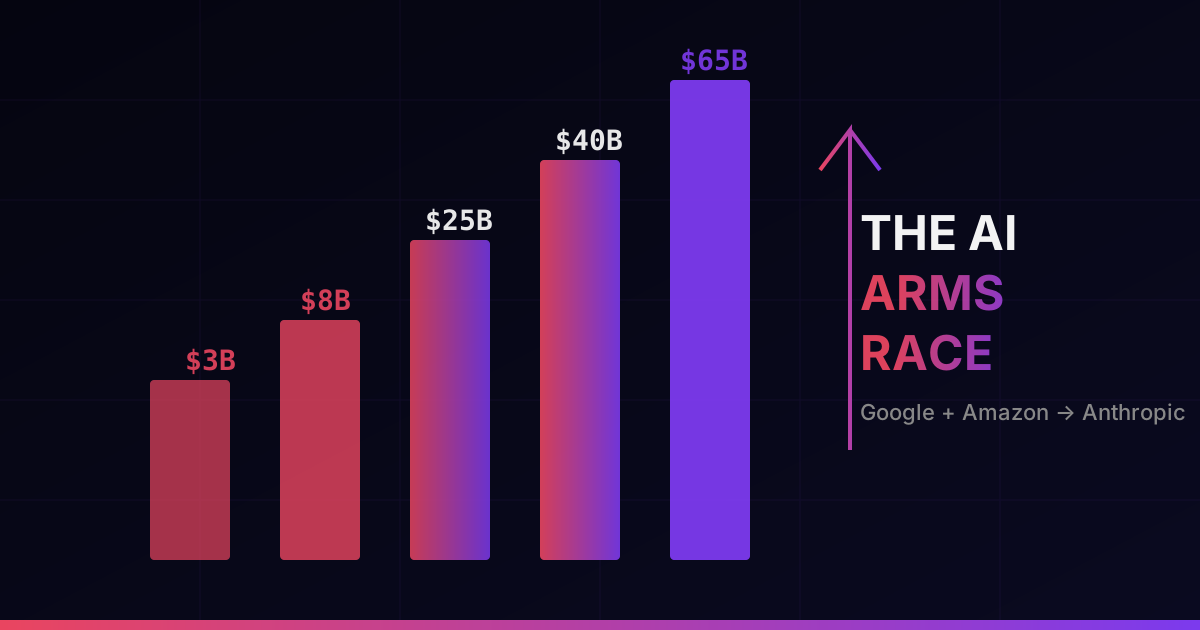
Google just committed up to $40 billion in Anthropic — the company behind Claude. This landed four days after Amazon announced its own $25 billion deal with the same company. Combined: $65 billion in potential investment from two competing tech giants, into a single startup, in one week.
The AI arms race isn’t heating up. It’s on fire.
The Structure: $10 Billion Now, $30 Billion If You Deliver
Google’s deal starts with $10 billion at Anthropic’s current ~$350-380 billion valuation. The remaining $30 billion hinges on undisclosed “performance milestones.” The partnership also includes 5 gigawatts of computing capacity through Google and Broadcom, expected online next year.
Amazon’s playbook mirrors this: $5 billion upfront, up to $20 billion more tied to commercial targets. In exchange, Anthropic committed to spending over $100 billion on AWS over the next decade. That’s not a partnership — it’s economic symbiosis.
Before these deals, Google held ~14% of Anthropic. Amazon owned 16-20%. Between them, they could soon control more than a third of what may be the most valuable private company on Earth.
Why Both Giants Want the Same Startup
The obvious question: why pour billions into a company that competes with your own AI models?
Three forces converged. First, Anthropic can’t build fast enough. Enterprise demand for Claude is outpacing infrastructure — even OpenAI has publicly needled Anthropic about compute shortfalls. Second, Claude Code and Claude Cowork are driving enterprise adoption faster than anyone projected. Third, the trust factor. OpenAI’s controversies have pushed cautious enterprise buyers toward Claude as the “responsible AI” option.
But the real logic is simpler than strategy decks make it sound.
The Gas Station Theory
Google makes Gemini. Gemini competes with Claude. Google is investing $40 billion in Claude’s parent company. This seems insane until you understand the infrastructure math.
If you owned the only gas stations in town, you’d invest in the most popular car manufacturer — even if you also made cars. The fuel revenue dwarfs everything else.
Google Cloud profits every time someone runs Claude through their platform. AWS profits from every Anthropic API call. The model competition is almost secondary to the infrastructure revenue stream. Both companies are hedging: if their in-house models don’t win the frontier race, they still profit from whoever does.
It’s diversification dressed up as partnership.
Regulators Are Watching
The FTC’s 2025 study on AI partnerships warned that cloud-provider investments risk “locking in the market dominance of large incumbent technology firms.” Senators Warren and Wyden have probed both the Google-Anthropic and Microsoft-OpenAI relationships. The DOJ and FTC launched a joint inquiry on competitor collaborations earlier this year.
Google’s 15% ownership cap and lack of board seats were clearly structured with antitrust in mind. But as one analysis noted, “$43 billion in total investment and a multi-gigawatt compute dependency create economic entanglement that no ownership percentage can fully capture.”
The AI startups need infrastructure only Big Tech provides. Big Tech needs the models startups are building. The result is a web of dependencies that doesn’t look like acquisition but creates the same competitive dynamics.
What $65 Billion Buys You
A compute monopoly. Between Google’s TPUs, Amazon’s Trainium chips, and 5+ gigawatts being built, Anthropic is now the best-resourced AI lab on the planet. OpenAI has Microsoft. Anthropic has both of the other major cloud providers. That advantage is staggering.
A valuation ceiling that keeps moving. At $380 billion, Anthropic is already one of the most valuable private companies ever. If milestone-based investments hit at future valuations, we’re looking at $500 billion+ before any IPO. That would top 90% of the S&P 500.
A moat made of money. For smaller AI companies, these numbers are extinction-level. When your competitor has $65 billion in fresh capital from two of the world’s largest companies, your Series A might as well be a lemonade stand budget.
A two-horse enterprise race. Despite open-source models from Meta, DeepSeek, and others, enterprise AI is consolidating around OpenAI and Anthropic. Both backed by cloud giants, both with comprehensive product suites, both maintaining frontier-level models. Everyone else is fighting for scraps.
Bubble or Cold War?
In the past week: Google commits $40 billion to Anthropic. Amazon commits $25 billion. SpaceX eyes a $60 billion Cursor acquisition. DeepSeek launches V4 variants. The numbers defy casual comprehension.
The bulls say AI is a genuine platform shift — like the internet, like mobile — and early investors will profit for decades. The bears note that Anthropic’s revenue, while growing fast, is a fraction of the capital being poured in.
Here’s the more honest framing: Google isn’t investing $40 billion because a spreadsheet justified it. They’re investing because they can’t afford to let Amazon own the Anthropic relationship alone.
That’s not a bubble. It’s a Cold War — where falling behind costs more than overspending, and rational actors make seemingly irrational bets.
Three Things to Watch
Regulators. The FTC and DOJ have tools to challenge these investments, and political pressure is building.
Milestones. If we learn what triggers the additional $30 billion from Google and $20 billion from Amazon, we’ll know where frontier AI is actually heading.
Microsoft’s counter-move. They can’t watch Google and Amazon corner the Anthropic market without responding.
We’ve entered the phase of the AI race where checks have more zeros than most people can count, and the companies writing them are betting the future of technology runs through a startup founded by ex-OpenAI researchers in 2021.
$65 billion is a hell of a way to find out if they’re right.