Two deals. Two days. Two of the biggest names in AI writing checks to the same company.
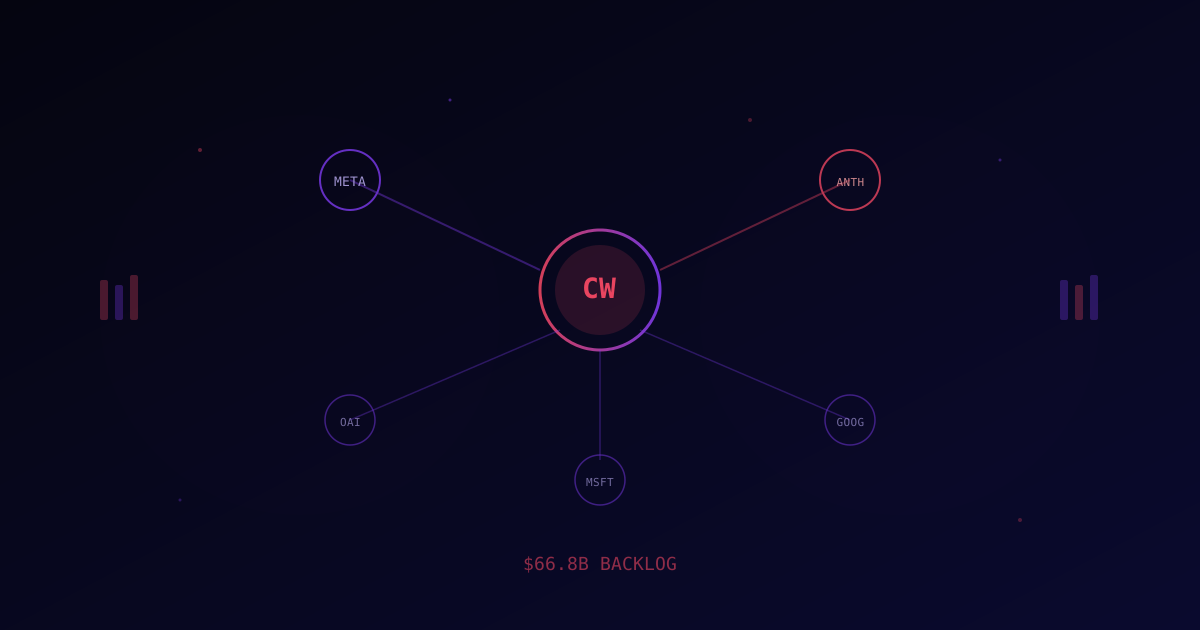
On Thursday, Meta committed an additional $21 billion to CoreWeave for AI cloud capacity through 2032. On Friday, Anthropic — the company behind Claude — signed a multiyear agreement to run its workloads on CoreWeave’s infrastructure. CoreWeave’s stock ripped past $103, and its total revenue backlog now exceeds $66.8 billion.
For a company that started out mining Ethereum, that’s not a bad week.
From Crypto Rigs to AI Kingmaker
CoreWeave’s pivot story is almost absurdly perfect. Founded in 2017 as a crypto mining operation, the company was sitting on racks of NVIDIA GPUs when the crypto winter hit. The founders looked at their hardware and realized the same chips that mined Ethereum were exactly what AI companies were desperate for.
So they pivoted. Today, CoreWeave operates data centers packed with hundreds of thousands of NVIDIA GPUs, offering specialized cloud computing built specifically for AI workloads. Unlike AWS, Azure, or Google Cloud — which try to be everything to everyone — CoreWeave went all-in on GPU-intensive computing.
That bet is paying off spectacularly. After its March 2025 IPO, shares have climbed from roughly $47 to over $103, a return of more than 120% for day-one investors.
Nine Out of Ten
Here’s the stat that should make you pay attention: nine of the top ten AI model providers now use CoreWeave’s platform. Microsoft, OpenAI, Google, Meta, Anthropic — the entire frontier AI ecosystem is renting compute from this one company. The lone holdout? Elon Musk’s xAI.
The Anthropic deal is particularly significant. Claude’s revenue run rate recently topped $30 billion, tripling in roughly four months. That kind of growth requires enormous compute, and Anthropic isn’t shy about buying it. The company is also tapping into 3.5 gigawatts of Google’s custom TPUs starting in 2027 and reportedly exploring designing its own AI processors.
The takeaway: AI compute hunger is so massive that even diversifying across multiple providers isn’t enough. Everyone needs more.
The $66.8 Billion Question
CoreWeave’s backlog is staggering. Revenue guidance for 2026 sits between $12 billion and $13 billion — a 150% jump over 2025’s $5.13 billion. Growth numbers that would make any enterprise software company weep with envy.
But here’s where things get interesting. CoreWeave held $21 billion in debt at the end of 2025. In March 2026, it added $8.5 billion more. This week, another $3 billion — including $1.75 billion in high-yield (read: junk) bonds.
One analysis pegs CoreWeave’s capital intensity at $2.60 spent for every $1 of revenue generated in 2026. The company is borrowing billions to buy GPUs, betting that AI demand will keep climbing fast enough to justify the debt load.
If demand holds — and every signal says it will for the foreseeable future — this looks like genius-level positioning. If demand plateaus or shifts toward custom silicon that big tech builds in-house, that debt becomes a very different conversation.
Why This Matters to You
Every time you use ChatGPT, ask Claude a question, or see an AI-generated image on Instagram, that request runs on hardware in a data center somewhere. CoreWeave’s deals determine who can build and scale those AI services — and how fast.
More compute availability means more capable AI systems. Without infrastructure providers like CoreWeave expanding capacity, AI services hit bottlenecks, slow down, or get more expensive. The infrastructure layer is the foundation everything else is built on.
There’s an economic ripple effect too. A $66.8 billion backlog means real construction, manufacturing, energy, and engineering jobs spread across the country.
The Bull Case vs. The Bear Case
Bulls say: Insatiable demand, locked-in contracts, specialized expertise, and a customer list that reads like a who’s-who of AI. CoreWeave is positioned as the essential infrastructure layer for the most important technology trend in a generation.
Bears say: Enormous debt, cash-burning capital intensity, customer concentration risk, and the possibility that the AI infrastructure buildout is getting ahead of actual demand. History is full of infrastructure companies that overbuilt for demand that never fully materialized.
CoreWeave CEO Mike Intrator isn’t losing sleep over it. “We are focusing our energy on taking advantage of this generational opportunity to massively grow and expand our business,” he told CNBC Friday. “Scaling is expensive.”
He’s right about that. The question is whether this generational opportunity is a decade-long megatrend or a cycle that peaks sooner than expected.
The Bottom Line
CoreWeave’s 48-hour deal blitz didn’t just move its stock price — it confirmed something the AI industry has known for months. The infrastructure layer is where the real power is consolidating. Models come and go, apps rise and fall, but someone has to own the GPUs. Right now, CoreWeave owns a lot of them, and the biggest names in AI keep coming back for more.
The AI infrastructure race isn’t slowing down. This week proved it’s accelerating.