Remember when ChatGPT just answered your questions without trying to sell you anything? Those days are officially over — and OpenAI is counting on it to the tune of $100 billion.
OpenAI has told investors it expects $2.5 billion in advertising revenue this year, scaling to $100 billion by 2030. That’s building an ad business in four years that took Google and Meta decades to create.
This isn’t some side experiment. This is the company that kicked off the AI revolution fundamentally reshaping how the internet makes money.
The Growth Curve Is Absurd
Here’s what OpenAI is pitching investors:
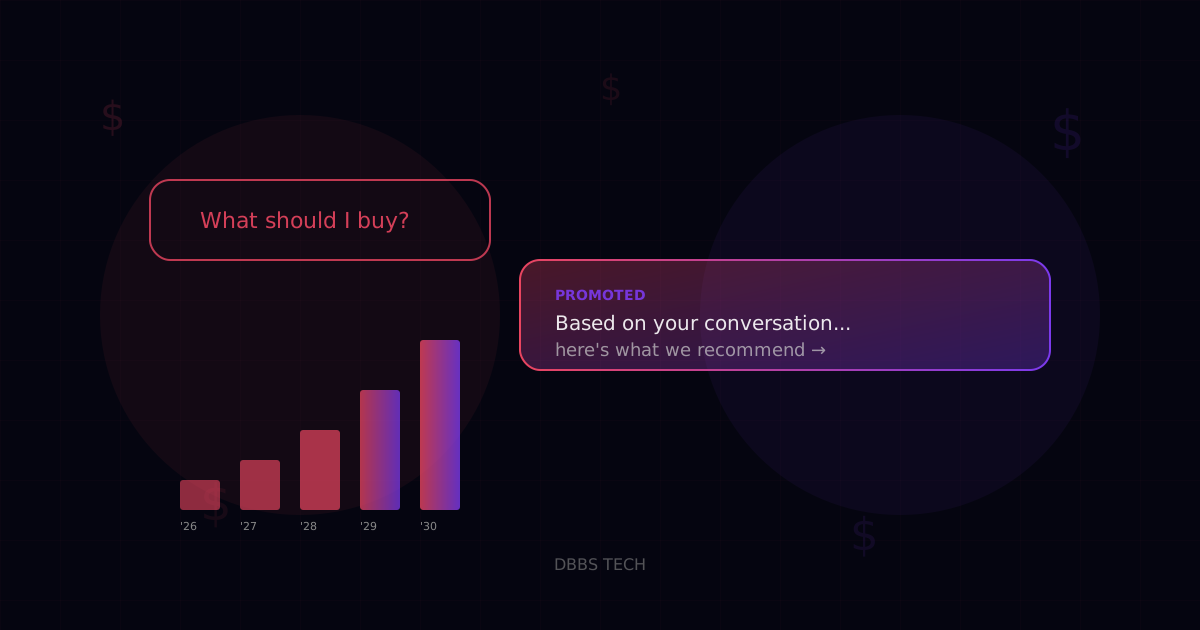
- 2026: $2.5 billion
- 2027: $11 billion
- 2028: $25 billion
- 2029: $53 billion
- 2030: $100 billion
A 40x increase in four years. Google’s entire ad machine generated $295 billion in 2025. Meta pulled $196 billion. OpenAI isn’t nibbling at the edges — it’s going for a massive chunk of the pie.
The assumption behind these numbers? OpenAI products reaching 2.75 billion weekly users by 2030. Roughly a third of humanity. Ambitious, but ChatGPT has been one of the fastest-growing consumer products ever built.
Six Weeks, $100 Million
The early results are what make this more than a pitch deck fantasy.
OpenAI launched its ad pilot on February 9, showing “promoted responses” to free-tier and ChatGPT Go users. Within six weeks: $100 million in annualized revenue. Over 600 advertisers signed up.
The ads aren’t banner garbage. They’re native content woven into the conversational flow, built with adtech firm Smartly to feel like natural dialogue rather than interruptions.
The targeting is the real weapon. ChatGPT ads combine something no previous platform offered: intent signals from what you just asked plus behavioral context from your chat history and saved memories. You’re not seeing ads based on a search query from five minutes ago — you’re seeing ads based on an ongoing, deeply contextual conversation about your actual needs.
That’s a targeting precision Google can only dream about.
Anthropic Goes the Other Way
Not everyone’s buying the ad gospel.
During Super Bowl 2026, Anthropic ran its first national campaign — explicitly positioning Claude as the AI that doesn’t serve ads. A 60-second pregame spot and a 30-second in-game ad, both pointed jabs at OpenAI.
It worked. Claude’s paid subscriptions more than doubled in the weeks after. Anthropic has committed to keeping Claude ad-free, framing it as a trust issue rather than a business decision.
The AI market is splitting in two. OpenAI takes the Google/Meta playbook: massive free base, monetized through ads. Anthropic goes premium subscription: fewer users, higher trust, direct revenue. Both viable — but they create very different products with very different incentive structures.
The Incentive Problem Nobody Wants to Talk About
Here’s where it gets uncomfortable.
When your AI assistant makes money from ads, its incentives shift. The best ad platform keeps you engaged longer, asks more questions, learns more about your preferences. That’s not necessarily the same thing as giving you the fastest, most accurate answer and sending you on your way.
OpenAI claims “no impact on consumer trust metrics” and reports low ad dismissal rates. Paid users (Plus, Pro, Team, Enterprise) won’t see ads. Users under 18 are excluded. Conversations aren’t shared with advertisers directly.
But as the Globe and Mail put it: “Behold as the internet is ruined all over again.”
The early internet was ad-free too. Then came banner ads, targeted ads, and the entire attention economy that reshaped how humans consume information. AI chatbots are following the exact same trajectory — except now the ads are embedded in something that feels like a trusted conversation, not a web page.
The Woman Behind the Machine
OpenAI’s CEO of applications, Fidji Simo, previously pioneered creative ad formats at Instacart — sponsored products, last-minute checkout suggestions, the whole playbook. She knows how to monetize a platform.
Whether that expertise is what’s best for an AI assistant that millions rely on for information, advice, and decision-making is a question OpenAI would rather you not dwell on.
The Bigger Advertising Arms Race
This isn’t happening in isolation. Google’s Gemini models already enhance ad targeting, reportedly delivering 80% revenue boosts for some brands. The search ad industry is being reshaped by AI, and OpenAI wants in before the market locks up.
Self-serve advertiser tools launching this month will be the real accelerant. Once any business can buy ChatGPT ads as easily as Google Ads, the revenue scaling becomes almost automatic.
This also puts OpenAI’s recent policy paper — recommending four-day workweeks, robot taxes, and public wealth funds — in an interesting light. Easy to be generous with policy recommendations when you’re projecting $100 billion in ad revenue. The company is simultaneously trying to capture a massive share of digital advertising and position itself as a responsible AI steward. Whether those goals are compatible is anyone’s guess.
What This Means for You
The next few quarters tell the story. If the $2.5 billion target holds, every AI company will rush to monetize through advertising. The winner won’t just be rich — they’ll shape how billions of people interact with information, make purchases, and understand the world.
The question is simple: Are you comfortable with your AI assistant being paid to influence what you see?
Because that’s the world we’re building, one promoted response at a time.