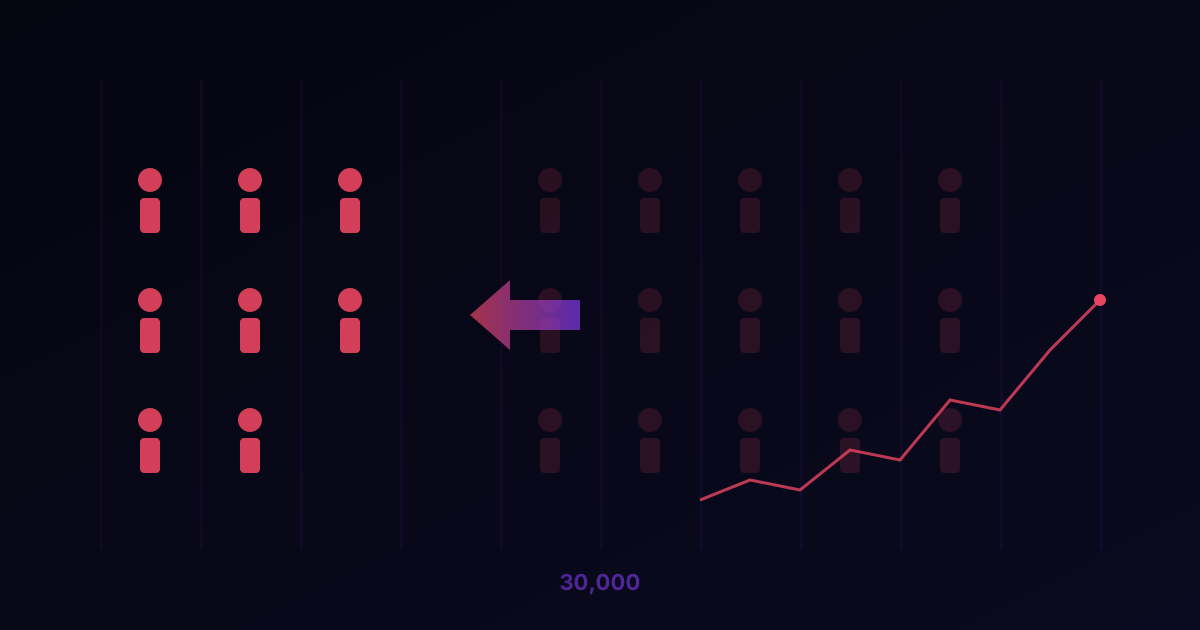
Thirty thousand people woke up Tuesday morning to a termination email from “Oracle Leadership.” No warning from managers. No heads-up from HR. Just a 6 a.m. message saying their role had been eliminated, effective immediately. System access? Already revoked.
Oracle’s stock rose over 5% on the news.
The Largest Layoff in Oracle’s 48-Year History
On March 31, 2026, Oracle executed what analysts believe is the single largest workforce reduction in the company’s history. Employees across the United States, India, Canada, Mexico, and Uruguay received identical termination emails citing “careful consideration of current business needs.” Entire teams at divisions like Revenue and Health Sciences and SaaS Virtual Operations Services saw reductions of 30% or more.
Investment bank TD Cowen estimates the cuts hit between 20,000 and 30,000 employees — roughly 18% of Oracle’s 162,000-person global workforce.
Oracle declined to comment.
The $156 Billion AI Bet Behind the Bloodbath
The math is brutally straightforward. Oracle has committed to an AI infrastructure buildout requiring an estimated $156 billion in total capital spending. For fiscal year 2026 alone, capex guidance jumped from $35 billion to $50 billion — staggering for a company that generated just $20.8 billion in operating cash flow in 2025.
Even with dramatic cash flow improvements, Oracle faces roughly $30 billion in negative free cash flow this year. The company raised $45–50 billion in debt and equity financing, and multiple U.S. banks have reportedly stepped back from financing certain Oracle data center projects entirely.
So where does the money come from? The people who used to work there.
TD Cowen estimates cutting 20,000–30,000 employees frees up $8–10 billion in annual cash flow. Oracle disclosed a $2.1 billion restructuring plan in its March 2026 SEC filing, with nearly $1 billion already spent.
Here’s the kicker: Oracle isn’t struggling. The company posted a 95% jump in net income last quarter, hitting $6.13 billion. Its remaining performance obligations stand at $523 billion, up 433% year over year, largely thanks to a $300+ billion deal with OpenAI.
This isn’t a company in distress. It’s a company making a leveraged bet on AI infrastructure and cutting humans to fund it.
The 2026 Layoff Cascade
Oracle is the latest and largest domino in a pattern that’s been accelerating all year. The 2026 tech layoff tracker already counted over 59,000 job cuts before this announcement:
- Block cut roughly 40% of its workforce, with Jack Dorsey explicitly stating AI made those roles unnecessary
- Meta is planning layoffs affecting 20%+ of the company to offset AI costs
- Amazon eliminated 16,000 corporate roles while projecting $200 billion in AI capex
- Dell, Atlassian, C3.ai, and Workday have all made significant cuts
Two flavors of AI-driven layoffs are happening simultaneously. Software companies are replacing workers with AI tools. Infrastructure companies are firing workers to fund AI buildouts. Oracle is firmly in the second camp — though some targeted roles are ones the company expects AI to eventually make redundant anyway.
Either way, the workers are gone.
Wall Street’s Perverse Incentive
The market’s reaction is the most unsettling part. Oracle popped 5% on a day when the Nasdaq was already up. But Oracle outpaced the broader market by a wide margin.
Block surged after its AI-driven layoffs. Meta climbed 3% on news of planned cuts. The pattern is unmistakable: investors reward companies for converting human capital into AI infrastructure capital.
The fastest way to boost your stock price in 2026 isn’t launching a great product — it’s announcing you’re replacing people with machines, or at least firing people to build more machines.
What If the Bet Doesn’t Pay Off?
Oracle’s AI infrastructure play depends on sustained demand for cloud AI workloads, which depends on enterprises finding genuine ROI from AI — something far from guaranteed.
Thirty thousand people with salaries averaging $80,000–$120,000 suddenly entering the job market means $2.4 to $3.6 billion in annual consumer spending that just evaporated. Scale that across every tech company making similar moves, and the Citrini Research scenario — where AI-driven layoffs cascade into broader economic contraction — starts looking less theoretical.
Meta already killed its metaverse project after pouring billions into it. There’s no guarantee AI infrastructure spending generates the returns these companies are projecting.
The Wake-Up Call for Tech Workers
If you work in enterprise tech — database management, SaaS operations, traditional IT infrastructure — Oracle’s news is a flashing red light. The company didn’t trim edges. It eliminated entire teams. Thirty percent of some divisions, gone in a single morning email.
The 2026 survival playbook:
- Upskill into AI-adjacent roles. AI engineering, ML ops, data center operations, AI safety — these are the jobs being created
- Don’t assume tenure protects you. Decades-long Oracle employees got the same 6 a.m. email as recent hires
- Watch the capex numbers. When a company raises AI spending guidance, that money comes from somewhere. If revenue isn’t growing fast enough, it comes from headcount
- Have a financial buffer. System access was cut immediately. There was no two-week notice
The Question No One Wants to Answer
We’re watching a real-time experiment in whether you can build the future by sacrificing the present. Oracle is betting $156 billion that AI infrastructure will be the backbone of the next computing era. To make that bet, it fired roughly one in five of its own people.
The stock went up. The CEO didn’t comment. The emails went out at 6 a.m.
This is the AI economy in 2026. Not the glossy demos and chatbot magic tricks. The 6 a.m. termination emails. The locked accounts. The stock ticking up while 30,000 people update their LinkedIn profiles.
At what point do we stop calling this “disruption” and start calling it what it is — a massive, one-directional transfer of value from labor to capital, enabled by the promise of artificial intelligence?
Thirty thousand people deserve an answer.