It’s no longer a partnership announcement. It’s shipping.
Microsoft officially launched Copilot Cowork today through its Frontier early-access program, and the headline feature is exactly the one that raised eyebrows three weeks ago: GPT and Claude working the same pipeline, where one drafts and the other rips it apart for accuracy.
This isn’t two models duct-taped together. It’s adversarial collaboration baked into enterprise infrastructure — and the early numbers suggest it actually moves the needle.
The Critique Loop Changes Everything
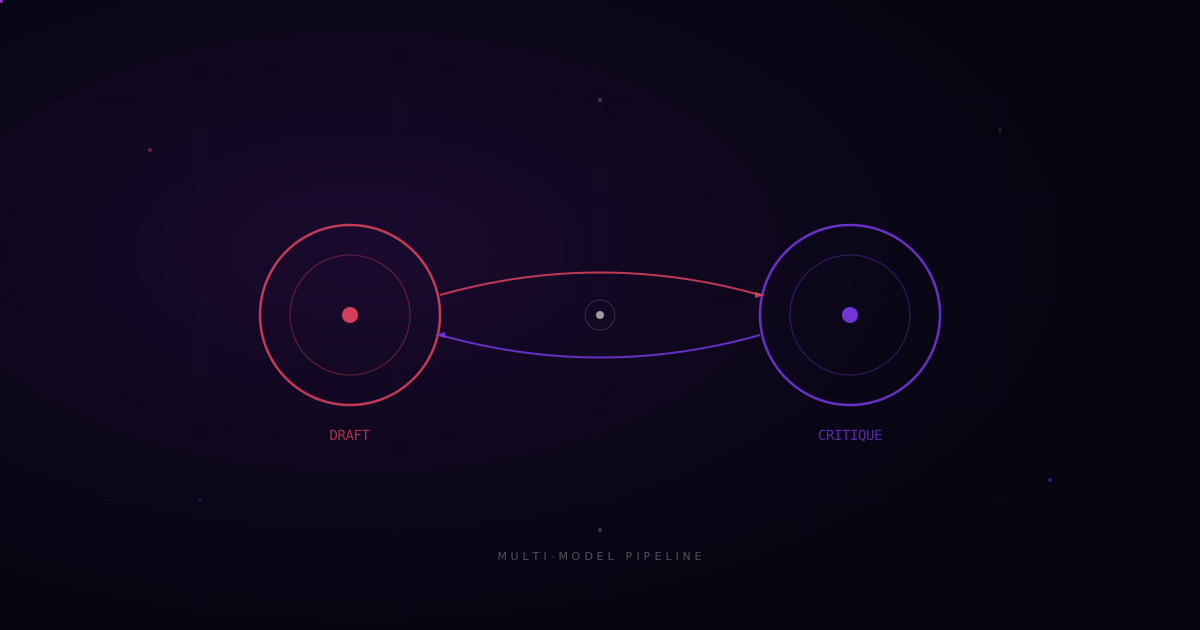
Here’s how Cowork’s dual-model pipeline works in practice: GPT handles the initial draft — the heavy lifting of generating content, analysis, or workflow outputs. Then Claude steps in as the critic, reviewing for accuracy, coherence, and hallucination.
It’s a simple idea with a not-so-simple result. Microsoft reports the “Critique” feature boosted their DRACO benchmark score by 13.8%. For context, that’s a meaningful jump on a benchmark designed to measure real-world task completion quality, not just vibes.
The reason this matters: single-model pipelines have a well-known blind spot. A model reviewing its own output is like proofreading your own essay — you’ll miss the same mistakes you made writing it. Bringing in a fundamentally different model architecture to challenge the first one’s work addresses this at a structural level.
Microsoft isn’t stopping there. Plans are already in motion for bi-directional workflows — Claude drafts, GPT critiques — and a “Model Council” feature that runs both models side-by-side for comparison on the same task. The implication is clear: the future isn’t picking one model. It’s orchestrating many.
Not a Chatbot. An Autonomous Worker.
Let’s be precise about what Cowork actually is, because “Copilot” has been slapped on everything from code completions to PowerPoint suggestions.
Cowork handles complex, multi-step workflows that run autonomously for minutes or hours. This isn’t autocomplete. It’s not a chat window. It’s a system that takes a high-level objective, breaks it into steps, executes across Microsoft 365 applications, and delivers results — with the dual-model critique loop running quality checks throughout.
Think: “Analyze our Q1 sales data across three regions, draft the executive summary, cross-reference against last year’s targets, and flag discrepancies.” Then you walk away. Cowork runs. The GPT-Claude pipeline catches errors that would’ve slipped through a single-model approach.
Built on Microsoft’s Work IQ framework, Cowork inherits the enterprise security and governance stack that IT departments actually require. Data stays within compliance boundaries. Audit trails exist. Admin controls work. This isn’t a startup demo — it’s enterprise infrastructure.
The Frontier Program and Who’s Already In
The launch comes through Microsoft’s Frontier program, their early-access track for enterprise customers willing to run bleeding-edge AI features in production. It’s not open to everyone, and that’s the point — this is controlled deployment with real feedback loops.
Capital Group is among the early adopters. Barton Warner, their SVP of Enterprise Technology, is already on record working with the platform. When a firm managing over $2 trillion in assets signs up for your AI agent preview, that’s not a marketing win — it’s a signal about where enterprise trust is heading.
Nicole Herskowitz, Corporate VP of Microsoft 365, and Jared Spataro, CMO of AI at Work, have both been vocal about Cowork representing the next phase of Copilot’s evolution. The messaging is consistent: this isn’t an add-on. It’s the direction.
400 Million Seats and Counting
Here’s the number that makes this launch different from every other AI agent announcement: Microsoft 365 has over 400 million paid seats.
Every AI startup building autonomous agents faces the same cold-start problem — distribution. You can build the most capable agent in the world, and it means nothing if it can’t reach users inside their existing workflows, behind their existing security stack, integrated with their existing data.
Microsoft doesn’t have that problem. Cowork ships inside the platform where enterprise work already happens. No new vendor approval. No separate security review. No additional SSO integration. It’s just… there.
This is the moat that matters. Not model quality — which fluctuates quarter to quarter — but distribution. When your agent framework sits inside the tool that hundreds of millions of knowledge workers open every morning, adoption isn’t a growth hack. It’s gravity.
What This Actually Means
Three weeks ago, we covered the partnership announcement and flagged the dual-model approach as the most interesting angle. Now it’s live, and the early data backs up the thesis.
The 13.8% DRACO improvement from the critique feature isn’t just a benchmark flex. It represents a fundamental shift in how we think about AI reliability in production. Instead of trusting one model to be right, you architect disagreement into the system. The models check each other. Errors get caught at the pipeline level, not the user level.
The Model Council roadmap takes this further — imagine presenting a board with analysis that was independently generated by two different AI architectures, with disagreements highlighted and resolved. That’s not artificial intelligence replacing judgment. That’s AI improving the inputs to human judgment.
Microsoft is betting that the future of enterprise AI isn’t the best single model. It’s the best orchestration of multiple models, each playing to their strengths, each keeping the other honest.
Based on today’s launch, that bet is looking pretty good.