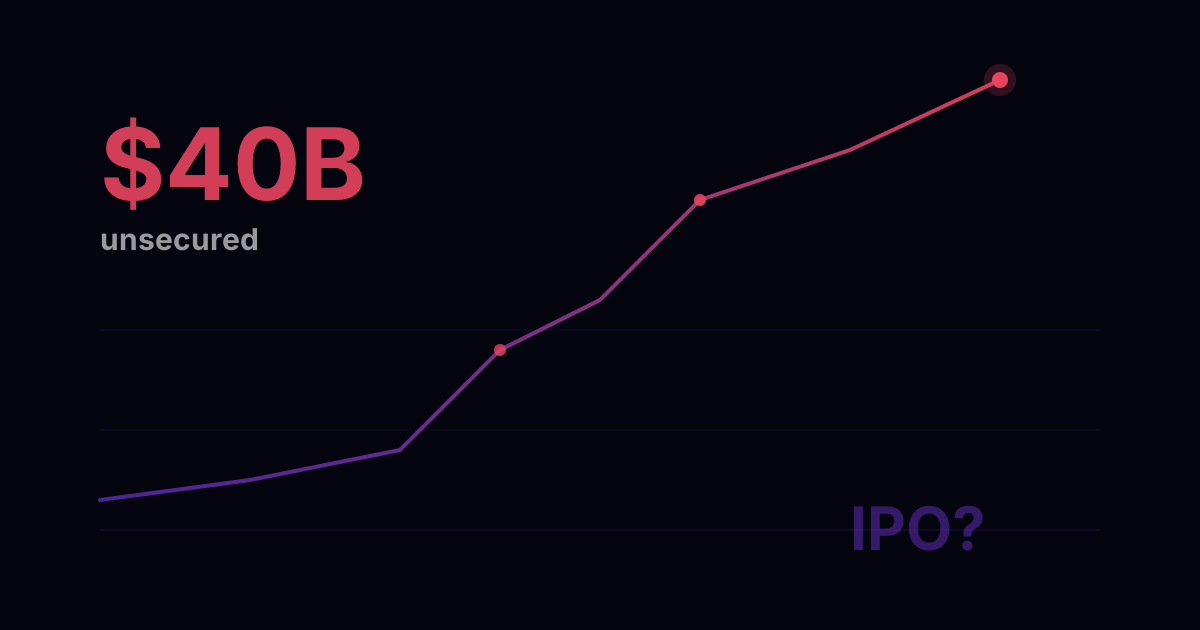
When Masayoshi Son makes a bet, he doesn’t do it quietly. The SoftBank founder swings for the fences — sometimes spectacularly (early Alibaba), sometimes painfully (WeWork). His latest move might be the most audacious yet: a $40 billion unsecured bridge loan, announced March 27, primarily to fund SoftBank’s massive stake in OpenAI.
Forty billion dollars. Unsecured. Twelve-month repayment window. This isn’t corporate financing. It’s a signal flare.
The Loan
SoftBank secured the loan through JPMorgan Chase, Goldman Sachs, and four major Japanese banks — Mizuho, SMBC, and MUFG among them. No specific assets pledged as collateral. Matures March 2027.
The stated purpose: “bolster investments in ChatGPT-maker OpenAI and general corporate purposes.” The real purpose: SoftBank committed $30 billion to OpenAI’s record $110 billion funding round in February 2026 — a round that valued OpenAI at $840 billion. This loan gives SoftBank the liquidity to actually deliver on that commitment.
JPMorgan and Goldman don’t hand out $40 billion unsecured loans to companies they think might struggle to repay. They’re pricing in a very specific outcome.
The IPO Signal Everyone’s Reading
The 12-month term is the tell. When you borrow $40 billion and promise to pay it back within a year, you need a plan. The most logical one: an OpenAI IPO.
Multiple reports from CNBC and InvestorPlace suggest OpenAI is targeting a public listing as early as Q4 2026. OpenAI CFO Sarah Friar recently told Jim Cramer the company is “starting to build that outcome.” No S-1 filed yet, but the infrastructure is clearly being assembled.
If OpenAI goes public at or near its $840 billion private valuation — and there’s reason to believe public markets could push it higher — SoftBank’s $60+ billion stake provides more than enough liquidity to settle a $40 billion debt. It’s a leveraged bet on an IPO, plain and simple.
The numbers support the thesis. OpenAI reportedly generated over $20 billion in annualized recurring revenue in 2025, growing 3x year-over-year. ChatGPT dominates consumer AI. Enterprise offerings are expanding rapidly.
The Scale of Son’s AI Obsession
SoftBank’s total OpenAI investment now exceeds $60 billion — a concentration that makes aggressive venture capitalists nervous.
But OpenAI is just one piece. SoftBank is a key partner in the Stargate Project, the Trump-adjacent initiative targeting $500 billion in U.S. AI infrastructure over four years. Son personally pledged $100 billion in U.S. AI investments.
Last week, FinTech Weekly reported SoftBank may exceed its own internal borrowing limits to maintain this pace. The company took on $27 billion in debt in Q4 2025 alone — partly for a $22.5 billion December investment in OpenAI. The $40 billion loan piles onto an already leveraged balance sheet.
This is a company that has gone all-in on AI being the defining technology of the century. Either Son is right and this becomes the greatest investment thesis in corporate history, or the debt load becomes a serious problem.
The Market Isn’t Entirely Convinced
SoftBank shares fell sharply following the announcement. Analysts described “growing investor anxiety over Chairman Son’s total commitment” to OpenAI. The Financial Times reported Son “faces investor nerves with massive spending on AI investments.”
The concern isn’t about OpenAI’s quality — it’s about concentration risk and leverage. Having $60+ billion in a single private company, funded significantly by debt, is objectively dangerous. If the IPO gets delayed, if market conditions shift, or if OpenAI hits unexpected headwinds, SoftBank’s position becomes very uncomfortable very quickly.
There’s also the valuation question. OpenAI at $840 billion, Anthropic at $380 billion — are these numbers sustainable? The AI industry is generating real revenue now, unlike the dot-com era, but the multiples are still staggering. If public market investors don’t share private market enthusiasm, an IPO could reprice the entire sector.
What This Means for AI’s Capital Arms Race
SoftBank’s move underscores something fundamental: the AI race is now a capital race. Building frontier models requires billions in compute. Training the next generation requires even more. The companies that raise and deploy capital fastest have an enormous structural advantage.
OpenAI’s ability to raise $110 billion (later topped to $120 billion) in a single round — and have its biggest backer immediately take on $40 billion in debt to fund their commitment — shows the gravitational pull of leading AI companies. Capital flows to perceived winners at unprecedented speed.
For competitors like Anthropic, Google DeepMind, Meta, and Mistral, this sets a high bar. You don’t just need a good model anymore. You need a war chest.
Son’s Redemption Arc
There’s a narrative thread worth noting. Son’s Vision Fund era was defined by costly missteps — WeWork, Katerra, a string of portfolio companies that burned billions. Critics called him reckless.
If OpenAI goes public at a trillion-dollar-plus valuation and SoftBank’s stake becomes the most profitable investment of the decade, Son’s legacy transforms overnight. WeWork becomes a footnote. The $40 billion loan becomes a masterclass in conviction investing.
That’s always been the bet with Son. He doesn’t hedge. He doesn’t diversify. He picks the horse and bets the farm. In 2000, it was Alibaba. In 2026, it’s OpenAI.
What to Watch
The next few months are critical:
- OpenAI S-1 filing — the clearest IPO signal, possibly Q3 2026
- SoftBank Q1 earnings — full balance sheet impact of the new debt
- AI market sentiment — a broader tech selloff could delay IPO plans and squeeze SoftBank’s refinancing timeline
- OpenAI revenue growth — continued rapid growth makes the public market story easier to sell
We’re watching the most expensive bet in the history of technology play out in real time. Whether it’s brilliant or reckless, we’ll know within a year.