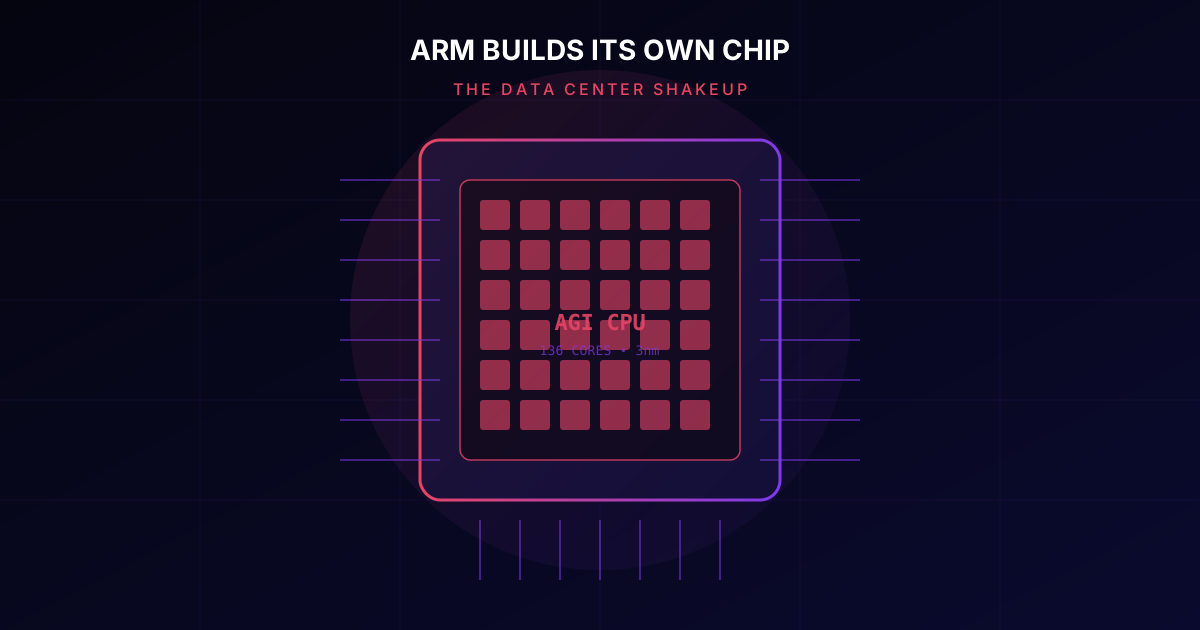
After 35 years as the Switzerland of semiconductors — licensing chip designs to anyone with a checkbook — Arm Holdings just crossed the Rubicon. It built its own chip. Not a demo. Not a reference design you’ll never see in production. A 136-core data center processor called the AGI CPU, fabricated on TSMC’s 3nm process, with Meta signed on as the debut customer.
This isn’t incremental. This is tectonic.
The Hardware: 136 Cores of Pure Intent
The specs read like Arm had something to prove.
Up to 136 Neoverse V3 cores at 3.2 GHz all-core (3.7 GHz boost). Chiplet design — two dies operating as one. 300-watt TDP. Twelve channels of DDR5 at 8800 MT/s delivering over 800 GB/s of memory bandwidth. Ninety-six PCIe Gen6 lanes. Native CXL 3.0 support.
Arm claims more than 2x performance per rack versus the latest x86 platforms. Those are internal numbers, not independent benchmarks — but even if they’re directionally correct, it’s a statement.
Supermicro is already building a liquid-cooled variant that crams 336 chips and over 45,000 cores into a single 200kW rack. That’s not a server. That’s a weapon.
Why CPUs Are Having Their Moment
Here’s the twist nobody saw coming three years ago: as AI evolves from monolithic model inference toward agentic systems, the bottleneck is shifting back to CPUs.
Agentic AI — systems that autonomously browse the web, write code, coordinate with other agents, manage workflows — demands strong sequential processing, memory management, and I/O coordination. That’s CPU territory.
Nvidia’s own Jensen Huang recently acknowledged that CPUs are “becoming the bottleneck” as agentic AI takes off. Futurum Group predicts CPU market growth could actually exceed GPU growth by 2028.
Arm CEO Rene Haas predicted a fourfold increase in CPU demand around agentic AI, then added the quiet part out loud: “We may be under-calling that number.”
Meta’s $135 Billion Vote of Confidence
Meta is planning to spend up to $135 billion on capex in 2026. One of the largest infrastructure buildouts in corporate history. They’ve already signed massive deals with Nvidia and AMD — and now they’re adding Arm to the mix.
Meta engineer Paul Saab, who’s been working on the Arm chip project since 2023, framed it as flexibility: “It allows a lot more flexibility in our software stack and in our supply chain.” Translation: Meta doesn’t want to be locked into two or three chip suppliers.
Chip analyst Patrick Moorhead did some napkin math: “Let’s say they get 5% of Meta’s $115 to $135 billion capex. That is a game changer on the top line.” For context, Arm’s total 2025 revenue was just over $4 billion. A single-digit slice of Meta’s spending could double the company.
The customer list extends well beyond Meta: OpenAI, Cloudflare, SAP, SK Telecom, Cerebras, and F5 have all signed on. About 50 partners signaled support before the launch even happened.
The Switzerland Problem
This is where it gets uncomfortable.
Arm’s entire business model was built on neutrality. It designed architectures. Apple used them for M-series chips. Nvidia built Grace on them. Amazon’s Graviton runs on them. Qualcomm, Samsung — all Arm customers.
Now Arm is competing directly with many of those same companies. It’s like the architect who designed your house suddenly opening a construction firm next door.
Arm CFO Jason Child tried to smooth things over: “We’re not going to force any of our existing customers to migrate to this new model.” But HSBC analysts flagged the risk head-on — Arm “faces fierce competition from Intel/AMD, lacks manufacturing, and risks alienating IP partners.”
Selling finished silicon at a 50% gross margin is a fundamentally different business than collecting royalty checks. It requires execution on manufacturing, supply chain, and customer support at a scale Arm has never attempted.
Bad News for x86
For Intel and AMD, this is the scenario they didn’t want.
Custom Arm chips at hyperscalers were already a headache. But those required enormous engineering investment — only the Amazons and Googles of the world could afford to build them. Most companies just kept buying x86.
Arm’s AGI CPU changes that calculus. Now any company that wants high-performance Arm silicon can just buy it. Mid-tier cloud providers. Enterprise customers. AI startups. The addressable market for Arm in the data center just expanded dramatically.
One telling detail: in its performance benchmarks, Arm chose to compare against AMD EPYC, not Intel Xeon. That tells you who Arm considers the real competition — and it’s not the company already on life support.
The $25 Billion Moonshot
Arm expects total annual revenue of $25 billion by 2031 with $9 earnings per share. From a 2025 base of $4 billion, that’s more than 6x growth in six years.
The chip alone is projected to generate $15 billion annually — meaning Arm expects it to become the majority of its business. The remaining $10 billion would come from traditional IP licensing.
The company spent $71 million and 18 months building new chip lab facilities in Austin. The chip is in testing now (“It’s back, and it works,” Haas told Reuters), with volume production planned for second half of 2026 and additional designs in the pipeline at 12- to 18-month intervals.
Wall Street loved it. Arm shares jumped over 15% on Wednesday.
Why This Matters Beyond Silicon
Strip away the chip specs and corporate strategy, and the bottom line is simple: more competition in AI infrastructure means lower costs.
The current AI compute landscape is dominated by a handful of suppliers, and compute is expensive and hard to get. Every new competitive entrant — Arm, Cerebras, custom hyperscaler chips — puts downward pressure on prices and upward pressure on availability.
Arm’s AGI CPU targets the orchestration layer of agentic AI — the part that coordinates all the moving pieces when an AI agent handles complex, multi-step tasks. As agentic AI goes mainstream, demand for this type of compute is going to surge.
More competition. Lower costs. More companies building AI products. Better tools for everyone. That’s the virtuous cycle the industry needs as AI infrastructure spending approaches half a trillion dollars annually.
The Gamble
Arm has never manufactured at scale. It’s competing with its own customers. A $15 billion chip revenue target by 2031 is wildly aggressive.
But with Meta’s backing, 50+ launch partners, a chip that addresses a genuine market gap, and the tailwind of agentic AI demand — Arm has a credible shot.
The company that built its empire on neutrality just bet its future on competition. The semiconductor industry is about to find out if that was genius or hubris.