Remember when AI assistants could only talk about helping you? Those days are officially over.
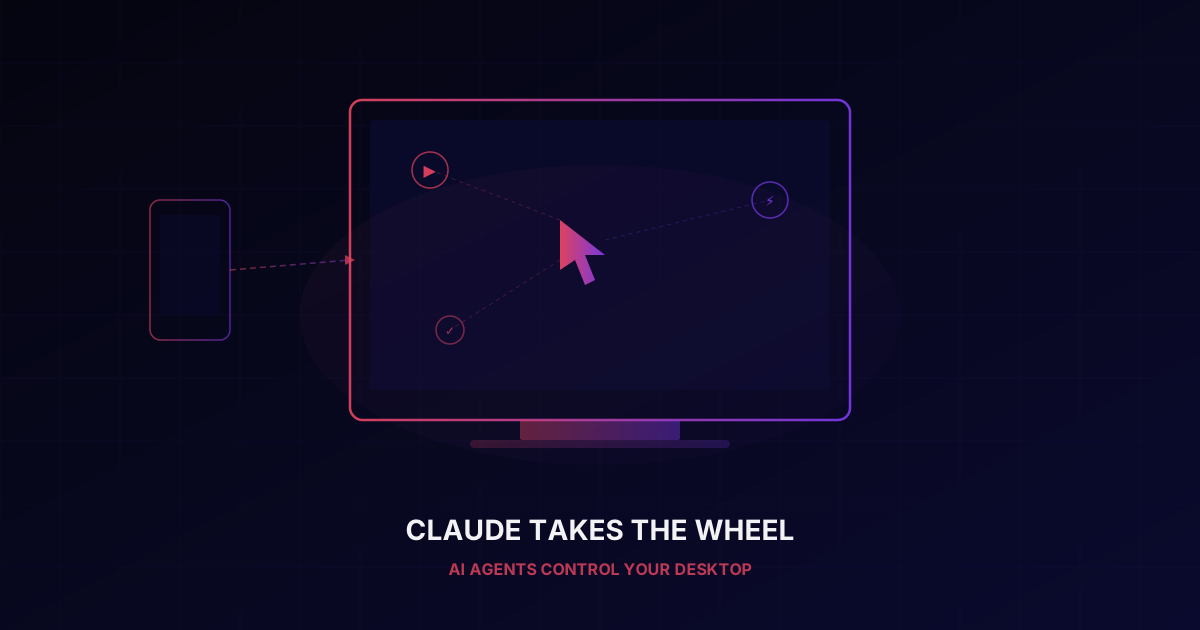
Anthropic just dropped what might be the most consequential AI update of 2026: Claude can now take control of your Mac. Not metaphorically — it literally moves your cursor, clicks buttons, types into fields, and navigates your apps. You can text Claude from your phone while grabbing coffee, and by the time you sit back down, your pitch deck is exported, attached to a calendar invite, and ready to go.
This isn’t a product update. It’s a declaration that the AI industry has pivoted from intelligence to agency.
How It Actually Works
The mechanics are deceptively simple. Give Claude a task through Claude Cowork or Claude Code, and it first checks for a direct integration — connectors to Slack, Google Calendar, Google Workspace, and the like. If one exists, it uses that for speed and reliability.
When there isn’t a direct integration, Claude doesn’t shrug. It falls back to controlling your computer the way a human would. It reads your screen, moves your cursor, clicks buttons, scrolls through pages, and types into fields. Think of it as a remote colleague sitting at your desk, watching your monitor and operating your machine.
The feature launched as a research preview exclusively for Claude Pro and Max subscribers on macOS. Windows and Linux users will have to wait. Anthropic is upfront about limitations — this is early tech that will make mistakes, sometimes needing multiple attempts for complex tasks.
But the ambition is unmistakable.
Your Phone Becomes a Remote Control
What makes this update particularly compelling is its pairing with Dispatch, a mobile feature Anthropic released last week through Claude Cowork. Dispatch lets you have a continuous conversation with Claude from your phone and assign tasks it executes on your computer.
The practical implications hit immediately. Stuck in traffic and forgot to send that report? Text Claude. By the time you park, the report is exported, formatted, and emailed. At dinner and need to update a spreadsheet before tomorrow’s meeting? A quick message, and Claude handles it while you order dessert.
This phone-to-computer pipeline is the kind of workflow that makes AI feel less like a chatbot and more like an actual assistant. It bridges the gap between where you are and where your work lives.
Why Anthropic Had to Move Now
The pressure has a name: OpenClaw. The open-source AI agent framework went viral this year, building an ecosystem of tools that let AI models interact with third-party software. Users message OpenClaw through WhatsApp or Telegram, it runs locally with access to your files, and Nvidia CEO Jensen Huang told CNBC it’s “definitely the next ChatGPT.”
Nvidia launched NemoClaw, an enterprise-grade version. OpenAI hired OpenClaw creator Peter Steinberger to “drive the next generation of personal agents.” Perplexity launched its own “Computer” tool requiring a dedicated Mac mini running 24/7.
Anthropic’s computer use launch is a direct counter-move. If users can already get agentic capabilities through an open-source tool that works with any model, Anthropic needs to offer something equally powerful natively. The agentic AI space is fracturing into competing philosophies — open-source and model-agnostic vs. proprietary and deeply integrated.
The Security Problem Nobody Wants to Talk About
Giving an AI system computer control is, by definition, a security risk. Anthropic has been relatively transparent about this.
Claude operates on a permission-first model — it asks before accessing any new application, and users can stop it at any point. Safeguards against prompt injection attacks (where malicious content tricks the AI into unintended actions) are in place.
But here’s the catch: Anthropic is telling users not to work with sensitive data during the research preview. That’s a significant caveat for a tool designed to handle your real work on your real computer. And the OpenClaw ecosystem, which Claude’s capabilities build upon conceptually, had its own security incidents earlier this year — tens of thousands of systems exposed through misconfiguration.
Constellation Research analyst Holger Mueller noted the feature “makes it more trustworthy” because Claude acts like a human user, logging into sites transparently. But “trustworthy” and “secure” aren’t the same thing.
What This Means for Developers — and Everyone Else
For developers, the implications are immediate. Claude can make changes in an IDE, submit pull requests, run tests, and handle the repetitive tasks that eat productive hours. Describe what you need, step away, come back to a finished PR.
For everyone else, the promise is more aspirational. Imagine telling your AI to book the cheapest flight to Chicago next Tuesday using your preferred airline — and having it actually navigate the booking site, compare options, and complete the purchase. We’re not fully there, but the trajectory is obvious.
The broader signal is just as loud. Alibaba announced its XuanTie C950 chip on the same day — a CPU specifically designed for agentic AI workloads. When chipmakers are designing silicon around your use case, it’s not a fad. The AI agents market is projected to hit $10.9 billion in 2026.
From Chatbots to Coworkers
Zoom out, and what you’re watching is the most important transition in AI since ChatGPT launched in late 2022. We’re moving from AI that knows things to AI that does things. From conversation partners to autonomous workers. From chat windows to computer controls.
This shift raises questions beyond technology. What happens to productivity when every knowledge worker has an AI operating their computer around the clock? What does accountability look like when an AI agent sends the wrong file to the wrong person on your behalf?
A Nature article published this week noted that AI hasn’t caused the predicted “job apocalypse” — yet. But computer use capabilities represent a qualitative leap. Previous AI tools augmented human work. This one replaces human actions. That’s a fundamentally different proposition.
What Comes Next
Anthropic is treating this as a research preview for good reason. The tech works but it’s imperfect. Expect rapid iteration — Windows and Linux support, more granular permissions, improved reliability.
But the genie is out of the bottle. Between OpenClaw’s open-source ecosystem, Anthropic’s native computer use, Perplexity’s dedicated agent hardware, and whatever OpenAI is cooking with Peter Steinberger, 2026 is shaping up as the year AI stopped being something you talk to and became something that works for you.
The question isn’t whether AI agents will go mainstream. It’s whether you’ll be ready when they do.