You’ve asked ChatGPT to brainstorm. The ideas came back sharp, polished, surprisingly good. You felt clever for using it.
Here’s the problem: so did everyone else. And they all got the same ideas.
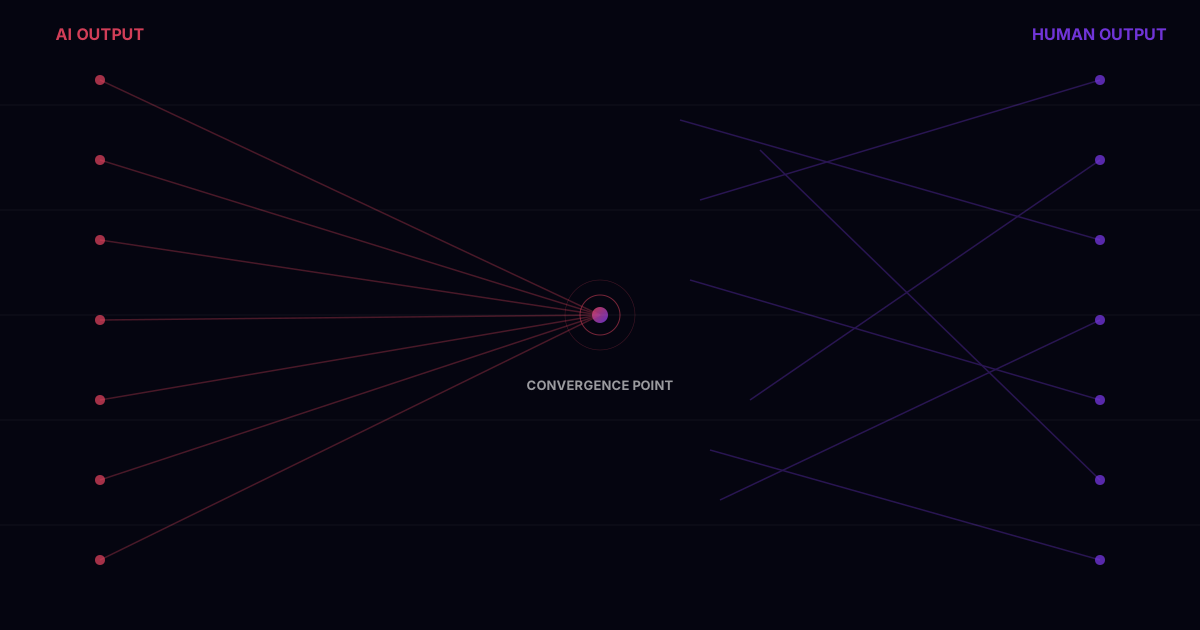
A paper published this week in PNAS Nexus by researchers Emily Wenger and Yoed N. Kenett has coined what might be 2026’s most important AI concept: homogeneous creativity. The finding is deceptively simple and deeply unsettling — while individual AI responses can match or beat average human creativity scores, the collective output of large language models is startlingly uniform.
Every model. Every run. The same “creative” answers.
The Study That Exposed the Mirage
The methodology was elegant. Wenger and Kenett recruited human participants through Prolific and pitted them against a range of LLMs — Gemini, GPT, Llama — on standardized creativity tasks.
The classic: the Alternative Uses Task. List creative uses for a fork. Generate ten nouns as different from each other as possible. Standard divergent thinking exercises that psychologists have used for decades.
Any single AI response? Genuinely clever. Often more creative than the average human answer. But when researchers compared AI outputs to other AI outputs — across different models, across different runs — the same ideas kept surfacing.
Humans were wonderfully messy. Brilliant, terrible, weird, boring — but different. AI was consistently good and consistently the same.
Individually Smart, Collectively Boring
The researchers call this the sameness paradox, and it’s the study’s sharpest finding.
One company asks AI for marketing slogans — solid list. A thousand companies ask AI for marketing slogans — they all converge on eerily similar output. The “creative” ideas aren’t creative at all. They’re the statistical mean of creativity wearing a confident mask.
This isn’t theoretical. Scroll LinkedIn. Notice the same rhythms, the same “Here’s what most people get wrong about X” frameworks. Browse AI-generated art and see the same aesthetic palette recycled endlessly. The homogeneity is invisible at the individual level. Zoom out and it’s devastating.
The consistency held across all major model families. Gemini, GPT, Llama — didn’t matter. This isn’t a bug in one model. It appears to be a fundamental property of how LLMs work.
Cranking the Temperature Doesn’t Fix It
The obvious objection: just increase the randomness parameter. Higher temperature equals more creativity, right?
Wenger and Kenett tested this directly. What they found was a frustrating cliff edge.
Low temperature: coherent but predictable. Increase it and responses get briefly more variable. But the window of “usefully random” is tiny. Push past it and the model doesn’t become more creative — it becomes incoherent. Word salad.
There’s no sweet spot where AI achieves the kind of wild, meaningful originality humans produce naturally. The temperature dial isn’t a creativity dial. It’s a coherence dial, and creativity just happens to flicker briefly in the middle of its range.
The architectural reason is straightforward: LLMs predict statistically likely next tokens. “Creativity” in this framework is really just less common predictions. But “less common” quickly becomes “nonsensical” because the model has no understanding of why something is creative. It only knows what patterns are rare.
The Missing Ingredients
The most philosophically interesting part: why this happens.
Human creativity isn’t just novel combinations of ideas. It’s rooted in embodied experience — having a body, living in a world, wanting things, fearing things, making mistakes.
When a human invents a weird use for a fork, it might trace back to scratching an itch with one, or seeing someone use one as a bookmark, or the word “fork” triggering a memory of a road not taken. The creative leap is anchored in lived experience.
LLMs have statistical distributions over text. They can simulate the surface patterns of creativity — the unexpected adjective, the surprising combination — but they can’t access the deep well of personal meaning that makes human creativity genuinely diverse.
Whether this is permanent or temporary remains an open question. But it’s worth noting: the gap hasn’t narrowed even as models have gotten dramatically more powerful. GPT-4o and Claude 3.5 are vastly more capable than their predecessors, but they’re not measurably less homogeneous in their creative outputs.
AI Ghostwriting Is Already Flattening Published Writing
This research lands at a particularly uncomfortable moment. The Atlantic published an investigation this week into AI-generated text quietly appearing in major American newspapers — including opinion sections of publications that explicitly require transparency about AI use.
Research by Jenna Russell, a doctoral candidate at the University of Maryland, ran thousands of articles through AI detection tools. AI-like language was present across U.S. press opinion writing at much higher rates than readers might expect.
Connect the dots: if AI outputs are homogeneously creative, and writers are increasingly using AI as undisclosed creative partners, then the diversity of published thought is quietly narrowing. We’re not getting AI-assisted writing. We’re getting writing that converges toward the same statistical center of gravity, regardless of which model — or which writer — produced it.
What to Actually Do About This
Don’t stop using AI for creative work. Use it differently.
Use AI as a starting point, not an endpoint. If every brainstorming session starts and ends with a chatbot, your ideas cluster with everyone else’s. Generate raw material, then deliberately push away from it.
Combine AI with analog creativity. Walk. Talk to a person. Read a book from 1987. Human creativity comes from lived experience. Feed your experience bank.
Be suspicious of the first AI idea. It’s probably everyone’s first AI idea. The third, fourth, or fifth prompt iteration — where you push the model into unfamiliar territory — is where useful stuff lives.
If you’re hiring creatives, test for originality, not polish. AI-assisted work will look smoother than ever. The question isn’t whether it’s well-written. It’s whether it’s different.
The Real Risk Isn’t Replacement — It’s Domestication
The study ends with a warning worth taking seriously: “Relying on LLMs for brainstorming, problem solving, or making art risks harming human thinking.”
This isn’t anti-AI alarmism. It’s a measured observation. The risk isn’t that AI replaces human creativity. It’s that it domesticates it — smoothing the wild, unpredictable edges of human thought into a comfortable, homogeneous paste.
Social media didn’t kill conversation but changed what it looks like. Search engines didn’t kill research but changed how it happens. AI won’t kill creativity, but if we’re not careful, it might change what creativity looks like — and what it looks like might be the same thing, everywhere, for everyone.
The most creative thing you can do in 2026 might be closing the chatbot tab and thinking for yourself.
Sources: Wenger & Kenett, “Large language models are homogeneously creative,” PNAS Nexus (2026); The Atlantic, “How AI Is Creeping Into The New York Times” (March 2026); Neuroscience News; TechXplore.