The biggest bottleneck in AI isn’t training anymore. It’s inference — the moment a model actually does something useful. And AWS just partnered with Cerebras Systems to attack that bottleneck with an approach nobody has tried at this scale.
The deal: Cerebras’ massive wafer-scale CS-3 chips will sit inside AWS data centers, accessible through Amazon Bedrock. The promise: 5x faster inference. The method: tearing the inference pipeline in half.
Splitting the Brain
Traditional AI inference runs both stages on the same GPU. You send a prompt, the chip processes it (prefill), then generates a response token by token (decode). One chip, both jobs.
AWS and Cerebras are breaking that apart.
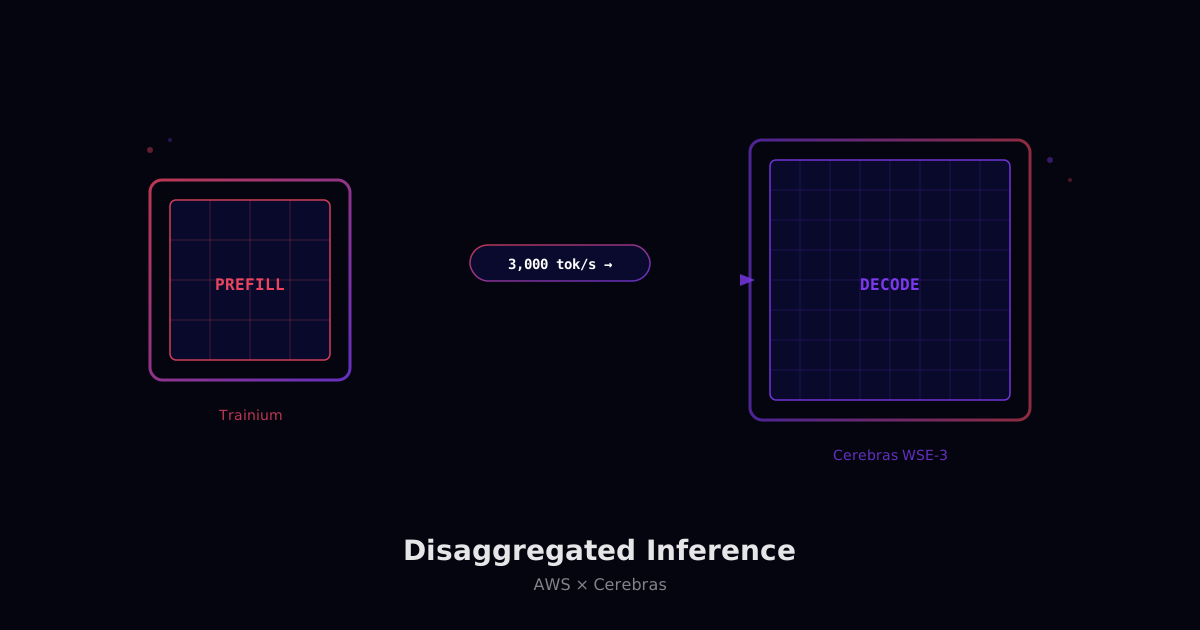
Their disaggregated architecture hands prefill to AWS Trainium chips — purpose-built for the parallel, compute-heavy work of processing your input. Decode goes to the Cerebras CS-3, whose Wafer Scale Engine 3 packs 900,000 cores and 44GB of on-chip SRAM into a single wafer-sized processor. The two systems connect via AWS’s Elastic Fabric Adapter, bypassing the OS entirely for low-latency data transfer.
Why bother? Because prefill and decode have completely different computational profiles. Prefill is parallelizable and compute-bound. Decode is sequential and memory-bandwidth-bound. The WSE-3 delivers 27 petabytes per second of internal memory bandwidth — over 200x what Nvidia’s NVLink offers. For sequential token generation, that’s an absurd advantage.
3,000 Tokens Per Second
Standard GPU inference generates output in the hundreds of tokens per second for large models. Cerebras claims the WSE-3 can hit 3,000 tokens per second for decode-heavy workloads.
That number matters more than it sounds. We’re entering the agentic AI era — systems that don’t just answer questions but chain together multi-step reasoning, write code, browse the web, and iterate. Every millisecond of inference delay compounds across agent loops. At 3,000 tokens per second, an AI coding assistant analyzing your codebase, proposing changes, and running tests could feel genuinely instantaneous.
The difference between a tool and a colleague is latency.
A Hyperscaler First
This isn’t a reseller deal. AWS is putting CS-3 hardware inside its own data centers, managed under the Nitro security perimeter, accessible through existing Bedrock APIs. No new instance types, no separate billing. If you’re already on Bedrock, Cerebras-powered inference becomes a premium tier option.
For Cerebras, this is massive validation. Wafer-scale computing has always carried a “too exotic for production” stigma. Getting embedded in the world’s largest cloud provider kills that narrative. CEO Andrew Feldman called it bringing “blisteringly fast inference” to every enterprise within their existing AWS environment.
The Catches
The press releases are optimistic. Reality is messier.
Complexity is real. Two different chip architectures means two different memory systems, failure modes, and performance profiles. Most teams have never dealt with orchestrating inference across heterogeneous silicon. This isn’t plug-and-play — it’s a genuine engineering challenge.
SRAM has limits. The WSE-3’s speed comes from on-chip SRAM, not HBM. That 44GB ceiling constrains which frontier models can run efficiently. GPU-based systems with high-bandwidth memory don’t face this particular wall.
Six months out. Availability is slated for H2 2026. In AI infrastructure, that’s forever. Nvidia’s Vera Rubin architecture, AMD’s next chips, and software optimizations like GPT-5.4’s efficiency gains will all land in that window. The competitive landscape shifts fast.
The Nvidia Question
This deal is a direct shot at Nvidia’s inference monopoly. While Nvidia GPUs remain the default, AWS betting on disaggregated architecture signals something bigger: the industry is diversifying away from GPU monoculture.
The logic is straightforward. If different stages of inference have different computational needs, why force one architecture to handle both? Purpose-built silicon for each stage should win on both speed and efficiency.
Nvidia isn’t ignoring this — Vera Rubin targets exactly these agentic inference workloads. But the “just rent some GPUs” era may be ending. Inference architecture is becoming an actual engineering decision, not a default.
What This Really Means
The AWS-Cerebras partnership is an architectural bet: the future of AI inference isn’t bigger GPUs doing everything, but specialized silicon handling what it’s best at.
If the numbers hold, it reshapes how AI applications deploy at scale. If they don’t — and that “if” is load-bearing — it becomes an expensive experiment in a market that punishes slow movers.
Either way, inference speed is now the primary battleground. Training got us frontier models. Inference gets those models into the real world. And whoever cracks inference at scale — fast, cheap, accessible — wins the next phase of the AI race.
The era of one chip to rule them all might be over.