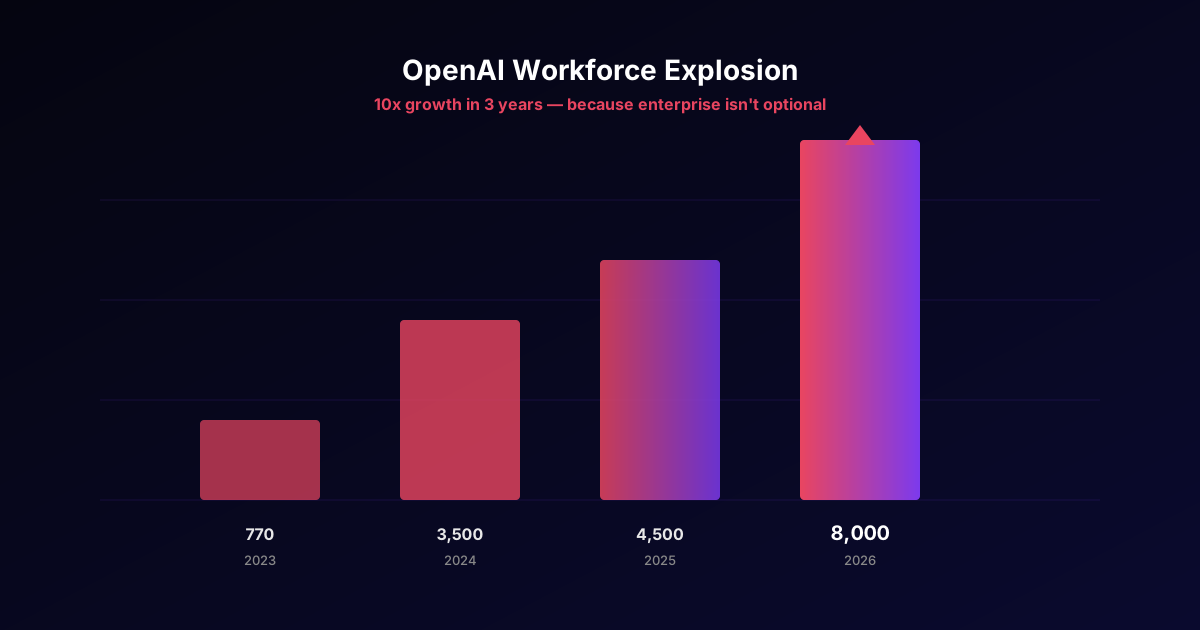
While the rest of tech quietly replaces humans with AI, OpenAI is doing the opposite — hiring at a pace that borders on reckless. The company plans to nearly double its headcount from 4,500 to 8,000 by December 2026. That’s roughly a dozen new hires every single day for the rest of the year.
This isn’t confidence. It’s a strategic panic response dressed in ambition.
The Anthropic Problem OpenAI Can’t Ignore
The hiring blitz makes a lot more sense when you see the numbers OpenAI is staring at internally.
According to Ramp’s AI spending index, businesses choosing an AI provider for the first time now pick Anthropic’s Claude over ChatGPT roughly 70% of the time. Axios puts it even higher — 73%. A year ago, OpenAI dominated new enterprise acquisition. That lead has evaporated.
Claude carved out its reputation the boring way: reliable APIs, longer context windows, and tools developers actually want to use in production. OpenAI still owns the consumer brand — everyone knows ChatGPT. But in enterprise, where the real money lives, Anthropic has flipped the script.
From Code Red to Hiring Frenzy
This traces back to Sam Altman’s internal “code red” in late 2025, triggered by Google’s Gemini 3 launch. Altman paused non-core projects and redirected the company toward three priorities: ChatGPT’s core experience, the Codex coding model, and enterprise adoption.
The 3,500 new hires span engineering, research, product, and sales. But the most revealing addition is a brand-new role: technical ambassador.
These aren’t salespeople. They’re specialists who help businesses actually deploy OpenAI’s tools — integration work, workflow redesign, the unglamorous stuff that determines whether an enterprise deal sticks or churns.
It’s OpenAI admitting what the industry already knew: the best model doesn’t win if companies can’t figure out how to use it. Anthropic learned this early. Google has its massive enterprise machine. OpenAI has been playing catch-up.
The Private Equity Shortcut
OpenAI is also in advanced talks with private equity firms — including Brookfield Asset Management — to deploy its AI tools across entire portfolio companies. One deal with a PE firm could mean instant deployment across dozens of businesses.
It’s clever go-to-market strategy, and it explains why they need thousands more people to handle what’s coming.
The Math Problem
Here’s the tension: OpenAI is still not profitable. Adding 3,500 employees at Silicon Valley salaries, on top of over a million square feet of leased San Francisco office space, will accelerate the burn rate significantly.
The company has raised $110 billion at an $840 billion valuation. A potential IPO looms. The bet is that enterprise revenue scales fast enough to justify everything. But the gap between “spending aggressively” and “running out of runway” is thinner than that valuation suggests.
The Model Race Is Now a Business Race
OpenAI’s hiring spree signals something bigger than one company’s growth plans. It marks the moment the AI industry shifted from “who has the best model” to “who has the best business.”
The models are converging. GPT, Claude, Gemini — they’re all impressive, increasingly interchangeable for most use cases. The differentiation now lives in developer experience, enterprise tooling, sales support, and ecosystem lock-in.
OpenAI hiring thousands of salespeople and technical ambassadors instead of just researchers is an admission of this reality. The AI company of 2026 looks less like a research lab and more like Salesforce with a $10 billion R&D budget.
The Irony Isn’t Lost
There’s a dark comedy here. AI companies are hiring aggressively while the technology they’re building eliminates jobs everywhere else. The industry creating the automation is the one industry that can’t automate its own growth.
Whether 8,000 employees and a million square feet of office space is the right answer in the age of AI is a question Sam Altman is betting $110 billion he already knows the answer to.
The rest of us will find out soon enough.