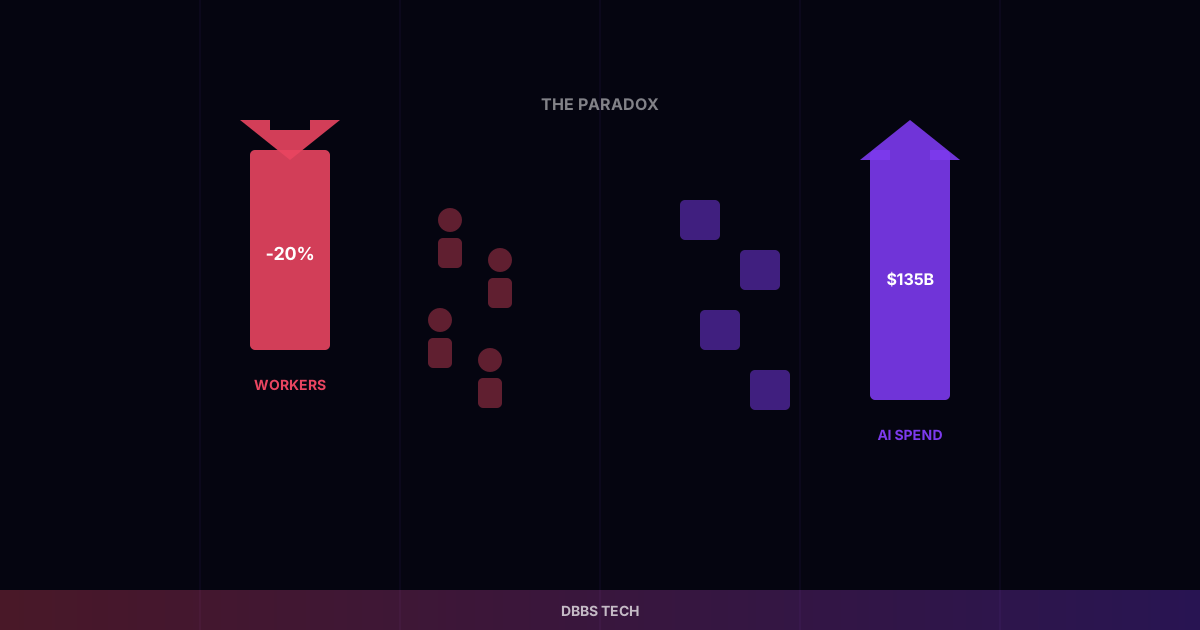
Here’s a number that should stop you cold: Meta is planning to fire roughly 16,000 people — 20% of its entire workforce — while simultaneously doubling its AI spending to $135 billion in 2026.
Fire the people. Fund the machines. It’s the most honest statement Big Tech has made about where things are going.
The Layoffs Aren’t About Survival
This isn’t 2022’s post-pandemic correction. Meta’s advertising business is still a cash machine. These cuts are proactive. The company isn’t trimming because it’s hurting — it’s reallocating capital from human labor to compute infrastructure.
The numbers are staggering. Meta’s 2026 capex guidance of $115–135 billion nearly doubles the $72 billion it spent in 2025. Total projected expenses? Between $162 and $169 billion. That’s more than the GDP of most countries, funneled primarily into the “Meta Superintelligence Labs” division and a constellation of new data centers.
Meanwhile, Zuckerberg has been saying the quiet part out loud. In January, he noted that “projects that used to require big teams” are now being “accomplished by a single very talented person.” Translation: Meta doesn’t need 79,000 employees when AI amplifies a smaller team by orders of magnitude.
Everyone’s Doing the Same Math
Meta isn’t an outlier. It’s a signal.
Amazon cut 16,000 corporate jobs in January — nearly 10% of its white-collar workforce — while aggressively integrating AI into every workflow. Block, Jack Dorsey’s fintech company, went further: it slashed nearly half its staff, dropping from 10,000 to just over 6,000. Dorsey was explicit that AI tools would absorb the eliminated roles.
Pinterest. Autodesk. Oracle. The list keeps growing. As The Atlantic put it: “Imagine losing your job to the mere possibility of AI.”
That’s the uncomfortable crux. Many of these companies aren’t cutting because AI has proven it can do these jobs better. They’re cutting because executives believe it will — and they’d rather restructure now than later. It’s a bet on the future dressed up as efficiency.
The $600 Billion Gamble
Meta has committed to spending $600 billion on data centers by 2028. For context, that’s roughly what the U.S. federal government spent on Medicare in 2024.
The obvious question: will it pay off? Meta’s track record with big bets is mixed at best. The metaverse pivot incinerated tens of billions before being quietly shelved. Its Llama 4 models faced criticism for underwhelming performance and questionable benchmarks. Forbes reports that Meta’s proprietary AI models “consistently underperform,” and there are rumors the company may need to license Google’s Gemini — an embarrassing prospect for a company spending this much on its own AI.
If the bet fails, Meta will have fired 16,000 people and burned $135 billion for nothing. If it works, those jobs still aren’t coming back.
Wall Street Isn’t Buying It (Yet)
Here’s the twist: Meta’s stock dropped 23% on the layoff news. Wall Street usually rewards headcount cuts. But investors can read the situation — Meta isn’t cutting to boost margins. It’s cutting to fund a speculative AI buildout with uncertain returns.
The layoffs aren’t the story. The $135 billion spending spree is. And the market doesn’t know whether that spending creates a leaner, AI-augmented juggernaut or a bloated money pit.
What This Actually Means
The Meta story crystallizes something that’s been building for years: the companies building AI are the first to use it to replace their own workers.
These aren’t factory robots displacing assembly-line workers. These are highly paid knowledge workers — engineers, product managers, analysts, content moderators — at some of the most desirable employers on the planet. If Meta, Amazon, and Block are concluding that AI makes 20–50% of their workforce redundant, every other company is watching and doing the same calculation.
The optimistic take: creative destruction that eventually produces new industries and roles. The pessimistic take: the most profitable companies in history hoarding AI’s gains while offloading costs to workers and society.
The realistic take? Somewhere in between, but darker than the tech industry wants to admit. Former Block employees told The Atlantic that AI tools like Claude Code genuinely changed how engineering work was done. The productivity gains are real. But “productivity gains” is a euphemism when it means your job ceases to exist.
The Cognitive Dissonance Can’t Hold
Every tech CEO watching this story is doing the same math. Every board is asking: if Meta thinks it can operate with 20% fewer people, can we?
The answer, increasingly, is yes.
The question nobody’s answering is what happens to the people.
Sources: Reuters, Forbes, The Atlantic, The Guardian, CFO Dive