There’s a moment in every technology wave where someone takes a floating concept and packages it so cleanly that the mainstream has to pay attention. For AI agents, that moment might be right now — and it’s coming from the company that’s been quietly eating Google’s lunch.
Perplexity dropped two products at its inaugural Ask 2026 developer conference that could reshape how we think about computers entirely. The first is called Personal Computer. The second is Computer for Enterprise. And if even half their internal claims hold up, we’re looking at a genuine inflection point.
Not Another Chatbot
Personal Computer runs continuously on a dedicated Mac Mini, giving AI agents persistent access to your local files, applications, and sessions. It’s a digital proxy that works 24/7 on your behalf.
This isn’t a chat window. It opens apps, manipulates files, coordinates tools, and executes multi-step workflows across your entire digital environment. You describe objectives in natural language — “create an interactive educational guide,” “triage my inbox and draft responses” — and the system handles the how.
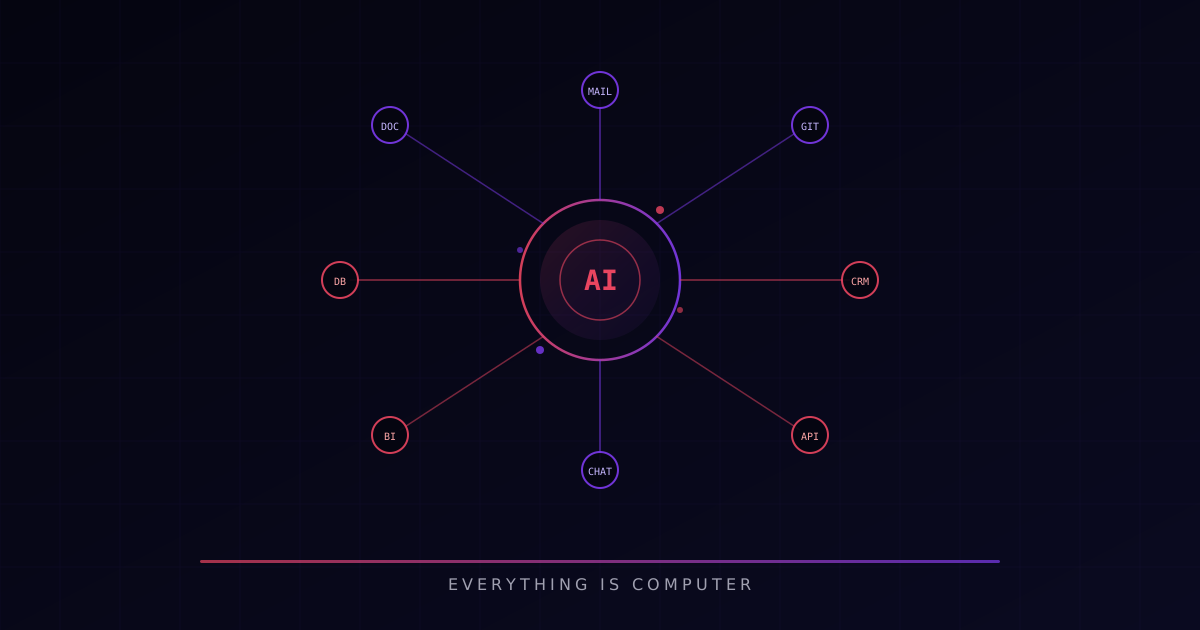
Computer for Enterprise is the cloud-based business version. It plugs directly into Salesforce, Snowflake, Slack, GitHub, Notion, Databricks, Gmail, and Outlook. It orchestrates 20 different AI models simultaneously, delegating subtasks to whichever model handles them best.
Enterprise is available now. Personal is waitlisted at roughly $200/month.
3.25 Years of Work in Four Weeks
That’s the headline claim. In internal testing across 16,000+ queries benchmarked against standards from McKinsey, Harvard, MIT, and BCG, Perplexity says the enterprise product completed the equivalent of 3.25 years of work in four weeks — saving approximately $1.6 million in labor costs.
Let’s be appropriately skeptical. As The Register noted, this claim arrives “absent data and methodological details.” Internal benchmarks from the company selling the product always carry an asterisk. What counts as a “unit of work”? How were labor cost equivalencies calculated? Perplexity hasn’t fully answered these questions.
But even if the real number is a fraction of that — six months instead of three years — the implications are significant. These aren’t systems that assist with tasks. They autonomously execute entire workflows, chaining research, analysis, drafting, and tool interaction without human intervention at each step.
“Everything Is Computer”
Perplexity’s branding is deliberately provocative. Their thesis: “When you have highly accurate AI search, an orchestration harness of 20 frontier models, and agentic internet access, AI is the computer.”
The Mac Mini is just a host. The real “computer” is the orchestration layer that understands your goals, gathers context, selects the right tools, and drives work forward.
This mirrors the broader industry trajectory. We’ve moved past AI as conversation partner (ChatGPT circa 2023) and past AI as copilot (GitHub Copilot, Microsoft Copilot). We’re entering the era of AI as autonomous worker — one that doesn’t wait for instructions but proactively executes on objectives.
CEO Aravind Srinivas also released APIs for Search, Agent, Embeddings, and Sandbox platforms, plus announced premium data partnerships with Statista, CB Insights, and PitchBook for institutional-grade data access.
How It Stacks Up
Perplexity isn’t entering an empty field. Microsoft Copilot has been embedded across Office 365 for two years. Salesforce has Agentforce. Google has Gemini integrations. Open-source projects like OpenClaw have let developers run AI agents on personal hardware for months.
Ars Technica drew the comparison directly: Personal Computer “looks like a more buttoned-up, user-friendly version” of what open-source alternatives already do. That might be exactly the point — Perplexity is betting on accessibility over flexibility.
The differentiator is multi-model orchestration. Rather than locking into a single AI provider, Computer for Enterprise routes queries across 20 frontier models, choosing the best one for each subtask. A financial analysis might use one model for data retrieval, another for reasoning, and a third for report generation. This hedge-your-bets approach could deliver more consistent results than single-model competitors.
The enterprise play targets tool fragmentation directly. Instead of juggling Slack, Snowflake, and Salesforce manually, a sales team could fire one prompt: “Pull Q4 pipeline data from Salesforce, cross-reference with revenue figures in Snowflake, and draft a competitive analysis using web sources.” One query, multiple tools, unified output.
The Security Question Nobody’s Answered
This is where it gets uncomfortable. Personal Computer requires giving AI agents access to your local files and applications. The enterprise version needs connectors to your most sensitive business systems.
Perplexity’s answer: “Sensitive actions require approval, and every session includes a full audit trail. A kill switch gives users immediate control.” Enterprise adds SOC 2 Type II compliance, SAML SSO, and isolated execution environments.
That’s a start. But just days ago, an AI agent hacked McKinsey’s chatbot and gained full read-write access in two hours. Agentic systems interacting with real-world tools create attack surfaces traditional security wasn’t designed for.
The approval-before-sensitive-actions model is the right framework. But as these systems scale and users inevitably start rubber-stamping approvals for speed, the gap between theoretical security and practical security will widen fast. Enterprises considering adoption should ask hard questions about data isolation, hallucination safeguards, and what happens when an AI agent confidently executes the wrong action across your production Salesforce instance.
What This Actually Means
If you’re a knowledge worker — analyst, researcher, marketer, developer — products like these are coming for the repetitive parts of your job. Not in a “you’re replaced” way, but in a “the boring stuff gets automated and you focus on judgment calls” way. The 3.25 years figure, however inflated, points to a real truth: enormous amounts of knowledge work consist of gathering information, cross-referencing sources, and packaging findings. AI agents excel at exactly this.
For enterprises, the decision isn’t whether to adopt agentic AI — it’s which platform to bet on. Perplexity positioning itself as the Switzerland of AI models (20 providers, no lock-in) could be compelling for companies wary of vendor dependency.
For developers and tinkerers, the $200/month price tag validates what the open-source community has been doing for free. Competition between polished commercial products and flexible open-source alternatives tends to make both better.
Bottom Line
Perplexity’s Ask 2026 announcements represent a significant escalation in the AI agent wars. Whether “3.25 years in four weeks” survives scrutiny matters less than the direction it signals: we’re moving toward a world where AI doesn’t just answer questions but autonomously operates across our digital lives.
The capability is sprinting. Security, reliability, and trust frameworks are trying to keep up. That gap is where the real story lives.