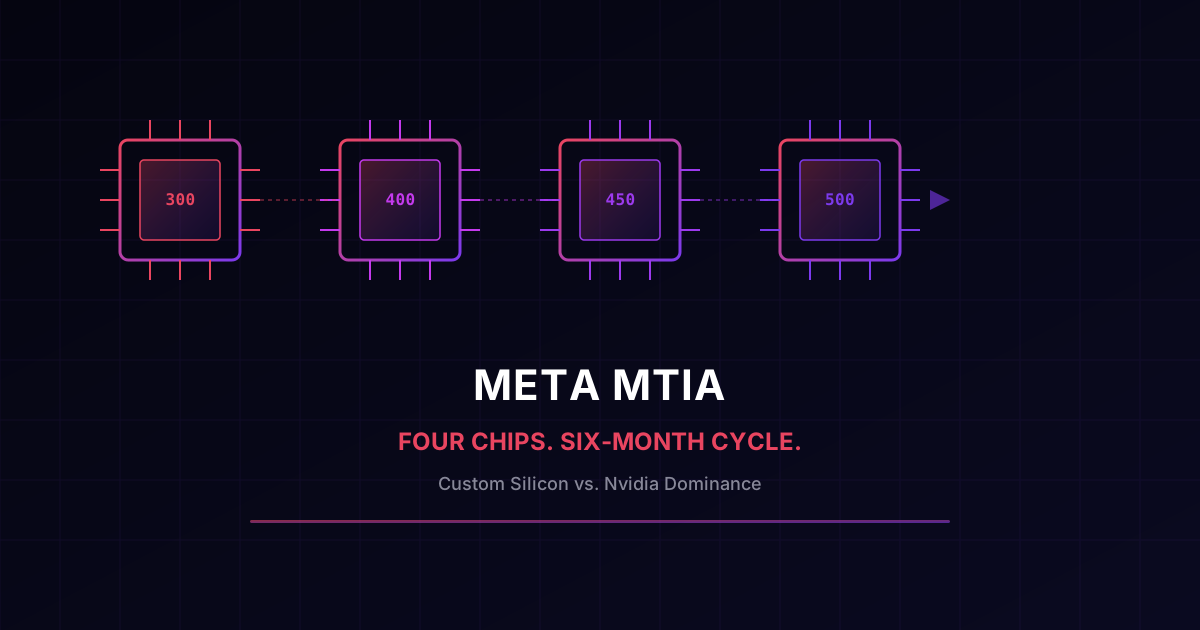
Meta just did something that should make Jensen Huang lose sleep. The company announced four new custom AI chips — the MTIA 300, 400, 450, and 500 — all shipping by late 2027. One is already in production. The rest arrive every six months.
Six months. Most chip development cycles take one to two years. Meta is moving at double speed, and the message couldn’t be louder: total Nvidia dependence is over.
The Lineup
The MTIA (Meta Training and Inference Accelerator) family has been brewing since 2023, but this week’s announcement represents a massive leap in ambition.
MTIA 300 is live now. It handles training for the ranking and recommendation algorithms that determine what billions of Facebook and Instagram users see. It pushes 1.2 petaflops in MX8 format with 216 gigabytes of high-bandwidth memory, built on a modular chiplet design.
MTIA 400 has finished testing and is heading into data centers as you read this. Here’s where things shift — the 400 and its successors target generative AI inference. Chatbot responses, image generation, video creation, all the generative features Zuckerberg keeps shipping.
MTIA 450 arrives early 2027 with double the HBM. MTIA 500 follows later that year with 516 gigabytes of storage and MX4 support — a more efficient data format that slashes the bytes needed per inference call.
The clever part: all four chips share the same rack and network infrastructure. Meta can hot-swap newer generations without redesigning data centers.
Why This Pace Is Insane
“It’s unusual for any silicon company or team to be releasing a new chip every six months,” Meta VP of Engineering YJ Song told CNBC. The reason? Meta expects to spend $115 billion to $135 billion on capex in 2026 alone. At that scale, every percentage point of efficiency translates to billions saved.
Song put it plainly: custom chips provide “more diversity in terms of silicon supply, and insulates us from price changes to some extent.”
Translation: Nvidia can’t charge us whatever it wants anymore.
The Silicon Independence Movement
Meta isn’t the first to go custom. Google pioneered the approach with TPUs starting in 2015. Amazon followed with Trainium and Inferentia. Microsoft has Maia accelerators. But Meta’s play is different in two critical ways.
First, these chips are entirely internal. Google, Amazon, and Microsoft offer their custom silicon to cloud customers. Meta’s MTIA chips power only Meta’s products. No revenue play — pure cost optimization and supply chain control.
Second, Meta built everything on open-source RISC-V architecture, partnering with Broadcom and fabricating at TSMC. No licensing costs, maximum design flexibility. It’s a bet that open-source hardware can compete with Nvidia’s proprietary CUDA ecosystem for Meta’s specific workloads.
The Nvidia Paradox
Here’s where it gets interesting. Weeks before this announcement, Meta signed massive multi-billion-dollar deals with both Nvidia and AMD for GPU capacity. It’s simultaneously building its own chips AND buying record quantities of everyone else’s.
That’s not contradiction — it’s portfolio strategy.
Custom MTIA chips handle workloads where bespoke silicon makes economic sense: inference at massive scale, recommendation systems, specific generative tasks. The big Nvidia GPUs handle heavy-duty training runs for frontier models like Llama. You go custom where volume justifies the investment, and buy off-the-shelf where flexibility matters more.
What This Means for the Chip Market
Inference is where the real volume lives. Training a model happens once. Serving it to users happens millions of times per second across Meta’s platforms. At that scale, even small per-query savings compound into billions annually.
If every hyperscaler builds custom inference chips, Nvidia’s addressable market for inference could shrink even as total AI compute demand explodes. Jensen Huang’s company dominates training and has been pushing hard into inference with Blackwell and Vera Rubin. But the hyperscalers are building their own inference future.
AMD and Broadcom are potential winners. AMD keeps gaining GPU share, and Broadcom’s MTIA partnership positions it as a key enabler of the custom silicon trend — alongside its existing TPU work with Google.
What 3 Billion Users Get
For Meta’s massive user base, this means faster feed recommendations, quicker Meta AI responses, and cheaper-to-deploy generative features. If your inference costs drop 30-40% on custom silicon, you can afford to put AI in places where the unit economics wouldn’t work on rented GPU time.
Meta can be more aggressive with AI features that competitors hesitate to deploy at scale. That’s the real competitive moat here — not the chips themselves, but what cheaper inference enables.
The Road Ahead
Meta’s six-month cadence is ambitious and faces real headwinds. Custom chip development is enormously expensive. HBM memory supply constraints could bottleneck production. And Nvidia’s CUDA software ecosystem remains a powerful moat.
But if Meta executes this roadmap through 2027, it will have fundamentally changed its AI cost structure and proven that the hyperscaler custom silicon playbook works outside the cloud business model.
The AI chip market is evolving from a one-vendor show into a multi-layered ecosystem. Nvidia still reigns for training. But for inference — the workload that actually touches users — the future is increasingly custom.
Meta just bet its entire data center strategy on that future. And with four chips already in the pipeline, this isn’t a press release. It’s a production schedule.