When billionaires start worrying about their children’s job prospects, the rest of us should probably pay attention.
“What will our kids do?” That’s the question Morgan Stanley analyst Adam Jonas — the bank’s first-ever “global embodied AI strategist” — says was the single most common thing investors asked at last week’s TMT Conference in San Francisco. Not revenue projections. Not competitive moats. What happens to the next generation of workers.
The Numbers Are No Longer Hypothetical
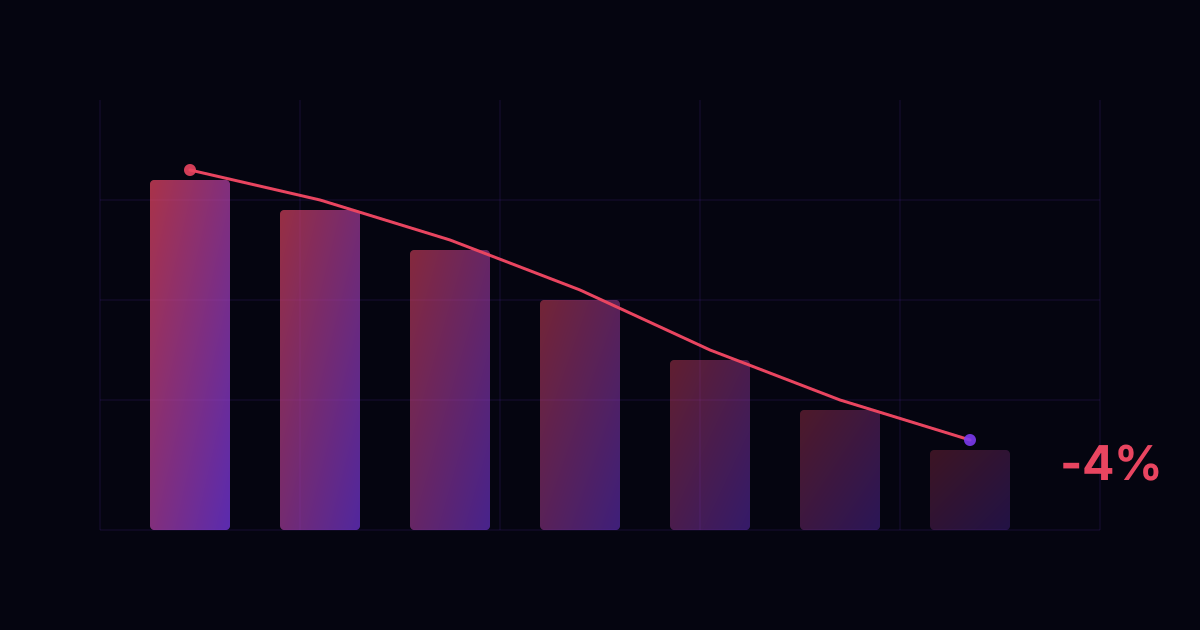
Morgan Stanley surveyed roughly 1,000 executives across five countries and found something jarring: an average net workforce reduction of 4% over the past 12 months, directly attributable to AI adoption. And that’s only in the sectors where AI is currently most advanced.
This isn’t a forecast. It’s a body count.
University of Chicago economist Alex Imas confirmed that aggregate economic data now shows “signs of AI productivity gains” — validating what had previously only appeared in micro-level studies. Harvard’s Jason Furman agrees with Stanford’s Erik Brynjolfsson: the AI productivity boost is finally showing up in the macro numbers.
“It feels like this is the most exciting time to be alive, especially if you’re interested in research,” Imas told Fortune. “But at the same time, I have little kids. I’m super worried about what sort of jobs they’re going to have.”
Exciting and terrifying. The dual reality of 2026.
Altman Said the Quiet Part Out Loud
OpenAI’s CEO told the conference he can envision one to five people running an entire company — and said that transition has compressed to the next few years, not the next decade.
Days earlier in India, he’d been blunter: “The world is not prepared. We are going to have extremely capable models soon. It’s going to be a faster takeoff than I originally thought.”
This is the CEO of the company that built ChatGPT telling a room full of investors that the economic structure we’ve known for generations is about to fundamentally change. And he’s not saying someday. He’s saying the timeline shortened from what even he expected.
The Layoff Wave Has a Name Now
If the conference was theory, the same week delivered practice.
Atlassian cut 1,600 jobs — 10% of its workforce — citing the need to restructure for the “AI era.” The savings go straight into AI development. It follows Block’s AI-attributed cuts earlier this month. Morgan Stanley itself slashed 2,500 positions. Oracle, Capital One, eBay — the list keeps growing.
The numbers from HR Executive tell the story cold: AI was cited in 4,680 job cut announcements in February alone, roughly 10% of the month’s total. Year to date, AI has been attributed to over 12,300 planned cuts — 8% of all announced reductions in 2026.
This isn’t a tech-only phenomenon anymore. Finance, professional services, enterprise software — the wave is spreading faster than even the analysts expected.
The Rich Get Richer. Everyone Else Gets Repriced.
Morgan Stanley’s analysts were unusually blunt about what comes next. Their modeling projects increased spending from high-income consumers — whose portfolios are swelling with AI-driven stock gains — alongside reduced spending from middle- and upper-middle-income consumers whose jobs are most exposed.
Translation: the people building AI get richer. The people whose work AI can replicate get squeezed.
Assets that can’t be replicated — luxury resorts, rare earths, proprietary data, authentic human experiences — hold value. Everything AI can approximate? Deflation.
This tracks with Citrini Research’s viral essay from February that rocked markets by arguing transformative AI will drive deflation across entire industries. Morgan Stanley now largely agrees. “We are continually surprised at how quickly, and violently, this prediction has become a key investor debate,” the bank wrote in its conference notes.
“2026 Is Gonna Be Insane”
The most striking quote didn’t come from a keynote. It came from a retirement announcement.
Jimmy Ba, cofounder of xAI, said upon stepping down: “Recursive self-improvement loops likely do live in the next 12 months. 2026 is gonna be insane and likely the busiest and most consequential year for the future of our species.”
Morgan Stanley’s own analysts predicted a non-linear jump in model capabilities between April and June. Meanwhile, Jensen Huang summed up the supply side in three words: “Compute equals revenue.” Demand for computing power is “higher than incredibly high,” with AWS ramping “like mad.”
The infrastructure buildout isn’t slowing. The models aren’t plateauing. And the displacement is accelerating.
What Actually Matters Here
Here’s the uncomfortable synthesis: the people building AI are telling you, clearly and publicly, that the pace of change is faster than they expected and the economic consequences are larger than most realize.
If you work in knowledge work — writing, coding, analysis, customer support, middle management, legal research, financial modeling — the value of your labor is being repriced in real time. That 4% isn’t the end state. It’s the opening act.
The venture capital world is already buzzing about who’ll build the first “one-person unicorn” — a billion-dollar company run by a single founder wielding agentic AI. Whether that’s inspiring or terrifying depends entirely on where you sit in the economic food chain.
The question Morgan Stanley’s investors kept asking — “What will our kids do?” — deserves a better answer than anyone at that conference could give.
Nobody has one yet.