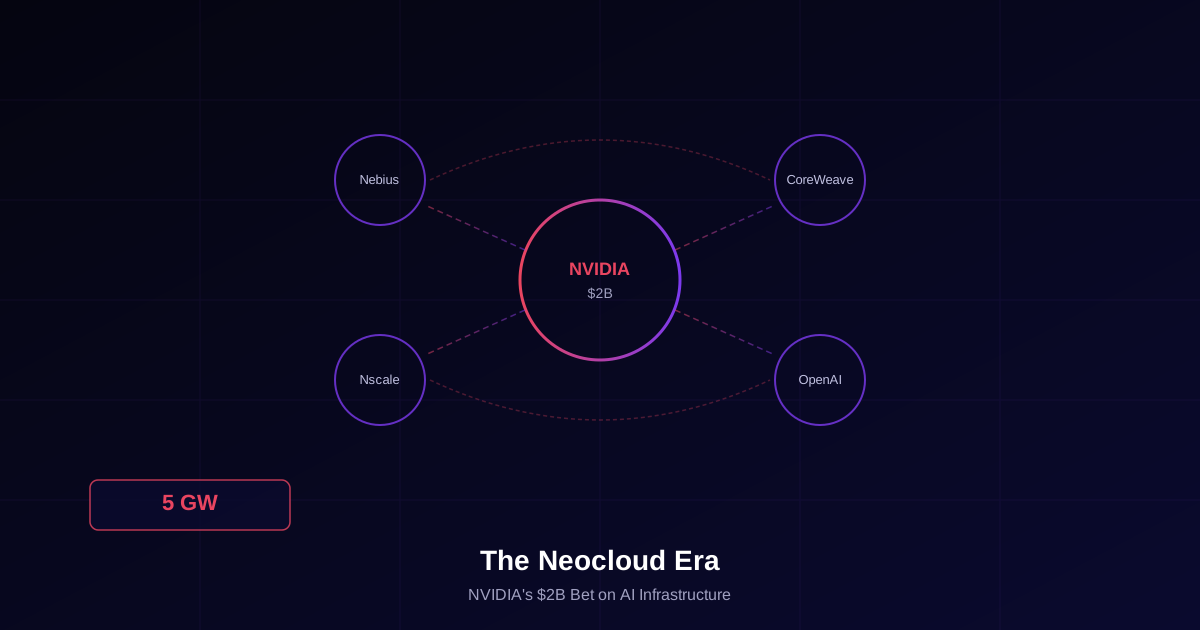
NVIDIA just wrote another $2 billion check. This time it’s going to Nebius Group, a Dutch-headquartered AI cloud company that crawled out of the wreckage of Russia’s Yandex. Nebius stock popped 16% on the news. And somewhere, a critic muttered something about circular investments.
They’re not wrong. But the story is more interesting than that.
What Is Nebius?
Nebius isn’t your typical cloud startup. After Yandex split its international operations amid geopolitical fallout, Nebius rebranded, relocated to Amsterdam, and went all-in on AI-specific cloud infrastructure. No general-purpose computing. No email hosting. Every server optimized for one thing: running AI workloads.
The strategy is working. Nebius has already landed a $17 billion infrastructure deal with Microsoft and a $3 billion deal with Meta. Its 300-megawatt cloud campus under construction in New Jersey exists for one purpose — housing AI training and inference at scale.
For NVIDIA, this is the dream partner: a company that will buy mountains of its hardware while showcasing the latest tech stack. Under this deal, Nebius gets early access to next-gen Rubin GPUs, Vera CPUs, and BlueField storage systems — hardware reportedly delivering 10x better performance per watt than the current Blackwell generation.
The Neocloud Layer Is Real Now
The term “neocloud” has been building momentum, but 2026 is when it became impossible to ignore. Unlike AWS, Azure, and Google Cloud — generalists that serve everything from e-commerce to email — neoclouds are laser-focused on AI. GPU-rich infrastructure, optimized networking, managed services built specifically for training and running large models.
Nebius, CoreWeave, Lambda, Nscale — they’re all competing here, and they’re scaling fast. CoreWeave went public in early 2025 and now holds multi-billion-dollar contracts with the biggest names in tech. Nebius is on the same trajectory.
The pitch is simple: hyperscalers are generalists. When you need to spin up thousands of GPUs for a training run, you want a provider that lives and breathes that workload. Better GPU utilization, faster deployment, purpose-built tooling.
Nebius’s Token Factory service is a good example — autoscaling inference with speculative decoding and safety guardrails, wrapping open-source models like NVIDIA’s Nemotron 3 Super (120B parameters, but only activates one-tenth per query). It’s the middle ground between running your own hardware and paying OpenAI’s API prices.
Five Gigawatts. Let That Sink In.
Nebius plans to deploy more than 5 gigawatts of computing capacity by 2030. That’s enough to power over 4 million American households. Five nuclear reactors’ worth of electricity, dedicated entirely to AI computation.
And they’re not alone. CoreWeave has the same 5-gigawatt target. NVIDIA has committed to at least 10 gigawatts for OpenAI. Add it all up across NVIDIA’s partner ecosystem, and you’re looking at power consumption that rivals small countries.
The conversation has shifted. It’s no longer “can we get enough GPUs?” It’s “can we get enough electricity?” Jensen Huang is betting yes, calling this the “agentic era” — autonomous AI agents that will drive compute demand far beyond what chatbots require.
The Circular Investment Problem
Here’s where it gets uncomfortable. NVIDIA’s investment playbook in 2026:
- January: $2 billion into CoreWeave
- February: $30 billion into OpenAI’s $110 billion funding round
- March (this week): $2 billion into Nebius, $2 billion into Nscale, plus stakes in Lumentum and Coherent
- Previously: Up to $10 billion planned for Anthropic, $2 billion in Synopsys
The pattern is obvious. Nearly every company NVIDIA invests in is also a major NVIDIA customer. Nebius will use the investment capital to buy NVIDIA hardware. CoreWeave uses its NVIDIA investment to buy more NVIDIA GPUs. The money flows in a circle.
The Motley Fool put it bluntly: this deal “won’t do anything to silence the critics.” Mercury News called it “circular investments fueling a bubble.”
NVIDIA’s defense: it’s ecosystem-building, not a Ponzi scheme. The company takes equity stakes, betting on long-term partner success. And the end-customer demand — Microsoft, Meta, OpenAI, enterprise AI adopters — is real. Nebius isn’t just recycling NVIDIA’s cash; it’s building infrastructure that powers actual workloads.
Fair point. But the circularity is undeniable. This looks brilliant in a boom. In a downturn, the interconnected web of investments amplifies the fallout instead of containing it.
What This Actually Means
Neoclouds are a permanent layer now. Microsoft and Meta aren’t building all their AI capacity in-house — they’re partnering with these specialists. The market has validated the model.
Power is the new GPU. Gigawatt-scale commitments will test energy grids worldwide. This is the bottleneck that matters now.
NVIDIA’s ecosystem play is working — for now. Investing in customers ensures next-gen hardware gets deployed fast. Intel ran this play in the 1990s. It worked beautifully until it didn’t.
The risk is real. If AI demand growth slows by even six months, these interconnected bets could unravel fast. The scale of commitment — tens of gigawatts, hundreds of billions — assumes AI agents become as ubiquitous as mobile apps.
That future might arrive. But the margin for error just keeps getting thinner.