Forget March Madness. The real buzzer-beater lands Monday when Jensen Huang takes the stage at San Jose’s SAP Center for GTC 2026 — and the pre-game leaks suggest this could be the most consequential tech keynote in years.
NVIDIA is now the world’s most valuable company at roughly $4.6 trillion. GTC has evolved from a niche developer gathering into a market-moving, policy-shaping global event. Nearly 20,000 attendees from 190 countries. Millions on the livestream. And an entire industry holding its breath.
Vera Rubin: 336 Billion Transistors of Raw Power
The headline act is the formal launch of Vera Rubin — the Blackwell successor named after the astronomer who proved dark matter exists. Appropriately, the chip’s ambitions are massive and somewhat mysterious.
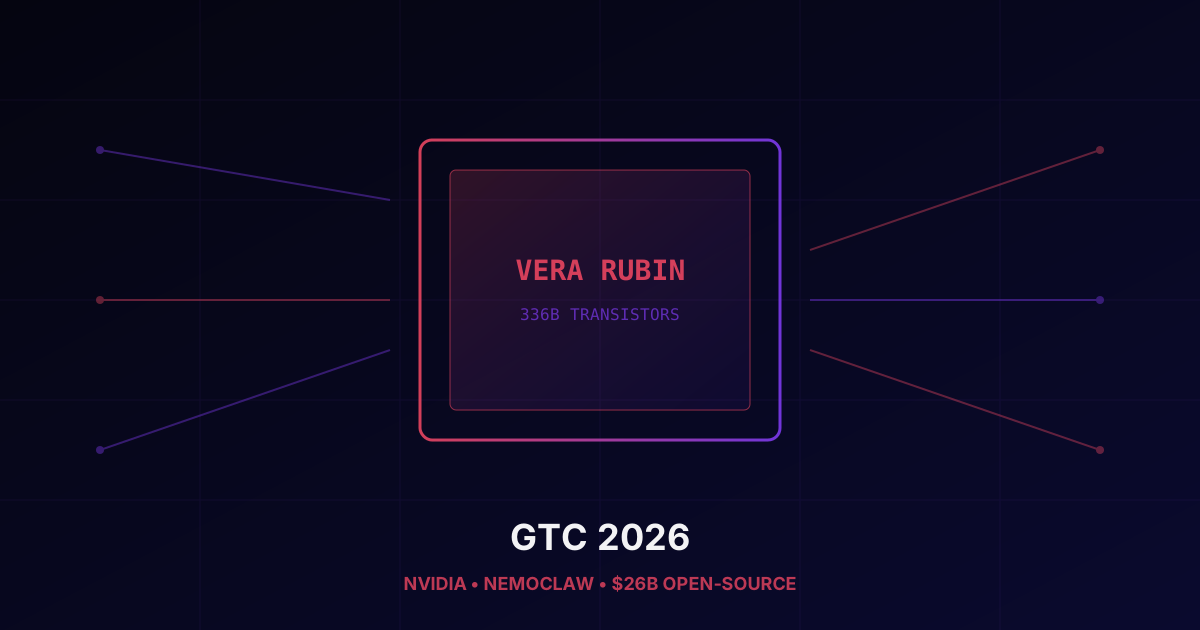
The specs are staggering: 336 billion transistors, HBM4 memory, and a reported 3.3x to 5x performance leap over Blackwell on FP4 workloads. It’s specifically optimized for the Mixture-of-Experts (MoE) models dominating enterprise AI.
But it’s not just a faster GPU. NVIDIA is pairing it with a custom ARM-based “Vera” CPU — replacing Grace — to create an integrated superchip built for the data throughput demands of autonomous AI agents. Not a faster calculator. A complete brain.
Hyperscalers like Microsoft and Meta already have early samples. Their feedback points to a 5x leap in inference performance. When every AI company is serving billions of queries daily, that’s not incremental — it’s transformational.
The Feynman Tease: 1.6nm and Silicon Photonics
The most electrifying rumor: Huang will preview the 2028 Feynman architecture. First chip on TSMC’s 1.6nm (A16) process node. And potentially the industry’s white whale — silicon photonics.
The problem is simple. AI data centers have scaled to gigawatt proportions, and copper interconnects are becoming a fundamental bottleneck. Silicon photonics — replacing electrical signals with light within the rack — could solve the energy efficiency crisis choking massive AI factories.
If NVIDIA skips the 2nm node entirely to land on 1.6nm with backside power delivery, it extends its lead over every competitor by years. AMD’s MI400, Intel’s Gaudi chips — they’d be playing a different sport entirely.
NemoClaw: The Play for the Agent Economy
Hardware is half the story. The strategically significant announcement might be NemoClaw — an open-source AI agent platform built for enterprise deployment.
First reported by WIRED and confirmed by CNBC, NemoClaw has already been pitched to Salesforce and Google. The platform lets companies deploy AI agents that don’t just answer questions but perform tasks — navigating complex software, executing multi-step workflows, operating with minimal human oversight.
This is NVIDIA’s clearest play for the software layer. By offering an open-source agent framework, NVIDIA ensures every enterprise AI agent runs on its ecosystem, which drives demand for more NVIDIA chips.
Same playbook that made CUDA the default language of AI development. Give away the software, sell the silicon. History says it works devastatingly well.
The $26 Billion Open-Source Chess Move
WIRED revealed NVIDIA plans to spend $26 billion over five years building open-weight AI models. This isn’t charity — it’s strategy.
Three birds, one stone. Developers stay inside the NVIDIA ecosystem (every model trained on NVIDIA hardware reinforces the CUDA moat). It undercuts the “NVIDIA tax” narrative by democratizing powerful AI. And it positions NVIDIA as the Switzerland of AI — not aligned with any frontier lab, powering all of them.
Combined with the Nebius $2 billion cloud investment and a significant stake in Mira Murati’s Thinking Machines startup (receiving over 1 GW of NVIDIA chips), Huang is deploying capital across every layer of what he calls the “5 Layer Cake” of AI: energy, chips, infrastructure, models, and applications.
NVIDIA isn’t selling shovels in the gold rush anymore. It’s buying the mines, building the roads, and opening the general store.
The Capex Arms Race Backdrop
The spending context is staggering. Amazon: $200 billion in planned 2026 capex. Alphabet: $180 billion. Microsoft: $155 billion. Over half a trillion from three companies, much of it flowing into NVIDIA’s order book.
But scrutiny follows the money. NVIDIA’s stock has retraced 11% from late 2025 highs. The DOJ has escalated its investigation, issuing subpoenas regarding alleged “loyalty penalties” used to deter customers from exploring rival hardware.
The competitive landscape is splitting into camps. AMD positions MI400 as the “80% performance at lower cost” value play. Broadcom has emerged as the backbone of AI networking and custom silicon. Amazon’s Trainium 3 represents hyperscalers’ desire to reduce NVIDIA dependence entirely.
The fundamental question: does this look more like the transformative internet buildout of the late ’90s, or the fiber-optic bubble that burst in 2001? GTC 2026 is where NVIDIA makes its case.
Why You Should Care
The shift to agentic AI means your work tools are about to get dramatically more capable. Not AI that drafts emails — AI that sends them, schedules meetings, files reports, and manages projects with minimal oversight. NemoClaw is designed to make this enterprise-grade.
Vera Rubin’s inference improvements mean faster, cheaper AI responses. Better consumer products, more responsive voice assistants, AI embedded in everything from car navigation to medical diagnostics. (80% of physicians now use AI professionally — double the 2023 rate, per the AMA.)
And that $26 billion open-source commitment could give smaller startups and developing nations the tools to compete with tech giants.
The Bottom Line
GTC 2026 arrives at maximum tension. Hype is maturing. Investors want receipts. Regulators are circling. The technical challenges of scaling AI are harder to ignore.
If Vera Rubin benchmarks hold up, NemoClaw gains traction, and the Feynman tease signals a credible path to silicon photonics — NVIDIA won’t just maintain dominance. It’ll redefine what dominance looks like.
The leather jacket has never had so much riding on it.