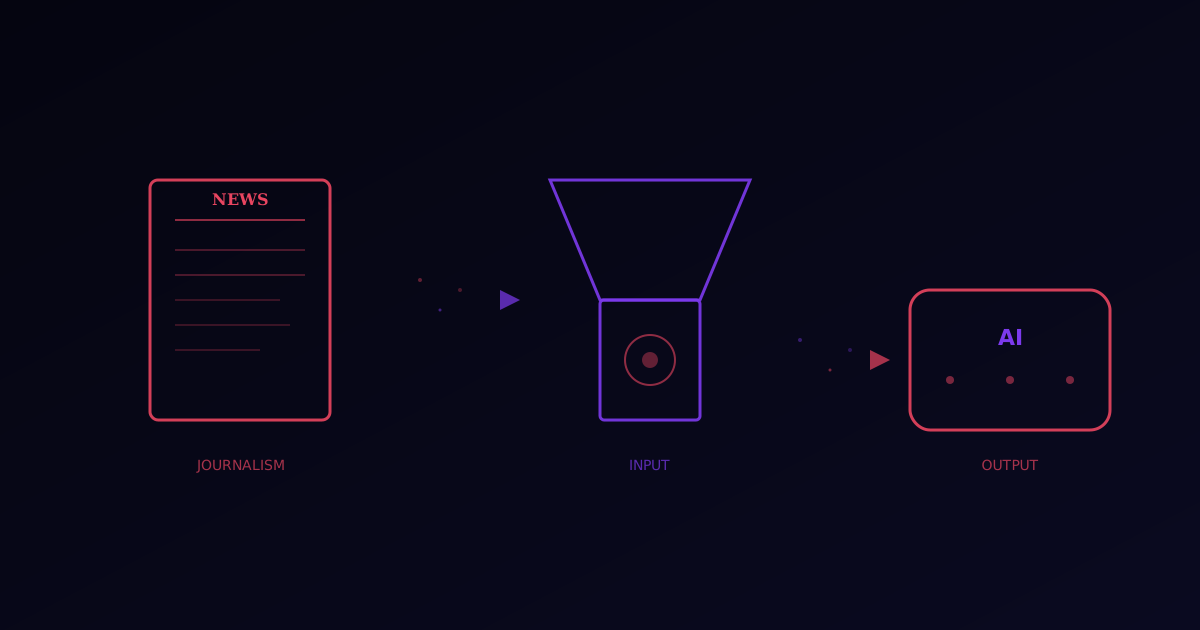
There’s a phrase that should keep every publisher up at night: “We’re essentially an input company.”
That’s Robert Thomson, CEO of News Corp — the Murdoch empire behind The Wall Street Journal, the New York Post, and The Times of London — casually redefining his company’s identity at a Morgan Stanley conference. He said it like it was obvious. And maybe that’s the scariest part.
The Deal That Sparked It
News Corp just signed a deal with Meta worth up to $50 million per year over at least three years. That’s roughly $150 million for the right to scrape WSJ, the Post, and other News Corp brands to train Meta’s AI models and power Meta AI chatbot responses.
This isn’t Thomson’s first content fire sale. News Corp inked a $250 million, five-year deal with OpenAI back in 2024. The man is systematically licensing his empire’s journalism to every AI company with a checkbook. And his pitch to holdouts is refreshingly blunt:
“We have what you might call a woo and a sue strategy. We’ll woo you. We’d like you to be our partner. But if you’re stealing our stuff, we are going to sue you.”
It’s a mafia-adjacent negotiation tactic dressed in corporate polish. And it’s working.
When Journalism Becomes a Commodity
Here’s where Thomson’s “input company” framing gets uncomfortable.
In traditional media, publishers were the output. They produced the final product. You bought the newspaper. You visited the website. The publisher owned the relationship with the reader.
In the AI era, Thomson is openly admitting that News Corp’s journalism is just fuel. The actual output — the thing consumers interact with — is Meta AI or ChatGPT, serving up synthesized Journal reporting without anyone ever clicking through to wsj.com.
Thomson even identified the shift himself: “The great threat in the age of AI is going to be to what you might call output companies.” He’s positioning News Corp on what he sees as the safer side.
But is it actually safer? He compared journalism to semiconductors and data centers — raw materials feeding a larger machine. The problem: semiconductors are commodities. Their producers compete on price and volume, face brutal margins, and live under constant threat of being replaced by the next generation.
Is that really the future News Corp wants for journalism?
The AI Content Arms Race
News Corp’s deal doesn’t exist in isolation. It’s part of an accelerating land grab:
- News Corp + OpenAI: $250M over 5 years (2024)
- News Corp + Meta: ~$150M over 3+ years (March 2026)
- Meta + CNN, Fox News, USA Today, People: Undisclosed multi-year deals (late 2025)
- AP + Google: Undisclosed real-time feed (January 2025)
Meanwhile, The New York Times chose litigation over licensing — suing OpenAI and Microsoft. Danish publishers followed suit. The industry is splitting into two camps: those who license and those who litigate. The licensors are cashing checks now. The litigators might get paid more later, or might get nothing.
But there’s a third group nobody talks about: the thousands of smaller publishers, bloggers, and independent journalists whose content gets scraped without any deal at all. The AI licensing boom is really a story about big media monetizing access that was already being taken. Smaller players don’t have the leverage to demand $50 million a year.
The Long Game Problem
Thomson is playing the hand he’s been dealt well. Getting paid $50 million a year beats getting scraped for free. But the long game is murky.
What happens when AI models become good enough that they need less training data? What happens when synthetic data replaces real journalism as a training input? What happens when the three-year deal expires and Meta decides it doesn’t need News Corp anymore?
The semiconductor analogy cuts both ways. Chips are essential — until the next architecture makes yours obsolete.
Thomson’s “input company” branding is the kind of corporate honesty that might age like milk. The real question isn’t whether journalism is an input for AI — it obviously is. The question is whether being an input is enough to sustain the kind of journalism society actually needs.
Right now, News Corp is getting paid. But when the CEO of a century-old media empire describes his company as raw material for someone else’s product, it’s worth asking: who’s really winning this deal?