There’s a dirty secret in the AI agent world: most teams running Claude Opus are burning money for bragging rights.
Don’t get me wrong — Opus 4.6 is a beast. It tops SWE-bench at 80.9%, handles 200K context windows without breaking a sweat, and orchestrates multi-tool workflows like a conductor with perfect pitch. But at $15 per million tokens (blended), it’s the filet mignon of language models. And most of us are building tacos.
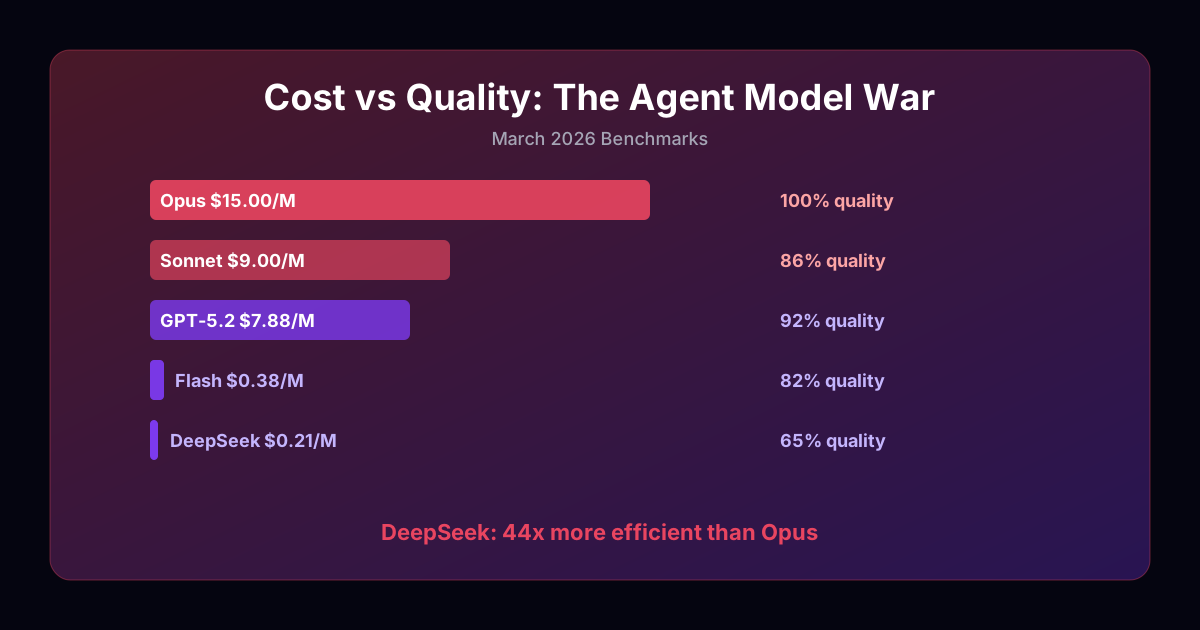
The March 2026 benchmarks tell a story that should make every AI team rethink their model budget.
The Numbers That Should Scare Opus Fans
Here’s the uncomfortable truth, laid out in cold efficiency metrics:
Gemini 2.5 Flash delivers roughly 82% of Opus quality at 2.5% of the cost. That’s not a typo. It scores 36% on Terminal-Bench (Opus hits 44%), nails 80% on τ²-Bench enterprise tool use (Opus: 90%), and actually beats Opus on instruction following — 78% vs 58% on IFBench.
DeepSeek V3 gets you about 65% of Opus quality at 1.4% of the cost. With off-peak pricing, that drops to $0.07 per million input tokens. Seven cents.
Even Claude’s own Sonnet 4.6 — same family, same DNA — was preferred over the previous Opus 4.5 by 59% of developers in head-to-head testing. At 60% of Opus pricing.
The Value Champions
After crunching quality-per-dollar across every major agentic benchmark, here’s what shakes out:
For production agents at scale: Gemini 2.5 Flash ($0.15/$0.60)
This is the model that changed the conversation. A 2-million-token context window (10x Opus), a free tier with 1,000 daily requests, and performance that makes you question why you’re paying premium prices. It handles customer service bots, data pipelines, and straightforward coding agents without flinching. At 31x more cost-efficient than Opus, it’s the default choice unless you specifically need peak performance.
For professional development work: Claude Sonnet 4.6 ($3/$15) or GPT-5.2 ($1.75/$14)
The sweet spot for teams that need real quality but can’t justify Opus pricing. Sonnet 4.6 excels at code review, multi-step tasks, and the daily grind of software development. GPT-5.2 matches Opus on several benchmarks — including a near-identical 80% on SWE-bench — at roughly half the cost.
For budget operations: DeepSeek V3 ($0.14/$0.28)
The most efficient model in the entire market. Period. DeepSeek V3.2 was trained on 1,800+ agent environments with 85,000+ instructions, making it shockingly capable at structured, high-volume tasks. If you’re running thousands of agent calls per day on anything less than brain-surgery-level complexity, this is your model.
For self-hosted and privacy-sensitive: Qwen3-Coder-30B-A3B
Only 3.3 billion active parameters (it’s a mixture-of-experts architecture), runs on consumer hardware, and delivers state-of-the-art open-source coding performance. It works with Claude Code, Roo Code, and CLINE out of the box. The 256K context window extends to 1M when you need it.
Where Opus Still Earns Its Keep
Before the Opus defenders @ me — yes, there are workloads where nothing else will do:
- Large repository refactors involving dozens of interconnected files
- Critical multi-agent orchestration with 100+ tool calls in a chain
- The hardest SWE-bench problems where that extra 10-15% accuracy margin matters
- Complex reasoning chains where one wrong step cascades into garbage output
Opus and GPT-5.2 Pro ($21/$168 at the pro tier) remain the ceiling. When the stakes are “this production deployment cannot fail,” you pay for the best.
But those workloads? They’re maybe 20% of what most teams actually run.
The Smart Play: Model Routing
The teams getting this right aren’t picking one model — they’re routing. Use Gemini 2.5 Flash for 80% of requests (the routine stuff), bump complex queries to Sonnet 4.6, and reserve Opus for the genuinely hard problems.
Add prompt caching (which slashes input costs by 75-90% on repeated prompts) and you’re looking at 60-80% savings versus running Opus across the board.
The math is simple. If Opus is a 100 on quality and costs $15/M tokens, and Flash is an 82 at $0.38/M, you’d need Opus to be solving problems worth 40x more per token to justify the premium on routine work. For most agent tasks, it isn’t.
The Bigger Picture
The gap between top-tier and mid-tier models has been narrowing all year, and March 2026 might be the inflection point where “good enough” became genuinely good. Open-source models like GLM-4.5-Air — the first model designed from the ground up for agent workflows — are Apache 2.0 licensed and closing fast.
We’re entering an era where model selection isn’t about finding the “best” model. It’s about finding the right model for each task at the right price point. The teams that figure this out first will build agents that are not just smarter, but sustainable.
The filet mignon is still delicious. But the taco shop down the street just got a Michelin star.
Benchmark data sourced from WhatLLM.org agentic rankings (Jan 2026), SWE-bench Verified (Epoch AI, Feb 2026), BFCL v4 (Berkeley), and current model pricing pages.