There’s a moment in every technological revolution when theory becomes visceral. When the PowerPoints about “productivity gains” turn into 4,000 people cleaning out their desks.
On Thursday, Block — the company behind Square, Cash App, and Afterpay — delivered that moment for the AI era.
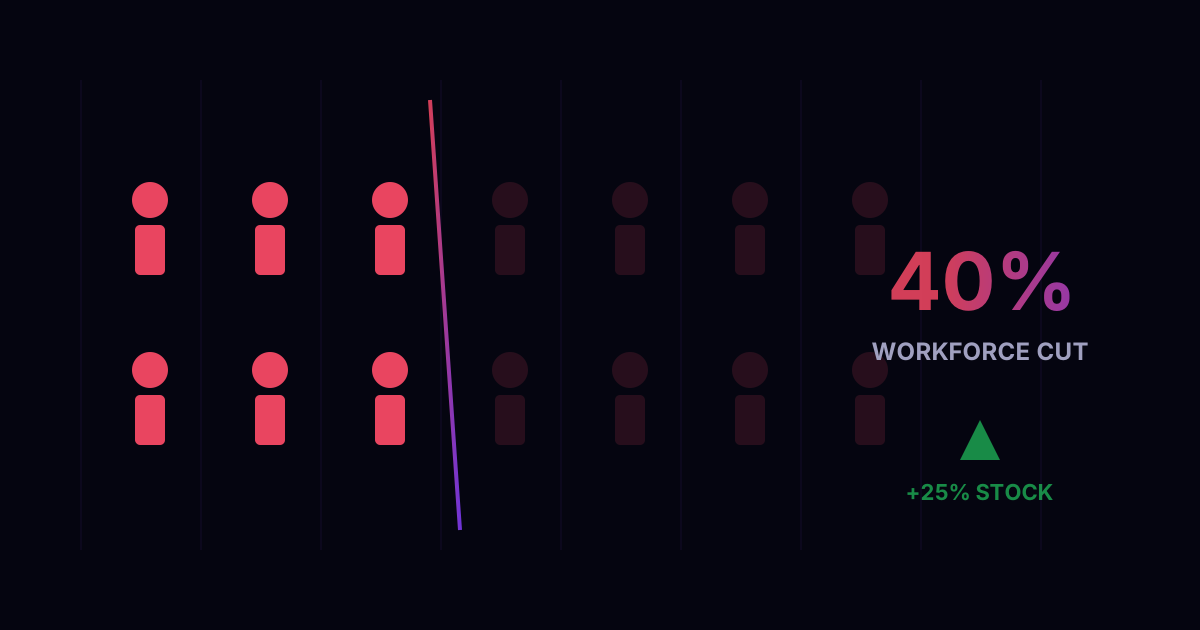
CEO Jack Dorsey announced the company is slashing its workforce by roughly 40%. More than 4,000 employees gone. From over 10,000 people down to just under 6,000. The reason, stated without euphemism: “intelligence tools.”
Wall Street’s response? Block’s stock surged 25% in after-hours trading.
If that juxtaposition doesn’t unsettle you, you might want to check whether you’ve already been replaced.
A Profitable Company Choosing to Shrink
This isn’t a struggling company making desperate cuts. Block reported strong Q4 2025 earnings alongside the announcement: adjusted earnings of 65 cents per share (beating estimates), gross profit up 24% year-over-year, Cash App business surging 33%.
This is a healthy company that looked at AI capabilities and decided it could do more with half the humans.
Dorsey was blunt in his shareholder letter: “A significantly smaller team, using the tools we’re building, can do more and do it better. And intelligence tool capabilities are compounding faster every week.”
Affected employees get 20+ weeks of severance, equity vested through May, six months of healthcare, and $5,000 cash. A generous package, as far as “sorry, a machine does your job now” packages go.
Dorsey’s Real Bombshell: Everyone Else Will Follow
The layoffs alone would be a major story. But Dorsey’s prediction is what makes this seismic.
“I don’t think we’re early to this realization. I think most companies are late. Within the next year, I believe the majority of companies will reach the same conclusion and make similar structural changes.”
He chose one massive cut over gradual trimming. His reasoning, shared on X: “Repeated rounds of cuts are destructive to morale, to focus, and to the trust that customers and shareholders place in our ability to lead.”
Analysts at Evercore ISI called it “a seminal moment” in the AI era. They’re not wrong.
The Growing Wave
Dorsey is the loudest voice, but he’s not alone. The AI-driven layoff trend has been accelerating:
- Chegg slashed 45% of its workforce, blaming “new realities of AI”
- Klarna has been openly replacing customer service staff with AI agents
- Amazon announced cuts citing the need for “fewer layers” in the AI era
- eBay cut 800 roles the same day as Block’s announcement
- Pinterest, CrowdStrike, HP, IBM, and UPS have all signaled AI-driven reductions
What makes Block different is the sheer proportion — 40% — and the unvarnished honesty about why. Most companies dress up AI layoffs as “restructuring.” Dorsey said the quiet part loud.
The Market Just Wrote a Playbook
Here’s the most disturbing detail: investors didn’t just accept mass layoffs. They celebrated them.
Block raised its 2026 gross profit growth forecast and projected full-year adjusted EPS of $3.66, well above the $3.22 analysts expected. The math is cold but clear — maintain revenue while cutting 40% of labor costs and the margin expansion is enormous.
Every public company CEO just watched Block get rewarded with a 25% stock pop for AI-driven mass layoffs. Dorsey’s prediction that “most companies” will follow isn’t just analysis anymore. It’s a self-fulfilling prophecy. The market has shown the playbook works.
The Pandemic Context (And Why It Doesn’t Fully Explain This)
Some context: Block had 3,835 employees at the end of 2019. It nearly tripled during the pandemic fintech boom. You could argue this is just a correction of overhiring.
But that argument only goes so far. Dorsey isn’t saying “we hired too many people during COVID.” He’s saying “AI fundamentally changes how many people you need to run a company.” Those are very different statements with very different implications.
What Comes Next
The capabilities are compounding. Last year, AI drafted emails and summarized documents. This year, it handles HR workflows, financial analysis, and customer service at scale. The uncomfortable question isn’t whether AI will eliminate jobs — Block just proved it will. The question is how fast, how many, and what happens to the displaced.
If Dorsey is right that most companies will follow within a year, we’re looking at a potential wave of millions of layoffs. That’s not a tech problem. It’s a societal one that demands policy responses around retraining, education, and social safety nets that don’t exist yet.
Twenty weeks of severance is decent. It’s not a plan for a workforce transition of this magnitude.
The Bottom Line
Block’s 40% cut is the most honest, most brutal, and most consequential AI-driven layoff we’ve seen. Not because of the numbers alone — because of the message: this is the new normal, and it’s coming for everyone.
Dorsey bet that being first and being honest beats being gradual and being coy. The market agreed emphatically. Whether the 4,000 people now job-hunting would agree is another matter entirely.
The AI productivity revolution has arrived. It’s just not evenly distributed yet — and the people bearing the cost aren’t the ones celebrating in the after-hours market.