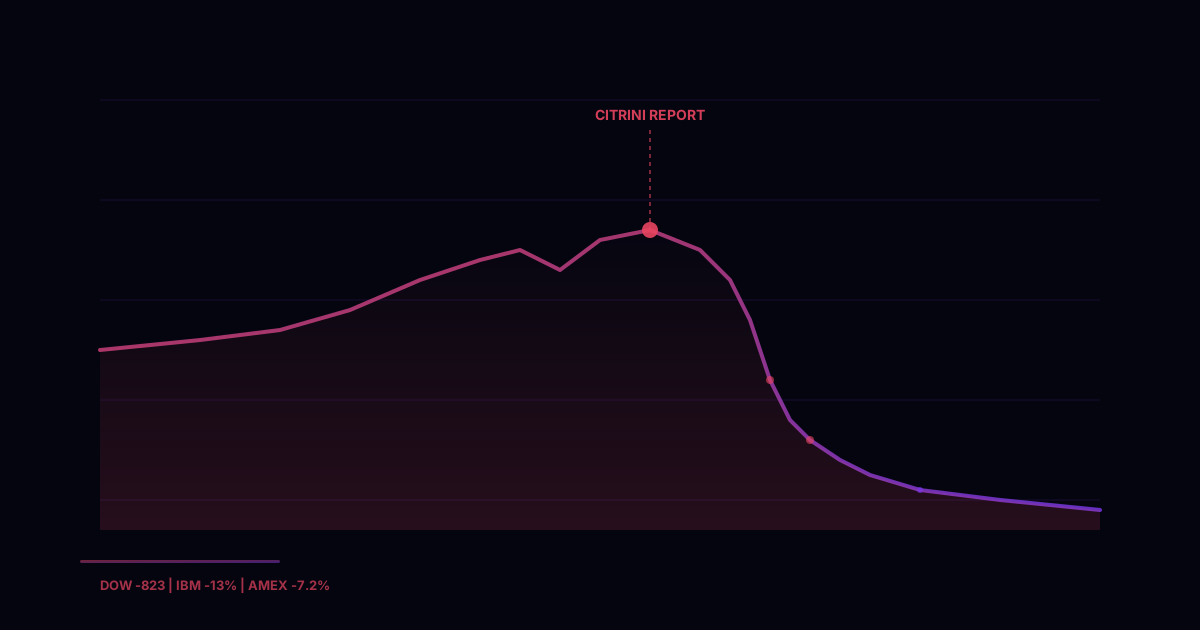
Not a Goldman Sachs research paper. Not a Fortune 500 earnings miss. A speculative thought experiment on a blogging platform — written by a firm most people had never heard of — just erased billions in market cap.
DoorDash dropped 7%. American Express fell 7.2%, its worst day since April. IBM cratered 13% — worst since 2000. MongoDB and AppLovin slid 8%. The Dow shed 823 points. All because people read a scary story on the internet and two famous contrarians hit “share.”
Welcome to the AI scare trade.
The Report
On Sunday, Citrini Research published “The 2028 Global Intelligence Crisis” on Substack. They were explicit: this was “a scenario, not a prediction.” Speculative fiction dressed up with market analysis.
The scenario runs from early 2026 to June 2028, and the dominoes fall fast:
Software gets eaten. AI agents replace SaaS tools. Why pay for Monday.com when Claude can manage your workflows? Oracle, Salesforce, and ServiceNow enter a pricing death spiral as businesses vibe-code their own internal tools.
Middlemen get disintermediated. Personal AI agents handle transactions, bookings, and purchases directly. DoorDash, travel agencies, even Visa and Mastercard — all bypassed as AI agents switch to stablecoins with lower transaction fees.
White-collar unemployment spirals. Mass layoffs hit, but unlike previous disruptions, there’s nowhere for displaced workers to go. AI improves at the very tasks humans would redeploy to. Displaced coders can’t pivot to “AI management” because AI already does that.
Consumer spending collapses. Unemployed people don’t spend. GDP keeps growing thanks to AI productivity, but it’s “ghost GDP” — output that shows up in national accounts but never circulates through the real economy. By June 2028: 10.2% unemployment and a full-blown crisis.
Bleak? Absolutely. Fiction? Technically yes. But it hit a nerve.
The Amplifiers
The Citrini report didn’t move markets because it was right. It moved markets because it crystallized a fear already bubbling under the surface.
Software stocks have been getting hammered all month in the “SaaSpocalypse.” Since Anthropic launched Claude Cowork in early February, investors have been reassessing whether traditional software companies can survive when AI replicates their products cheaply and quickly.
“The seemingly wide moats of these companies feel a lot more narrow today,” Ocean Park Asset Management CIO James St. Aubin told Reuters. “Perhaps this is an overreaction, but the threat is real.”
Into this jittery market, the Citrini report landed like a match on dry timber. Then the amplifiers kicked in.
Michael Burry — the guy from “The Big Short” who predicted the 2008 housing crash — shared the report to millions of followers on X. His commentary was vintage Burry: “And you think I’m bearish.”
When the man who called the last major financial crisis signals that an AI doomsday scenario deserves attention, people pay attention. Monday’s trading session was the result.
Nassim Taleb — “The Black Swan” author and one of the most influential risk thinkers alive — appeared on Bloomberg TV with his own warning. Software companies will “definitely” face bankruptcies, he said. The gains concentrated in AI-hyped stocks will be “eradicated.”
His historical analogy cuts deep: the companies that pioneer a technology are rarely the ones that dominate it. The Wright brothers didn’t build Boeing. The first automakers didn’t become Ford and GM. Why should current AI leaders be any different?
Between Citrini’s fictional 2028, Burry’s cryptic endorsement, and Taleb’s probabilistic doom, Wall Street experienced something like a coordinated narrative attack — except nobody coordinated it. It was emergent. A feedback loop of fear.
The Part That’s Actually Worth Worrying About
The Citrini report is overwrought. The timeline is compressed to absurdity. AI agents aren’t replacing DoorDash by 2028. Stablecoins aren’t dethroning Visa in two years.
But the dynamics it describes? Those deserve serious attention.
“Ghost GDP” — where AI productivity gains show up in aggregate numbers but don’t translate to wages or consumer spending — is a real concern. We’re already seeing early hints. Corporate profits are healthy. AI efficiency gains are real. But wage growth is stagnating, and the labor market is softening in white-collar sectors.
If AI lets a company do the work of 100 people with 20 people and a few agents, GDP goes up. Margins improve. But 80 people just lost their income. They stop spending. The businesses they patronize suffer. That’s not a 2028 problem — it’s a feedback loop that could start much sooner.
The question isn’t whether AI disrupts industries. It will. The question is whether disruption happens gradually enough for the economy to adapt, or so fast that retraining, new job creation, and market rebalancing can’t keep up.
What to Actually Watch
Forget the doomsday timeline. Here’s what matters:
The SaaSpocalypse has legs. The repricing of software companies is based on real competitive dynamics, not just vibes. If you own SaaS stocks, this isn’t a blip — it’s structural.
AI scare trades will keep happening. Every new capability announcement from Anthropic, OpenAI, or Google will now be analyzed through “who does this kill?” — a fundamentally different dynamic than the “rising tide” mentality of 2024-2025.
Watch the labor market, not stock prices. Hiring data in tech, finance, legal, and consulting is the real canary. If the layoffs Citrini imagines start materializing even partially, the feedback loop becomes real regardless of timeline.
Policy responses will accelerate. Senator Bernie Sanders has already proposed a moratorium on AI data centers. Political pressure on AI companies will intensify as disruption fears grow.
The Real Story
The most remarkable thing about this week isn’t that stocks fell. It’s that a speculative blog post, amplified by two famous contrarians, became a market-moving event.
That tells you something profound about where we are — not just in the AI cycle, but in the information cycle. When fiction can move billions, we’re in uncharted territory.
The AI revolution is real. The disruption is coming. But the pace, scope, and consequences? Nobody knows — not Citrini, not Taleb, not Burry, and definitely not the market.
The only honest position is uncertainty. And as Monday showed us, uncertainty itself can be the most powerful force of all.