It’s not every day that a single product launch wipes out tens of billions of dollars in market capitalization across an entire sector. But that’s exactly what happened last week when Anthropic unleashed Claude Code Security on the world.
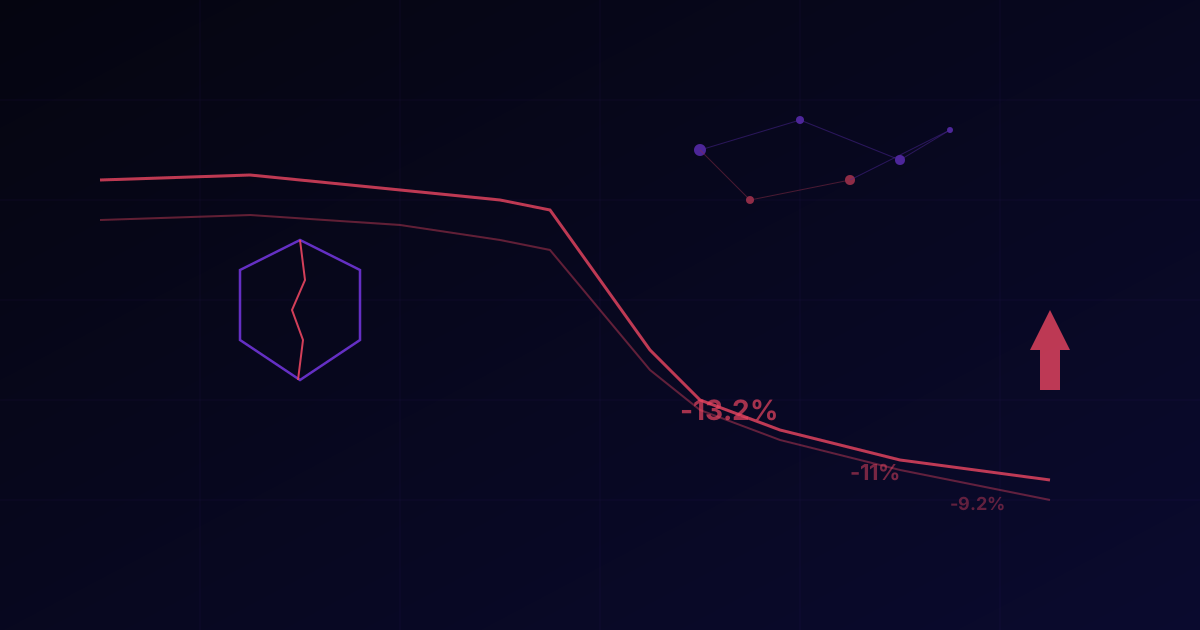
IBM tanked 13.2% on Monday — its worst single-day drop in 25 years. CrowdStrike shed over 11%. Cloudflare fell 8%. Okta cratered 9.2%. JFrog lost nearly a quarter of its value. Nassim Taleb is warning of bankruptcies. Analysts are furiously rewriting their models. And the phrase “the Anthropic Effect” has entered the financial lexicon as shorthand for what happens when AI doesn’t just compete with an industry — it threatens to make it irrelevant.
What Anthropic Actually Built
On February 20, Anthropic rolled out Claude Code Security as a limited research preview for Enterprise and Teams customers. At first glance, it sounds like another static analysis tool. It’s not.
Traditional security scanners match code patterns against known vulnerability signatures. They catch common bugs but miss anything novel, context-dependent, or buried in complex business logic. They’re spell-checkers for security.
Claude Code Security, powered by Claude Opus 4.6, does something fundamentally different. It reasons about code the way a human security researcher would. It maps how application components interact, traces data flows across entire codebases, and identifies vulnerabilities that require understanding the intent of the software — not just its syntax.
The kicker? Anthropic’s Frontier Red Team used the tool to discover and patch over 500 previously unknown zero-day vulnerabilities in production-level open-source software. Bugs that had been sitting there for years, invisible to every existing tool and human audit. That’s not incremental improvement. That’s a paradigm shift.
Why IBM Got Hit the Hardest
IBM’s plunge wasn’t directly about Claude Code Security. It was about a related announcement: Claude Code can now automate COBOL modernization.
Quick primer if you’re unfamiliar: COBOL is a programming language from 1959 that somehow still runs the world. An estimated 95% of U.S. ATM transactions run on COBOL. So do massive chunks of banking, airline, insurance, and government systems. Hundreds of billions of lines of it sit in production today.
The problem? The people who understand COBOL are retiring and dying. Modernizing these systems has been one of the most expensive, painful undertakings in enterprise IT. And IBM built an enormous consulting and mainframe business around that pain.
Anthropic’s blog post was almost surgical: “Legacy code modernization stalled for years because understanding legacy code cost more than rewriting it. AI flips that equation.” Claude Code can now map dependencies across thousands of lines of COBOL, document workflows, and identify risks that would take human analysts months to surface.
For IBM — already down 24% year-to-date — this was an existential announcement dressed up as a product feature.
The Cybersecurity Shockwave
The sell-off started Friday when Claude Code Security was unveiled. CrowdStrike lost 8% that day. By Monday, the bleeding accelerated as analysts spent the weekend doing math that kept coming out ugly.
Here’s the core threat: if AI can autonomously find and patch vulnerabilities at the source — before code ever ships — then what exactly are you paying CrowdStrike, Cloudflare, or Okta for? Their entire business model assumes software ships with bugs, networks get breached, and you need expensive monitoring layers to catch the bad stuff.
Claude Code Security doesn’t just detect threats. It generates natural language explanations of each vulnerability, ranks them by severity, and offers a “suggest fix” button that generates patches. It automates the entire discovery-to-remediation pipeline.
This isn’t theoretical. It’s a working product that found 500 zero-days on its first real outing.
The Pentagon Subplot Makes Everything Weirder
Anthropic is simultaneously locked in a public standoff with the Pentagon — now rebranded as the “Department of War” — over how its technology gets used by the military.
Reports emerged that Claude was used in the operation to capture Venezuelan President Nicolás Maduro, via Anthropic’s contract with Palantir. Anthropic maintains it hasn’t found policy violations, but the Pentagon says the relationship is “being reviewed.”
The tension is fascinating. Anthropic brands itself around AI safety, maintains red lines about lethal autonomous weapons and domestic surveillance, and claims to want guardrails. But it also has a $200 million defense contract and its technology is deployed in classified military operations through Palantir’s networks.
For investors, this adds geopolitical risk on top of market disruption.
Is This a DeepSeek Moment — or Something Bigger?
The obvious comparison is to DeepSeek’s January 2025 shock, when the Chinese startup spooked markets by demonstrating frontier capabilities at a fraction of expected cost. But there’s a crucial difference.
DeepSeek’s impact was about AI economics — proving you didn’t need billions in compute to build competitive models. The Anthropic Effect is about AI capabilities — demonstrating that AI can now do things entire industries were built around doing poorly and expensively.
That’s the difference between “AI might get cheaper” and “AI might make your company unnecessary.” The second one hits harder.
Meanwhile, the arms race accelerates. DeepSeek V4 Lite has surfaced with breakthrough SVG generation capabilities, and OpenAI’s GPT 5.3 (codenamed “Garlic”) reportedly drops February 26 with claims of surpassing human-level common-sense reasoning. OpenAI launched its own cybersecurity tool, Aardvark, back in October 2025 — but Anthropic’s more dramatic demonstration finally spooked the market.
What This Means for Everyone
If you work in cybersecurity or legacy IT consulting: the clock is ticking. Not as in “you have a decade,” but as in “your next quarterly earnings call just got uncomfortable.”
If you’re running legacy systems: this is great news. COBOL modernization that would’ve cost hundreds of millions might now be feasible for a fraction of the price. Security audits requiring expensive consultant teams might be replaceable with an AI tool that does a better job in hours.
For developers: the value isn’t in writing code or finding bugs anymore. It’s in understanding systems, making architectural decisions, and doing creative work AI still can’t replicate. The commodity parts of software engineering are getting commoditized — fast.
For investors: the Anthropic Effect previews what happens when AI gets good enough to threaten entire sectors in a single product announcement. Every industry built on information asymmetry, manual expertise, or technical complexity should be watching.
The Bottom Line
We’re entering an era where a single AI demo can evaporate billions in market cap before lunch. The “Anthropic Effect” isn’t about one company or one tool — it’s about the dawning realization that AI disruption doesn’t arrive gradually. It arrives all at once, in a blog post, on a random Thursday.
The cybersecurity industry isn’t disappearing overnight. Neither is IBM. But the comfortable assumption that incumbents could evolve at their own pace while AI slowly caught up? That assumption died this week.
The question isn’t whether AI will reshape these industries. It’s whether incumbents can adapt faster than the market loses faith in them. Based on this week’s trading, Wall Street has already placed its bet.