Remember when “AI-powered” was the magic phrase that made stock prices go up? Those days are over.
In the first seven weeks of 2026, enterprise software has experienced what might be its worst bloodbath in history. The iShares Expanded Tech-Software Sector ETF (IGV) has plunged over 23% year-to-date, officially entering bear market territory. Salesforce down 28%. ServiceNow down 30%. Adobe’s market cap has cratered from $350 billion to roughly $107 billion. Figma, which IPO’d to fanfare last summer, has collapsed 85% from its 52-week high.
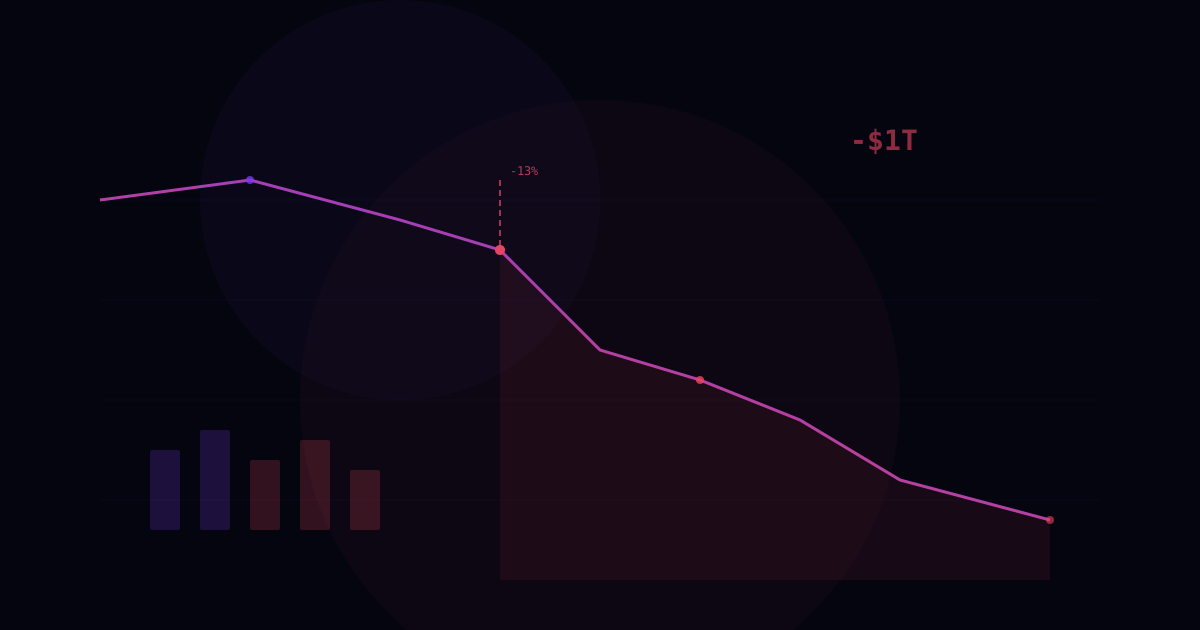
Total damage: an estimated $1 trillion in enterprise software market cap — gone.
And it all started with a single product launch.
Black Tuesday
On February 3rd, Anthropic unveiled Claude Cowork — a suite of AI agents designed to automate complex professional tasks, starting with legal automation. It didn’t just demonstrate that AI could do these things. It showed it could do them now, at production quality, for a fraction of the cost.
Traders at Jefferies christened it “Black Tuesday for Software.” The S&P 500 Software Index dropped 13% in a single day — its worst performance ever. Thomson Reuters plunged 16%. Roughly $285 billion in market value vanished before the closing bell.
But Claude Cowork wasn’t the cause. It was the catalyst. The selloff had been building for years.
Three Years of Declining Growth Nobody Mentioned
Public SaaS growth rates have declined every single quarter since the 2021 peak. Every. Single. Quarter.
Jason Lemkin, the godfather of SaaS, pointed this out on SaaStr — the AI crash narrative simply gave Wall Street permission to reprice what organic growth numbers had been signaling for three years. Strip out price increases from recent SaaS earnings, and the underlying picture looks far worse than headlines suggest.
Software price-to-sales ratios have compressed from 9x to 6x, levels not seen since the mid-2010s. The “AI-washing” era of 2024-2025 — where every SaaS company slapped “AI-powered” on their product and watched the stock rise — is definitively over.
Even Microsoft, which posted a massive $81 billion quarter, saw its stock plunge 10% because Azure growth decelerated from 40% to 39%. A company beats expectations with $81 billion in revenue and still gets punished. That’s how brutal this environment is.
The Real Threat: Seat Compression
The popular narrative is that AI will replace enterprise software entirely. That’s probably wrong — at least near-term. The more accurate threat is something called seat compression.
AI doesn’t need to replace Salesforce to devastate Salesforce’s business model. It just needs to reduce the number of humans who use Salesforce. If an AI agent handles the work of three customer service reps, a company doesn’t need three licenses anymore. It needs one. Maybe zero.
This is why the selloff has been so indiscriminate. It’s not about any individual company’s product quality. It’s about the fundamental economics of per-seat pricing in a world where AI is rapidly reducing headcount in exactly the white-collar roles that drive software consumption.
Only 71% of S&P 500 software companies are beating revenue estimates this quarter, compared to 85% for tech overall. The gap between “software that helps humans work” and “AI that replaces the work entirely” is narrowing fast.
The Bull Case
Not everyone thinks the apocalypse is here. Dan Ives at Wedbush has been the most vocal contrarian, calling the selloff the “most disconnected trade” he’s seen and labeling Salesforce and ServiceNow “historic buys.”
His argument has merit. Enterprise customers are deeply embedded in platforms with high switching costs and long-term contracts. You can’t rip out a company’s entire CRM overnight, no matter how good the AI alternatives get. JPMorgan and Goldman analysts echo similar sentiment — P/S ratios at 6x price in a doomsday scenario that almost certainly won’t fully materialize.
The most likely outcome is a strategic pivot from per-seat to consumption-based or outcome-based pricing. Salesforce won’t die — it’ll evolve. Charge for the value AI agents provide, not the number of humans clicking buttons. Painful transition, but survivable.
AI Is Eating Its Own Hype Cycle
The irony is delicious. For years, AI was the narrative that lifted tech stocks. Now it’s the narrative destroying them. The same technology that fueled the 2023-2025 bull run is now being priced as an existential threat to the entire sector.
This isn’t unprecedented. The internet did the same thing to retail. First, e-commerce boosted every stock with a website. Then it crushed every brick-and-mortar retailer. Some adapted (Walmart, Target). Many didn’t (Sears, JCPenney).
Meanwhile, hyperscalers are planning to spend $660-690 billion on AI infrastructure in 2026 — nearly double 2025. Much of that is being redirected from enterprise software budgets. Companies aren’t cutting tech spending. They’re reallocating it from SaaS subscriptions to AI infrastructure. That’s structural, not cyclical.
What This Means For You
If you work in enterprise software: Your industry is undergoing a fundamental repricing of what human labor is worth in a software context. Companies that can’t articulate how they add value on top of AI will struggle.
If you run a business: You’re about to have enormous leverage in contract negotiations. Every SaaS vendor is terrified of churn right now. Use that.
If you’re an investor: The contrarians might be right short-term. But the long-term structural headwinds for per-seat pricing are real. Look for companies already transitioning to consumption-based models.
If you’re building a startup: Don’t build another per-seat SaaS tool. The market just told you that model is dying. Build AI-native products with outcome-based pricing from day one.
Bottom Line
The SaaSpocalypse isn’t just a stock market story. It’s the moment the AI revolution stopped being theoretical and started showing up in quarterly earnings. For three years, everyone talked about how AI would transform business. Now it’s actually happening — and “transformation” looks a lot like “destruction” if you’re on the wrong side.
The software industry isn’t dead. But the version of it that charges 100 employees $50/month each for a CRM they could automate with an AI agent? That version might be.
The companies that survive will charge for outcomes, not seats. They’ll make AI their product, not their marketing tagline. Everyone else is on borrowed time.