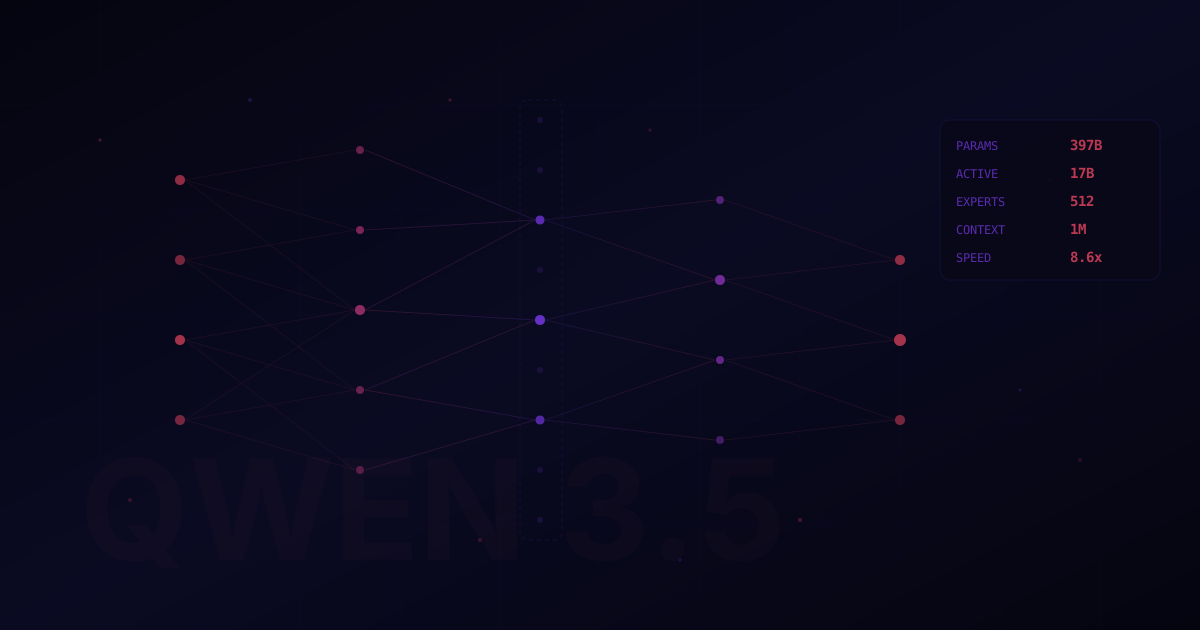
Alibaba just dropped a model with 397 billion parameters that only uses 17 billion of them. And it might be the most important AI release of 2026 so far.
Qwen 3.5 landed on the eve of Chinese New Year — 60% cheaper to run than its predecessor, 8x faster at decoding, and supposedly beating GPT-5.2, Claude Opus 4.5, and Gemini 3 Pro on multiple benchmarks. Bold claims. But even if you discount the scoreboard, the engineering underneath tells a story worth paying attention to.
500 Experts, 11 on the Clock
The secret sauce is a Mixture-of-Experts (MoE) architecture combined with Gated Delta Networks — a linear attention mechanism that sidesteps the brutal scaling costs of standard transformers.
The numbers: 60 layers, 512 expert modules, but each token only activates 10 routed experts plus 1 shared expert. You get the reasoning depth of a 400B model while burning the compute of a 17B one.
Think of it as a hospital with 500 specialists on staff. For any given patient, you call in 11. The rest stay home. You still get world-class care. Your electricity bill doesn’t bankrupt you.
Three out of every four layers use the cheaper linear attention. Only every fourth layer fires up full traditional attention. This 3:1 hybrid pattern is what drives the 8.6x to 19x throughput improvement over previous generations. Not incremental. Categorical.
“Agentic AI” — This Time With Receipts
Every model launch now comes with an “agentic” narrative. Most of it is marketing vapor. Qwen 3.5 actually ships the goods.
The model can look at a UI screenshot and generate the HTML/CSS to replicate it. It navigates mobile and desktop apps autonomously. It supports the Model Context Protocol (MCP) and handles complex function-calling chains — the plumbing you need for AI that actually does things rather than just talks about things.
On IFBench — the instruction-following test that measures whether a model can execute complex, multi-step tasks accurately — Qwen 3.5 scored 76.5, beating several proprietary competitors.
This isn’t academic. Anthropic’s recent agent tools sent software stocks tumbling. Salesforce, ServiceNow, the whole SaaS stack got rattled by the idea that AI agents could replace traditional enterprise software. Alibaba is planting its flag in the same territory.
China’s AI Arms Race Just Shifted Gears
Qwen 3.5 didn’t drop in a vacuum. The same week:
- ByteDance launched Doubao 2.0, also built for the agent era
- Zhipu AI released upgraded agent-capable models
- A new DeepSeek model is reportedly days away
This traces back to Chinese New Year 2025, when DeepSeek’s R1 reasoning model — built at a fraction of Western costs — shocked the industry and briefly overtook ByteDance’s Doubao in downloads. That moment proved a single viral AI release can reshape an entire market overnight. Now everyone’s sprinting.
ByteDance leads with 155 million weekly active users on Doubao. DeepSeek sits at 81.6 million. Alibaba has been catching up — a $433 million promotional blitz drove a 7x increase in active Qwen users earlier this month.
Marc Einstein at Counterpoint Research put it bluntly: companies that aren’t prepared for AI agents to “upend traditional Internet business models” will face “severe” consequences.
Native Multimodal — Not a Bolt-On Job
Here’s a technical detail that matters more than it sounds: Qwen 3.5 is a native vision-language model trained via Early Fusion. Images and text were learned together from the start, not stitched after the fact.
Why care? Models with grafted-on vision stumble when tasks require deep integration between seeing and reasoning. Early Fusion means visual and textual information are fundamentally intertwined — exactly what you need for interpreting UI screenshots, analyzing charts, or processing video.
And yes, it handles video — long-form, with second-level temporal accuracy. The hosted Qwen3.5-Plus version offers a 1 million token context window. Feed it an entire codebase. Feed it hours of footage. No chunking. No RAG pipeline. Just send it.
Language support jumped from 82 to 201 languages and dialects, covering South Asia, Oceania, and Africa. Alibaba isn’t just competing in China anymore.
What Developers Actually Get
Qwen 3.5 is open-weight. Download it from Hugging Face. Fine-tune it. Deploy it on your own hardware. Or use Alibaba’s Model Studio cloud platform if you’d rather not manage GPUs.
The practical impact:
- 60% cheaper inference — your API costs just dropped
- 8x faster decoding — your users stop waiting
- 1M token context — skip the RAG complexity for large documents
- MCP + function-calling — drop it into agent frameworks like OpenClaw out of the box
If you’re building AI-powered products and inference costs are eating your margins, a frontier-class model at dramatically reduced cost changes the entire equation.
About Those Benchmarks
Alibaba claims Qwen 3.5 beats GPT-5.2, Claude Opus 4.5, and Gemini 3 Pro. These are self-reported numbers. CNBC couldn’t independently verify them.
Self-reported AI benchmarks are roughly as reliable as dating profiles — directionally useful, probably flattering. The claimed scores are impressive (83.6 on LiveCodeBench v6, 91.3 on AIME26), but treat them as aspirational until independent evals confirm.
That said, the architecture is real regardless of where benchmarks land. MoE + Gated Delta Networks, Early Fusion multimodal training, 17B active parameters from 397B total — these aren’t benchmark tricks. They’re genuine engineering advances.
Google DeepMind’s Demis Hassabis said in January that Chinese AI models were “just months” behind Western rivals. With Qwen 3.5, that gap may have closed entirely in certain domains.
The Real Story: Efficiency Eats Everything
Zoom out. The biggest takeaway isn’t about Qwen specifically.
A year ago, the assumption was you needed tens of billions in compute infrastructure to build frontier AI. DeepSeek challenged that. Now Alibaba is hammering the point home: 397B parameters, 17B active, 60% cheaper, 8x faster.
Brute force is losing to architectural cleverness. And when you combine that efficiency with open weights, you democratize access to cutting-edge AI. The era of needing a $100 million GPU cluster to play in this game is ending faster than anyone predicted.
The question isn’t whether efficient architectures will win. It’s who builds the next one.
Sources: CNBC, Reuters, MarkTechPost, TechBriefly, Qwen Blog