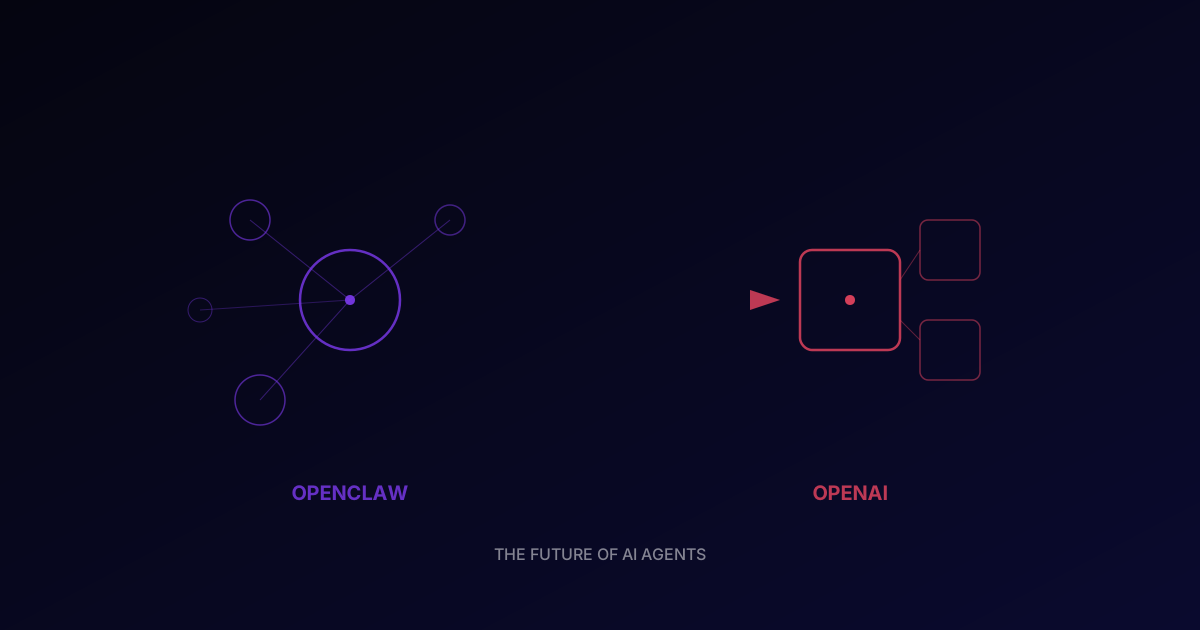
A solo developer vibe-codes an AI assistant. It goes viral. Anthropic sends a cease-and-desist over the name. He rebrands — twice. Within a month, OpenAI hires him to “drive the next generation of personal agents.”
Peter Steinberger’s journey from hobbyist tinkerer to OpenAI employee is the most 2026 story imaginable. But beneath the speed-run narrative, his move tells us something important about where the entire AI industry is heading.
From Side Project to Industry Shaker
OpenClaw — originally called Clawdbot, then Moltbot — is an AI assistant that actually does things. Not just answers questions. It manages calendars, books flights, sends messages, and even interacts with other AI assistants on what became a bizarre and delightful AI social network.
The project went viral in late January 2026. Within days: thousands of GitHub stars, a passionate developer community, and TechCrunch calling it “the AI that actually does things.”
That tagline resonated because it exposed a gap in the market. Most AI chatbots are glorified text generators. OpenClaw positioned itself as a true agent — one that connects to your real life and takes real actions on your behalf.
Why OpenAI Over Starting a Company
In his blog post announcing the move, Steinberger was refreshingly blunt: “Yes, I could totally see how OpenClaw could become a huge company. And no, it’s not really exciting for me.”
Rare admission in Silicon Valley, where the default trajectory for any viral project is to raise a $50M Series A. Instead, Steinberger chose OpenAI because “teaming up with OpenAI is the fastest way to bring this to everyone.”
His stated mission? Build an agent that “even my mum can use.” That’s deceptively ambitious. Current AI agents — including OpenClaw — still require significant technical skill to set up. Making them accessible to non-technical users means solving problems in safety, reliability, UX, and trust that nobody has cracked yet.
OpenClaw Goes to a Foundation
The most consequential part of this announcement isn’t the hire — it’s what happens to the project. OpenClaw is moving to an independent foundation, with OpenAI sponsoring it financially.
Smart move that serves everyone. The community gets assurance the project won’t be absorbed and locked down. OpenAI gets goodwill and influence over the most vibrant open-source agent ecosystem. Steinberger keeps working on what he loves without running a company.
But skeptics have reason to watch closely. OpenAI’s relationship with “open” has always been complicated — the company literally has “Open” in its name while operating as one of the most closed AI labs in the industry. Whether the foundation model actually preserves OpenClaw’s independence or slowly funnels its innovations into OpenAI’s products remains an open question.
The Vibe Coding Debate
On Hacker News, where Steinberger’s announcement hit 913 points and 630+ comments, the reaction was… complicated.
The core criticism: Steinberger has admitted he “vibe coded” OpenClaw — building with AI assistance without reading much of the underlying code. Security researchers flagged significant vulnerabilities. For traditional engineers who pride themselves on careful, secure code, watching someone get hired by OpenAI for the opposite approach feels like a slap in the face.
“Would you hire someone who never read any of the code that they’ve developed?” one top commenter asked.
But others pushed back: “You don’t get hired for being a 10x programmer who excels at HackerRank. You get hired for your proven ability to deliver useful products. Creativity, drive, vision. Code is a means to an end.”
This debate isn’t really about Steinberger. It’s about a fundamental shift in what “building software” means. If an LLM writes the code and a human provides the vision, which skill is more valuable? The answer increasingly favors the human qualities — taste, ambition, the ability to ship something people care about — over raw engineering prowess.
That’s uncomfortable for a lot of people. It should be.
OpenAI’s Agent Play
The hire fits OpenAI’s broader push into AI agents. The company has built out capabilities from custom GPTs to the Assistants API, but they’ve struggled to create agents that feel personal and proactive rather than reactive and generic.
That’s exactly what OpenClaw nails. Its architecture treats AI as a persistent companion with memory, personality, and the ability to act across multiple platforms. It’s the difference between asking ChatGPT a question and having an AI that knows your schedule, remembers your preferences, and takes initiative.
OpenAI clearly wants to bring this experience to hundreds of millions of users. Hiring the person who built the best example of it — even if the code was vibe-coded — makes perfect strategic sense.
What Happens Next
Can Steinberger’s vision survive inside a massive organization? Will OpenClaw’s community thrive under a foundation, or slowly wither as its creator’s attention shifts? Can OpenAI deliver personal AI agents that work for everyone — not just developers?
These questions will define the next chapter of AI. And for the first time, they feel less like science fiction and more like a product roadmap.
The distance between “playground project” and “industry-shaping platform” has never been shorter. The tools are that powerful. The demand is that intense. And the talent wars for people who understand how to build useful agents — not just capable models — are just beginning.